A Historical Report on Origins, Society, Displacement and Culture
Palestine is a historic region of the eastern Mediterranean that has been inhabited, governed and culturally transformed by many peoples over thousands of years. Its history includes ancient Canaanite communities; the kingdoms of Israel and Judah; Assyrian, Babylonian, Persian, Greek, Roman and Byzantine rule; centuries of Islamic government; the Crusader and Mamluk periods; approximately four centuries within the Ottoman Empire; British colonial administration; and the establishment of Israel in 1948.
The modern Palestinian people are an Arabic-speaking population whose identity developed from the inhabitants of this region and the broader communities of the southern Levant. Palestinians are not reliably reducible to one ancient tribe, one religion or one moment of migration. Their ancestry, like that of most long-inhabited regions, reflects continuity, conversion, migration, intermarriage and cultural change across many centuries. Modern Palestinian national consciousness became especially visible during the late Ottoman and British Mandate periods, but Palestinian society, towns, villages, families, religious communities and regional attachments existed before modern nationalism.
Palestinians are predominantly Muslim, with an important Palestinian Christian minority and other smaller communities. Their culture includes regional Arabic dialects, agriculture, oral storytelling, poetry, embroidery, food, music, dance, religious traditions and strong connections to particular towns, villages and landscapes.
The central rupture in modern Palestinian history was the Nakba, or catastrophe, of 1947–1949. During the war surrounding the creation of Israel, more than 700,000 Palestinian Arabs fled or were expelled from their homes. Hundreds of Palestinian localities were depopulated, and most refugees were prevented from returning. Another major displacement occurred during and after the 1967 Arab-Israeli war, when Israel occupied the West Bank, including East Jerusalem, and the Gaza Strip.
Palestinian displacement did not end in 1948 or 1967. Refugees and their descendants remain dispersed across the occupied Palestinian territory, Jordan, Lebanon, Syria and a global diaspora. Palestinians also continue to experience displacement through warfare, settlement expansion, home demolitions, evictions and restrictions on access to land.
The history of Palestine cannot accurately be told as the exclusive history of only one people. Jewish and Palestinian histories both have deep connections to the land. Recognizing Palestinian history and displacement does not require denying Jewish history, and recognizing Jewish history does not erase the documented dispossession of Palestinians.
1. What is Palestine?
The word Palestine has been used in different geographic and administrative senses over many centuries. It has generally referred to a region between the Mediterranean Sea and the Jordan River, although its exact boundaries have varied according to the government and historical period.
The ancient Greek historian Herodotus used a form of the name in the fifth century BCE. Under Roman rule, the province of Judea was later incorporated into a larger province called Syria Palaestina. Variations of the name continued to be used under Byzantine, Islamic, European and Ottoman geographical traditions. The name is historically associated with the coastal region once inhabited by the Philistines, although Palestine eventually came to designate a much wider area than ancient Philistia.
Palestine was not always an independent sovereign state with fixed modern borders. It was often a geographic region within larger empires. This does not mean that the land, its inhabitants or their local identities did not exist. Many regions possessed recognized geographic and cultural identities long before becoming modern nation-states.
During the Ottoman period, Palestine was divided among several administrative districts rather than governed for the entire four centuries as a single province called Palestine. Nevertheless, the term remained in geographic, religious, commercial and international use.
Under British rule after the First World War, Palestine became the formal name of a defined Mandate territory administered by Britain under League of Nations authority.
2. The ancient history of the region
Canaan and the Bronze Age
In the Bronze Age, much of the region later known as Palestine was part of the area called Canaan. Canaan was not one centralized modern nation. It included numerous city-states, agricultural settlements and local populations that interacted with Egypt, Mesopotamia, Anatolia and the Mediterranean world.
Over time, the region was inhabited by or came under the influence of numerous peoples, including Canaanites, Israelites, Judahites, Philistines, Phoenicians, Arameans and others.
It is historically misleading to treat any modern population as an unchanged, biologically pure continuation of one ancient group. Ancient populations moved, mixed, converted, adopted languages and reorganized themselves under successive states and empires.
Ancient Israel and Judah
During the Iron Age, the kingdoms of Israel and Judah existed in parts of the region. Jewish history, religion and collective identity are deeply rooted in this period and in Jerusalem, Judea and other parts of the land.
The Assyrian Empire conquered the northern Kingdom of Israel in the eighth century BCE. The Babylonian Empire conquered Judah and destroyed the First Temple in Jerusalem in the sixth century BCE. The Persian conquest of Babylon later permitted some Judean exiles to return.
These events became foundational to Jewish religious and historical memory. They are also part of the broader history of the land inherited by all later inhabitants.
Greek, Roman and Byzantine rule
Alexander the Great’s conquests brought the region into the Hellenistic world. It later came under Roman control.
Jewish revolts against Roman rule in the first and second centuries CE led to large-scale destruction, death, enslavement and displacement, although Jewish communities continued to exist in the region. Christianity emerged from Jewish society in Roman-ruled Judea and later spread throughout the Roman Empire.
Under Byzantine rule, Christianity became institutionally dominant, and the region contained Christian, Jewish, Samaritan and other communities. Jerusalem became one of Christianity’s most important sacred centers.
3. Islamic conquest, Arabization and religious change
Muslim Arab armies took control of much of Byzantine Palestine during the seventh century. The region became part of successive Islamic states, including the Umayyad, Abbasid and Fatimid caliphates.
The conquest did not mean that the existing population disappeared and was entirely replaced by migrants from Arabia. Historical change generally occurred through a combination of migration, political conquest, conversion, intermarriage and gradual adoption of the Arabic language.
Over several centuries, much of the population became Arabic-speaking. A majority eventually became Muslim, while Christian, Jewish and Samaritan communities continued to live in the region.
This process is usually described as Arabization and Islamization, but the two were not identical. A person could adopt Arabic while remaining Christian or Jewish. Palestinian Christians, for example, became Arabic-speaking while preserving Christian religious identities.
The Umayyad period left major architectural monuments, including the Dome of the Rock in Jerusalem, completed in the late seventh century.
4. Crusader, Ayyubid and Mamluk Palestine
European Crusaders captured Jerusalem in 1099 and established states in parts of the Levant. The conquest involved extensive violence against Muslim and Jewish inhabitants.
The Muslim leader Saladin recaptured Jerusalem in 1187. The region later came under Ayyubid and then Mamluk rule.
During these centuries, cities including Jerusalem, Gaza, Hebron, Nablus, Acre and others served as religious, agricultural and commercial centers. The population included Muslims, Christians, Jews, Samaritans, merchants, farmers, artisans, religious scholars and pilgrims.
Jerusalem was not simply a site of permanent conflict. At different times it was also home to overlapping communities, languages, trading networks and religious institutions.
5. Palestine under the Ottoman Empire
The Ottoman Empire conquered the region in 1516–1517 and governed it until the First World War.
Ottoman Palestine formed part of the broader province of Syria and was divided among districts administered from cities including Jerusalem, Nablus, Acre, Damascus and Beirut at different times. The region participated in imperial trade, pilgrimage and taxation networks.
Most inhabitants lived in villages and depended on farming, livestock, olive cultivation, grain production and local commerce. Towns contained merchants, artisans, religious institutions and administrative families.
The population was predominantly Arabic-speaking and Muslim, but it also included Palestinian Christians, Jewish communities, Samaritans, Bedouin groups, Armenians and others.
Jerusalem, Bethlehem, Nazareth and other religious centers attracted Christian, Muslim and Jewish pilgrims. Coastal ports linked the region with Egypt, Anatolia, Europe and the rest of the Mediterranean.
Local society and identity
People in Ottoman Palestine commonly identified themselves through several overlapping forms of belonging:
- Their village, town or city
- Their extended family or clan
- Their religion
- Their district
- The broader region of Syria or the Arab world
- The land known as Palestine
- Ottoman citizenship
These identities were not mutually exclusive.
It would be inaccurate to demand that Palestinians before the twentieth century possess exactly the same kind of nationalism that modern states created later. Italians, Germans, Syrians, Jordanians and many other peoples also developed modern national movements gradually.
Nineteenth-century changes
During the nineteenth century, Palestine experienced population growth, greater international trade, European religious and diplomatic involvement, changes in land registration and transportation, and the expansion of printing and education.
Jaffa became a major port and center of citrus cultivation. Jerusalem expanded outside its old walls. Towns such as Haifa, Nablus, Gaza, Acre, Hebron and Bethlehem remained economically and culturally important.
The late Ottoman period also saw the early development of Palestinian journalism and political organization.
6. Who are the Palestinian people?
Palestinians are the Arabic-speaking people whose families originate in historic Palestine and who developed a shared modern national identity connected to that land.
They include:
- Muslims
- Christians
- Residents of the West Bank
- Residents of Gaza
- Palestinian citizens of Israel
- Residents of East Jerusalem
- Refugees in neighboring countries
- Members of the global diaspora
- Bedouin and other regional communities
Palestinian identity should not be understood as proof that every Palestinian descends exclusively from one ancient people. Nor should it be dismissed because national identity changed over time.
The most historically defensible account is that modern Palestinians descend from the diverse populations that lived in the southern Levant over many centuries, together with migrants who entered the region at different times. Their culture became predominantly Arabic-speaking through the region’s long history under Islamic and Arab cultural influence.
Palestinians may understand their heritage as including Canaanite, Arab, Islamic, Christian and other historical layers. Claims of direct, exclusive descent from a single ancient group are difficult to prove and should not be presented as settled fact.
Palestinian national consciousness
Distinct Palestinian political consciousness became increasingly visible during the late Ottoman period and especially under the British Mandate.
Newspapers, civic organizations, Muslim-Christian associations, congresses, schools and political movements began using the language of Palestine and Palestinian interests more consistently.
Palestinian identity developed alongside, rather than entirely separate from, broader Arab identity. A person could regard themselves as Palestinian, Arab, Muslim or Christian and a resident of a particular city at the same time.
The confrontation with British colonial administration and the Zionist movement further strengthened Palestinian nationalism.
7. Zionist migration and the changing political landscape
Modern political Zionism emerged in Europe during the late nineteenth century. Zionists argued that Jews constituted a people entitled to national self-determination and that antisemitism demonstrated the need for a Jewish homeland or state.
Jewish migration to Palestine began before political Zionism and continued in several waves. Some migrants came because of religious attachment, while others fled pogroms, antisemitism and persecution in Europe.
Zionist organizations purchased land, established agricultural settlements, revived Hebrew as a modern spoken language and built political, labor, educational and military institutions.
Palestinian Arabs increasingly feared that the Zionist movement intended to create a Jewish-majority state in a land where the majority of the population was Arab. Conflict grew over immigration, land, employment, political control and competing national aspirations.
Jewish migrants were themselves diverse. Some were refugees escaping severe persecution. This history does not eliminate the political consequences for Palestinians, just as Palestinian displacement does not erase the persecution from which many Jews fled.
8. The First World War and the British Mandate
The Ottoman Empire was defeated during the First World War, and Britain occupied Palestine.
In the Balfour Declaration of 1917, the British government announced support for the establishment in Palestine of a “national home for the Jewish people.” It also stated that nothing should prejudice the civil and religious rights of the existing non-Jewish communities.
The declaration did not describe the Arab majority as possessing national or political rights. Palestinians later viewed this as a colonial government promising their country to another national movement without their consent.
The League of Nations Mandate for Palestine incorporated Britain’s commitment to a Jewish national home. Britain governed Palestine formally from the early 1920s until 1948.
During the Mandate:
- Jewish immigration increased.
- Zionist political and economic institutions expanded.
- Palestinian political organizations developed.
- Land disputes and labor conflicts intensified.
- Violence occurred among Palestinian Arabs, Zionist organizations and British forces.
- British policy shifted repeatedly and satisfied neither national movement.
The persecution of Jews in Europe, particularly the rise of Nazism and the Holocaust, made the demand for a secure Jewish refuge increasingly urgent.
For Palestinians, however, European antisemitism was creating political consequences in a country whose Arab inhabitants had not caused that persecution.
9. The Palestinian revolt of 1936–1939
Between 1936 and 1939, Palestinians launched a major revolt against British colonial rule and mass Jewish immigration.
The revolt included strikes, civil disobedience, attacks on British and Jewish targets, rural insurgency and internal Palestinian violence.
Britain suppressed the revolt using extensive military force, arrests, executions, home demolitions and collective punishment. Palestinian political and military organization was severely weakened.
This weakening had major consequences when war began less than a decade later.
The British Peel Commission proposed partition in 1937, including a transfer of populations. Palestinian leaders rejected the plan, while different Zionist leaders treated partition as either a possible foundation or an insufficient territorial offer.
10. The United Nations partition proposal
After the Second World War, Britain referred the Palestine question to the United Nations.
On November 29, 1947, the UN General Assembly adopted Resolution 181, recommending the division of Mandatory Palestine into:
- A Jewish state
- An Arab state
- An internationally administered area around Jerusalem
The states were supposed to be connected through an economic union.
Zionist leadership accepted partition as the legal and political basis for creating a Jewish state, although not every Zionist faction accepted the proposed borders.
Palestinian Arab leaders and Arab governments rejected the plan. Their reasons included opposition to dividing the country without majority consent and the territorial allocation to the proposed Jewish state.
The UN resolution was a recommendation of the General Assembly. It did not create the proposed Arab state, and the partition was never implemented as designed.
Civil war began between Palestinian Arab and Jewish forces after the vote.
11. The Nakba and the displacement of 1948
The Arabic word Nakba means catastrophe. It refers to the mass displacement and dispossession of Palestinians during the war of 1947–1949.
By the end of the conflict, more than 700,000 Palestinians had fled or been expelled from their homes. Estimates vary somewhat because wartime records were incomplete, but the scale of the displacement is not seriously disputed.
Palestinians were displaced through several different processes:
- Direct expulsions by Jewish or Israeli forces
- Flight during military assaults
- Fear following reports of violence or massacres
- Collapse of local Palestinian leadership
- Evacuation from active combat zones
- Orders or pressure from military forces
- The expectation that people would return after the fighting
- Destruction or depopulation of villages
No single explanation accounts for every locality. Historians examining military archives, village records and testimony have shown that the causes differed from place to place.
There is not credible evidence for a universal order from Arab governments telling all Palestinians to leave. There were localized evacuation instructions in some circumstances, but they do not explain the mass displacement as a whole.
Likewise, it would be inaccurate to claim that every Palestinian was removed under one centrally administered expulsion order. The documented history includes planned expulsions in some locations, military operations that predictably displaced civilians, panic, flight and varied local decisions.
Depopulated communities
Hundreds of Palestinian towns and villages were depopulated during the war. Many were later demolished, repopulated, incorporated into Israeli communities or left abandoned.
Homes, farmland, businesses and property belonging to refugees were brought under Israeli control through wartime measures and later legislation.
The destruction of villages was not only a physical loss. Palestinian communities had organized identity around local agricultural practices, family networks, religious sites, dialects, clothing patterns and oral histories. The disappearance of a village could therefore mean the destruction of an entire social environment.
Israeli independence and Palestinian catastrophe
Israel declared independence in May 1948 after Britain ended the Mandate. Neighboring Arab armies entered the war shortly afterward.
For most Jewish Israelis, 1948 represents independence, survival and national restoration after centuries of persecution and the Holocaust.
For Palestinians, it represents the destruction of their society, loss of homeland and beginning of prolonged refugeehood.
Both historical experiences are real, although they are not politically or morally identical in every respect.
12. Why did most refugees not return?
Many Palestinians initially believed their displacement would be temporary. After the war, however, Israel generally prevented the mass return of Palestinian refugees.
Israeli leaders argued that return would threaten the security and Jewish demographic character of the new state. Israel also maintained that the refugee question had to be resolved through a broader peace agreement.
Palestinians argued that civilians had a right to return to their homes and should not permanently lose property because of war.
In December 1948, UN General Assembly Resolution 194 stated that refugees wishing to return to their homes and live at peace should be permitted to do so at the earliest practicable date and that compensation should be paid for property belonging to those who did not return and for loss or damage. The resolution has been repeatedly cited in later UN discussions, but its repatriation and compensation provisions have not been implemented.
Israel has permitted some limited family reunification but has consistently rejected a general Palestinian right of return to territory inside Israel.
The refugee issue remains one of the most difficult unresolved questions in the conflict.
13. UNRWA and the refugee population
The United Nations established the United Nations Relief and Works Agency for Palestine Refugees in the Near East, known as UNRWA, in 1949. It began operations in 1950.
UNRWA defines Palestine refugees for its operational purposes as people whose normal residence was Palestine between June 1, 1946, and May 15, 1948, and who lost both their homes and means of livelihood as a result of the conflict. Eligible descendants may also be registered for services.
UNRWA operates in:
- The West Bank, including East Jerusalem
- Gaza
- Jordan
- Lebanon
- Syria
The agency provides education, health care, relief and other services. Its registration system does not itself determine the final legal solution to the refugee question.
Approximately 5.9 million people are currently registered with UNRWA, although not every registered person lives in a refugee camp or is personally displaced from a 1948 home.
Refugee status has continued across generations because the original political conflict and claims concerning return, citizenship, property and compensation remain unresolved.
14. Palestinians who remained inside Israel
Not all Palestinians fled or were expelled in 1948.
Approximately 150,000 Palestinians remained within the territory that became Israel. They and their descendants became Israeli citizens, although many lived under military administration until 1966.
Some became internally displaced Palestinians: they remained inside Israel but were prevented from returning to their original villages or recovering their property.
Today, Palestinian citizens of Israel constitute a substantial national minority. They possess voting rights and citizenship but have experienced inequalities involving land, planning, public resources and national identity.
They identify in varied ways, including Palestinian citizens of Israel, Arab citizens of Israel, Palestinian Arabs or simply Palestinians.
15. The West Bank and Gaza after 1948
The Palestinian Arab state proposed by the UN partition plan was not established.
After the 1948 war:
- Jordan controlled and later annexed the West Bank and East Jerusalem.
- Egypt administered the Gaza Strip.
- Israel controlled substantially more territory than had been allocated to the proposed Jewish state under the UN plan.
Large refugee populations were concentrated in the West Bank, Gaza, Jordan, Lebanon and Syria.
The Gaza Strip became especially crowded as refugees from towns and villages in southern Palestine settled within a small territory.
16. The Palestinian national movement after the Nakba
The Nakba fragmented Palestinian society. Political leaders were displaced, communities were scattered and Palestinians lived under different governments.
During the 1950s and 1960s, Palestinian political organization re-emerged.
The Palestine Liberation Organization, or PLO, was founded in 1964. It eventually became the principal representative institution of the Palestinian national movement.
The Fatah movement, associated with Yasser Arafat and other Palestinian organizers, became dominant within the PLO after 1967.
Palestinian nationalism increasingly emphasized independent political action rather than dependence on surrounding Arab governments.
17. The 1967 war and the Naksa
In June 1967, Israel fought Egypt, Jordan and Syria in the Six-Day War.
Israel captured:
- The West Bank
- East Jerusalem
- The Gaza Strip
- The Sinai Peninsula
- The Golan Heights
Palestinians refer to the new displacement caused by the war as the Naksa, meaning setback.
Several hundred thousand Palestinians fled or were displaced from the West Bank and Gaza, including people who had already become refugees in 1948. Some were displaced for a second time.
Israel later returned Sinai to Egypt under a peace agreement, but the West Bank, East Jerusalem and Gaza became the territories at the center of the continuing Israeli-Palestinian conflict.
The international community generally describes the West Bank, East Jerusalem and Gaza as the occupied Palestinian territory.
18. Occupation, settlements and land
After 1967, Israel established settlements for Israeli civilians in the occupied West Bank and East Jerusalem.
Israel disputes or qualifies some international legal descriptions of the territories and argues that their final status should be determined through negotiation.
The International Court of Justice and the overwhelming majority of the international community regard the settlements as violating international law. In its 2024 advisory opinion, the ICJ reaffirmed that Israeli settlements in the West Bank and East Jerusalem and the associated regime are established and maintained in violation of international law.
The settlement system has involved:
- Land appropriation
- Separate Israeli residential communities
- Roads and infrastructure
- Military protection
- Movement restrictions
- Demolitions and permit systems
- Restrictions on Palestinian construction
- Fragmentation of Palestinian territory
Israeli governments have described settlements using varying combinations of security, religious, historical and territorial arguments.
For Palestinians, settlement expansion represents a continuing loss of land and a barrier to viable statehood.
19. The First Intifada and the Oslo process
The First Intifada began in 1987 as a predominantly popular uprising against Israeli occupation. It included demonstrations, strikes, boycotts, stone throwing and organized civil resistance, as well as violence.
Israel responded with arrests, military force and other security measures.
The uprising helped bring the Palestinian issue back to international attention and contributed to negotiations between Israel and the PLO.
The Oslo Accords of the 1990s created the Palestinian Authority and introduced limited Palestinian self-government in parts of the West Bank and Gaza.
The agreements did not establish a sovereign Palestinian state or resolve final-status issues, including:
- Jerusalem
- Borders
- Settlements
- Refugees
- Security
- Sovereignty
- Water
The West Bank was divided into Areas A, B and C with different levels of Palestinian and Israeli control.
The peace process weakened as settlement expansion continued, violence increased and political trust collapsed.
20. The Second Intifada and political division
The Second Intifada began in 2000 and was significantly more militarized than the first.
Palestinian armed groups carried out attacks, including suicide bombings against Israeli civilians. Israel conducted major military operations, assassinations, arrests and incursions.
Thousands of Palestinians and Israelis were killed.
Israel began constructing a separation barrier, most of which runs inside the West Bank rather than along the 1949 armistice line. Israel describes the barrier as a security measure against attacks. Palestinians argue that its route annexes land, separates communities and restricts movement.
Israel removed its permanent settlements and ground forces from inside Gaza in 2005 while continuing to control most external access, airspace and maritime movement.
Hamas won Palestinian legislative elections in 2006. Fighting between Hamas and Fatah culminated in Hamas taking control of Gaza in 2007, while the Palestinian Authority remained dominant in parts of the West Bank.
Israel and Egypt imposed severe restrictions on Gaza. Repeated wars and military escalations caused extensive death, destruction and displacement.
21. Continuing displacement
Palestinian displacement is not limited to two historical dates.
In the West Bank and East Jerusalem, Palestinians have continued to lose homes or access to land through:
- Demolitions
- Evictions
- Settlement expansion
- Military operations
- Revocation or denial of residency
- Settler violence
- Restrictions affecting herding communities
- Inability to obtain building permits
UN humanitarian monitoring reported that between January 2023 and July 2026, more than 120 Palestinian communities in the West Bank experienced full or partial displacement, particularly Bedouin and herding communities in Area C.
In Gaza, large portions of the population have repeatedly experienced internal displacement during wars and military operations.
Internal displacement means people have been forced from their homes but remain inside the same territory rather than crossing an international border.
22. The Palestinian diaspora
Palestinians today live across the world.
Major Palestinian communities exist in:
- Jordan
- Lebanon
- Syria
- Chile
- The Gulf states
- The United States
- Canada
- Europe
- Latin America
- Australia
Their legal and social conditions differ dramatically.
Many Palestinians in Jordan received citizenship. Large numbers in Lebanon have faced restrictions involving employment, property and public services. Palestinians in Syria experienced further displacement during the Syrian civil war.
The diaspora is not culturally uniform. Families from Jaffa, Haifa, Jerusalem, Gaza, Hebron, Safed, Acre, Ramla, Lydda and hundreds of villages retain distinctive memories and traditions.
Oral histories, family records, keys, deeds, photographs, embroidery and village maps have become ways of preserving connections to places that descendants may never have been allowed to visit.
23. Palestinian religion
Most Palestinians are Sunni Muslims.
Palestinian Christians belong to several traditions, including:
- Greek Orthodox
- Roman Catholic
- Melkite Greek Catholic
- Armenian
- Anglican
- Lutheran
- Other Eastern and Western churches
Palestinian Christians have deep historical roots in Jerusalem, Bethlehem, Nazareth and other communities.
There is also a small Samaritan community centered near Nablus and Mount Gerizim. Samaritans maintain a distinct ancient religious tradition connected to the Torah.
Palestinian culture should therefore not be treated as exclusively Muslim. Muslim and Christian Palestinians share language, food, national history and many social customs while maintaining different religious practices.
24. Palestinian language
Palestinians primarily speak Palestinian varieties of Arabic, which form part of the Levantine Arabic continuum.
Dialects vary according to:
- City
- Village
- Region
- Bedouin background
- Religion
- Class
- Diaspora experience
Urban dialects from Jerusalem, Jaffa, Haifa or Nablus may differ from rural or Bedouin speech.
Modern Standard Arabic is used in formal writing, education, news and literature.
Many Palestinians also speak Hebrew, English or other languages depending on where they live.
Language has served as a form of cultural continuity, especially for refugees and diaspora communities.
25. Village life, agriculture and the land
Before 1948, a large portion of Palestinian society lived in rural villages.
Agriculture centered on crops and products including:
- Olives
- Wheat
- Barley
- Grapes
- Citrus fruit
- Figs
- Almonds
- Sesame
- Vegetables
- Dates in appropriate regions
The olive tree has become a major Palestinian cultural symbol because of its economic importance, longevity and relationship to family land.
Land was connected not merely to income but to inheritance, identity, social structure and memory.
Seasonal activities such as olive harvesting brought extended families and communities together.
Urban Palestinian culture was equally important. Jerusalem, Jaffa, Haifa, Acre, Nablus, Gaza, Hebron, Bethlehem and other towns supported merchants, newspapers, schools, theaters, artisans and intellectual life.
26. Palestinian food
Palestinian cuisine belongs to the wider cuisines of the Levant while containing strong regional variations.
Common dishes and foods include:
- Musakhan: bread, onions, sumac, olive oil and chicken
- Maqluba: rice cooked with vegetables and meat and inverted for serving
- Maftoul: hand-rolled grains similar to couscous
- Knafeh Nabulsiyeh: a cheese-based sweet associated with Nablus
- Falafel
- Hummus
- Mujaddara
- Stuffed grape leaves
- Freekeh
- Za’atar
- Olives and olive oil
- Taboon bread
- Ka’ak al-Quds, Jerusalem sesame bread
Food cannot always be assigned exclusively to one modern national group because communities throughout the Levant have shared and adapted recipes for centuries.
Palestinian cuisine nevertheless contains identifiable local traditions, methods and relationships to specific places.
For displaced families, preparing regional dishes can preserve memory and family continuity.
27. Tatreez and the Palestinian thobe
Tatreez is Palestinian decorative embroidery, historically associated especially with women’s clothing.
Traditional embroidered dresses, or thobes, varied by village and region. Colors, patterns, fabrics and construction could communicate local origin, social status, marital status or aesthetic preference.
Common motifs include:
- Cypress trees
- Flowers
- Birds
- stars
- Geometric forms
- Agricultural imagery
UNESCO added the art of Palestinian embroidery to its Representative List of the Intangible Cultural Heritage of Humanity in 2021. UNESCO describes the practice as historically widespread in rural areas and now practiced throughout Palestine and the diaspora.
The Metropolitan Museum of Art explains that tatreez allowed Palestinian women and girls to express history, memory, identity and connection to place through stitched motifs.
After the Nakba, embroidery gained additional political and memorial meaning. Dresses preserved regional designs from villages that had been depopulated.
Tatreez should not be reduced solely to political resistance. It is also a living art practiced for beauty, celebration, family and personal expression.
28. Dabkeh
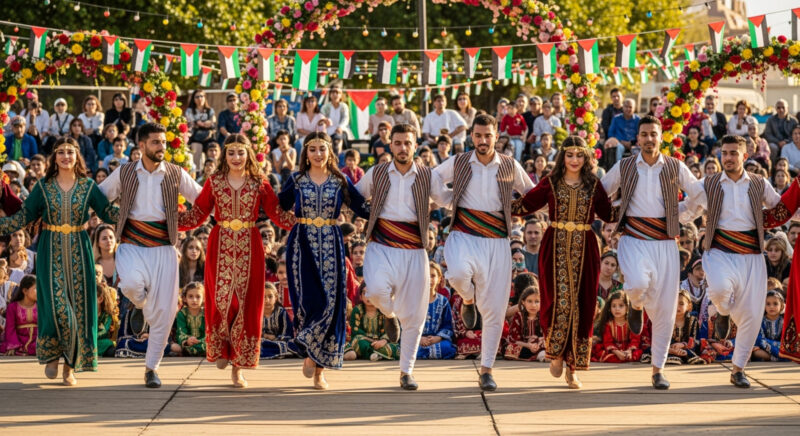
Dabkeh is a communal line dance performed in Palestine and elsewhere in the Levant.
Dancers stand in a line or semicircle, often holding hands or shoulders, while stamping, stepping and moving together to music.
It is performed at:
- Weddings
- Festivals
- Graduations
- Family celebrations
- Cultural events
- Public performances
UNESCO inscribed Palestinian dabkeh on its Representative List of the Intangible Cultural Heritage of Humanity in 2023. UNESCO describes it as a social activity expressing cohesion and performed by people of different genders.
Dabkeh is shared across several Levantine societies, but Palestinians have developed their own performance traditions and national associations with it.
29. Oral storytelling and poetry
Oral storytelling has played a major role in Palestinian family and community life.
The Palestinian Hikaye is a narrative tradition historically practiced especially by women, often in domestic or community settings. UNESCO recognized it as intangible cultural heritage.
Folktales can transmit:
- Moral lessons
- Humor
- Family roles
- Social criticism
- Memories
- Local beliefs
- Women’s perspectives
Poetry has also been central to modern Palestinian culture.
Notable Palestinian poets include Mahmoud Darwish, Fadwa Tuqan, Samih al-Qasim and others. Their writing addresses exile, love, land, identity, loss, resistance and the complexities of ordinary life.
Palestinian literature should not be understood only as political testimony. It includes novels, memoirs, humor, romance, family history and experimental writing.
30. Music, theater, film and visual art
Palestinian music draws from Arab classical music, village song, religious traditions, modern popular music and diaspora influences.
Traditional instruments include the oud, qanun, ney and percussion instruments.
Palestinian theater and cinema have addressed social life, exile, occupation, gender, class and historical memory.
After 1967, Palestinian visual artists, filmmakers and theater practitioners played a significant role in sustaining national culture under occupation and across the diaspora.
Recurring artistic symbols include:
- The olive tree
- The key
- The map
- The village
- The cactus
- Traditional embroidery
- Jerusalem
- The refugee camp
These symbols are not interchangeable. The key, for example, often represents the homes and property from which refugee families were displaced.
31. Nabulsi soap and other crafts
Nablus developed a well-known tradition of producing olive-oil soap.
The craft depends on local olive oil and methods passed through families and workshops. UNESCO inscribed the tradition of Nabulsi soap making on its intangible cultural heritage list in 2024.
Other Palestinian crafts include:
- Olive-wood carving
- Ceramics
- Glassmaking, especially associated with Hebron
- Mother-of-pearl work
- Basketry
- Weaving
- Metal engraving
- Jewelry
These traditions reflect regional trade, religious pilgrimage and family craft industries.
32. Culture after displacement
Displacement changed Palestinian culture without destroying it.
Refugee camps developed their own communities, political organizations, schools, arts and social structures. They were not simply temporary collections of tents, although many began that way.
Families attempted to preserve village identities by:
- Marrying within displaced communities
- Naming associations after villages
- Passing down stories
- Preserving dialects
- Recording genealogies
- Recreating foods and celebrations
- Teaching children the geography of their family’s origin
Culture became a form of continuity, but Palestinian identity should not be romanticized as consisting only of suffering or resistance.
Palestinians also experience ordinary human life:
- Work
- Parenting
- Humor
- Art
- Love
- Education
- Religion
- Sport
- Disagreement
- Migration
- Personal ambition
A people should not be defined only by what was done to them.
33. Common historical misconceptions
“There was never a Palestine”
It is correct that there was not always an independent sovereign state called Palestine in the modern sense.
It is incorrect to conclude that Palestine was an invented place or that its inhabitants did not possess communities and attachments to the land.
Palestine was a long-used geographic name and became a formally administered Mandate territory under Britain.
“Palestinians arrived only recently”
Palestinian society included families with long roots in the region as well as families whose ancestors migrated during different historical periods.
Like neighboring populations, Palestinians are the result of centuries of demographic continuity and movement. There is no evidence that the entire Palestinian population suddenly arrived shortly before the Zionist movement.
“Palestinians are simply Arabs from somewhere else”
Palestinians are Arabs in language and much of their culture, but Arab identity does not mean that every Palestinian family originated recently in the Arabian Peninsula.
Arabization frequently occurred through language and culture rather than total population replacement.
“All Palestinians left voluntarily in 1948”
The historical record does not support this. Palestinians left for multiple reasons, including direct expulsions, attacks, fear, warfare and the collapse of their communities.
“Every Palestinian was expelled under one master plan”
This also oversimplifies the record. Expulsions occurred, but local circumstances differed. Flight, military assault, fear and organized removal all contributed.
“The land was empty”
Palestine had towns, villages, farms, ports, religious institutions and a substantial population before large-scale Zionist migration.
Describing it as empty erases the people living there.
“Recognizing the Nakba denies Jewish history”
The documented displacement of Palestinians does not erase Jewish historical connections or the persecution of Jews.
Two peoples can possess real historical relationships to the same land while experiencing radically unequal outcomes during the creation of a state.
34. What remains disputed?
Several questions remain subjects of political and scholarly disagreement:
- The intentions of individual Zionist leaders regarding population transfer
- The degree of central coordination behind expulsions
- The causes of flight in specific towns and villages
- The legal interpretation of the Palestinian right of return
- The final political status of Jerusalem
- The legality and future of settlements
- Whether one state, two states or another arrangement is viable
- The relative influence of security, nationalism, colonialism and religion
- How responsibility for repeated wars should be allocated
Disagreement over these matters does not make all historical facts uncertain.
The following facts are firmly established:
- A settled Palestinian Arab society existed before 1948.
- Palestinian national identity developed before Israel’s creation.
- More than 700,000 Palestinians became refugees during the 1948 war.
- Expulsions occurred in multiple locations.
- Hundreds of communities were depopulated.
- Most refugees were not permitted to return.
- Additional mass displacement occurred in 1967.
- Israel has occupied the West Bank and East Jerusalem since 1967.
- Palestinian refugeehood and displacement remain unresolved.
35. Conclusion
Palestinian history is the history of a people formed in one of the world’s oldest and most culturally interconnected regions.
Palestinians are not the descendants of only one ancient population, nor are they newcomers without roots. They emerged from the populations of the southern Levant through centuries of continuity, migration, Arabization, conversion, trade and political change.
Their culture developed through village agriculture, urban commerce, Muslim and Christian traditions, family networks, Arabic language, embroidery, food, poetry, dance, storytelling and relationships to particular landscapes.
The Nakba transformed that society. More than 700,000 Palestinians were displaced during the war surrounding Israel’s creation, and most were prevented from returning. The 1967 war produced another major displacement and placed the West Bank, East Jerusalem and Gaza under Israeli occupation.
Despite this fragmentation, Palestinians maintained a shared identity across borders, refugee camps, occupied territory, Israel and the global diaspora.
The most accurate understanding of Palestine avoids two forms of erasure. It does not deny the profound Jewish history and attachment to the land, and it does not treat Palestinian society as though it did not exist before Israel.
A responsible history must recognize that the creation of safety and sovereignty for one people coincided with the dispossession and statelessness of another. That history cannot be undone by denying either population’s existence. It can only be confronted by acknowledging the full humanity, memory and rights of both.
Continue the Exploration
Whether you consider yourself pro-Palestine, pro-Israel, politically undecided, or you’re only beginning to learn about this history, we invite you to keep exploring.
History is rarely changed by reading a single article. Understanding grows when we become willing to examine not only events, but also the assumptions, identities, cultures, fears, loyalties, and narratives that shape the way every one of us interprets those events. Two people can look at the same facts and reach very different conclusions, not because one necessarily cares more than the other, but because each is viewing them through a different lens.
Our goal is not to tell you what to think. It is to encourage the kind of awareness that allows us to think more clearly, ask better questions, recognize our own biases, and remain open to learning—even when the answers are uncomfortable.
If this article sparked your curiosity, consider exploring our collection of articles on identity, culture, perception, awareness, belief, fear, conflict, and the psychology of being human. These subjects may seem unrelated at first, but they often reveal the deeper patterns that influence politics, history, and human relationships across every nation and generation.
For readers who want to explore these questions even further, our book, Proof That You’re God, examines how identity, perception, and consciousness shape the way we experience ourselves, one another, and the world we share. Whatever conclusions you ultimately reach about Israel, Palestine, the United States, or any other subject, we hope your understanding continues to expand through curiosity, careful investigation, and a willingness to question both the world around you and the assumptions within yourself.