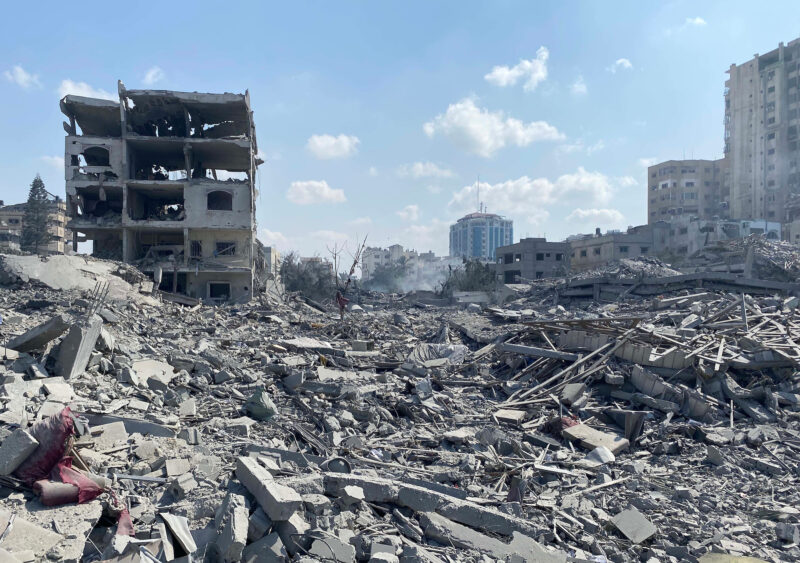
The United Nations (UN) was founded on October 24, 1945, in the aftermath of the deadliest conflict in human history: the Second World War. Between 70 and 85 million people died, entire cities were destroyed, and the Holocaust exposed the devastating consequences of industrialized genocide. The founders hoped that by creating an international organization where nations could resolve disputes peacefully, humanity could avoid repeating those horrors.
More than eighty years later, war still exists. Genocides have occurred in Cambodia, Rwanda, Bosnia, Darfur, and today many governments, human rights organizations, and legal experts argue that grave atrocities are occurring in Gaza, while others dispute the legal classification of genocide. Regardless of terminology, millions of civilians continue to suffer in armed conflicts around the world.
This raises an important question:
If the United Nations was created to maintain peace, why doesn’t it stop wars?
The answer is both simple and frustrating.
The UN Was Never Given the Power to Rule the World
Many people assume the United Nations functions like a global government. It does not.
The UN is an organization made up of sovereign countries. Those countries voluntarily agree to treaties, resolutions, and international law—but the UN generally cannot force governments to obey.
Its ability to act depends largely on the political will of its member states.
The biggest limitation lies within the Security Council.
Five countries—the United States, Russia, China, the United Kingdom, and France—hold permanent seats and possess veto power. If any one of these nations vetoes a proposed action, the Security Council can be prevented from authorizing military intervention, sanctions, or other enforcement measures.
This structure was intentionally designed in 1945 because the founders believed the world’s major military powers had to remain inside the international system rather than outside it. Without their participation, they feared another world war would become even more likely.
The result is a system capable of coordinating humanitarian aid, diplomacy, peacekeeping, refugee assistance, public health initiatives, and international agreements—but often unable to stop powerful states or their allies from continuing armed conflict.
Comparing the League of Nations and the United Nations
Before the UN existed, there was the League of Nations.
Created after the First World War in 1920, the League sought to preserve peace through diplomacy. However, it lacked military power, several major nations never fully participated, and it failed to stop Japanese expansion into China, Italy’s invasion of Ethiopia, and Nazi Germany’s aggression.
After World War II, world leaders attempted to build something stronger.
The United Nations improved upon the League by creating:
- A Security Council capable of authorizing collective military action.
- Peacekeeping missions.
- International courts.
- Specialized agencies like the World Health Organization, UNICEF, and the World Food Programme.
- Universal forums where nearly every nation could negotiate.
Yet the same compromise that allowed powerful nations to join also limits the organization’s effectiveness today.
Has the United Nations Failed?
That depends on what success means.
If success means eliminating war, the answer is clearly no.
Wars continue.
Civilian suffering continues.
Genocides and mass atrocities have not disappeared.
However, if success means providing humanitarian relief, coordinating responses to disease outbreaks, negotiating treaties, reducing some conflicts through diplomacy, supporting refugees, and creating international norms around human rights, the UN has had measurable successes.
The organization has helped eradicate smallpox through coordinated global efforts, supported decolonization across much of the world, delivered food and medical aid to millions, and facilitated numerous peace agreements.
Its record is neither complete success nor complete failure.
It reflects both the possibilities and limitations of international cooperation.
Does Global Governance Reduce Local Self-Governance?
This question deserves careful consideration.
Communities throughout history solved most problems locally.
Food was grown nearby.
Water was managed locally.
Homes were built from regional materials.
Knowledge passed between generations.
Communities understood their own climate, ecosystems, and social needs because they lived within them.
Today many societies rely on global supply chains for food, medicine, energy, fertilizer, technology, and manufactured goods.
This interconnectedness has brought enormous benefits, including reduced poverty in many regions, access to modern medicine, rapid communication, and scientific collaboration.
At the same time, it has also created vulnerabilities.
When food production becomes concentrated in a few regions, climate disasters or conflict can disrupt supplies.
Large-scale industrial agriculture has contributed to deforestation, biodiversity loss, soil degradation, freshwater depletion, and greenhouse gas emissions in many parts of the world. These impacts vary by region and agricultural practice, but they are well documented by organizations such as the Intergovernmental Panel on Climate Change (IPCC) and the UN Food and Agriculture Organization (FAO).
Communities increasingly ask whether greater local resilience should complement—not necessarily replace—global cooperation.
What Small Organizations Often Do Better
Around the world, local organizations frequently solve problems because they understand local realities.
Community gardens improve neighborhood food security.
Watershed groups restore rivers.
Volunteer fire departments protect rural communities.
Food banks respond to local hunger.
Neighborhood associations organize mutual aid during disasters.
Indigenous stewardship programs restore ecosystems using generations of ecological knowledge.
These organizations often succeed because they are close enough to the problem to observe it directly and adapt quickly.
Rather than applying one solution everywhere, they adjust to the unique ecology, culture, and history of their own communities.
Should Humanity Return to Greater Local Self-Sufficiency?
Perhaps the better question is not whether we should abandon global cooperation, but how we balance it with local resilience.
History suggests that communities are often strongest when they can meet many of their own essential needs while still cooperating peacefully with others.
Local food production.
Local energy where practical.
Healthy forests.
Clean water.
Thriving local businesses.
Strong civic organizations.
Community decision-making.
These goals do not require isolation from the rest of the world. Rather, they encourage communities to become more capable of caring for themselves while remaining connected through trade, science, culture, and diplomacy.
Global institutions can coordinate where problems cross borders—such as pandemics, climate change, aviation, or ocean management—while local communities remain best positioned to address many day-to-day challenges that are unique to their environments.
A Future Worth Building
The United Nations was created because humanity had witnessed unimaginable destruction.
Its existence reflects a hope that dialogue is preferable to war.
Yet no international institution can replace the responsibility of individuals and communities to build resilient, compassionate, and sustainable societies.
Perhaps the future is not choosing between global cooperation and local self-governance.
Perhaps it is recognizing that healthy civilizations require both.
The strongest world may ultimately be one composed of strong communities—communities that understand their ecosystems, care for one another, steward their resources responsibly, and cooperate voluntarily with others when challenges extend beyond their borders.
Real peace may begin not only in international assemblies, but around neighborhood tables, community gardens, local schools, and conversations where people learn to solve problems together.
Join the Conversation
If these questions about governance, sustainability, community resilience, and the future of civilization interest you, we’d love to explore them together.
Join us for our live Patreon community discussion this Sunday at 11:00 AM PST, where we’ll examine these ideas, challenge assumptions, and discuss practical ways communities can become more resilient while remaining connected to the wider world.