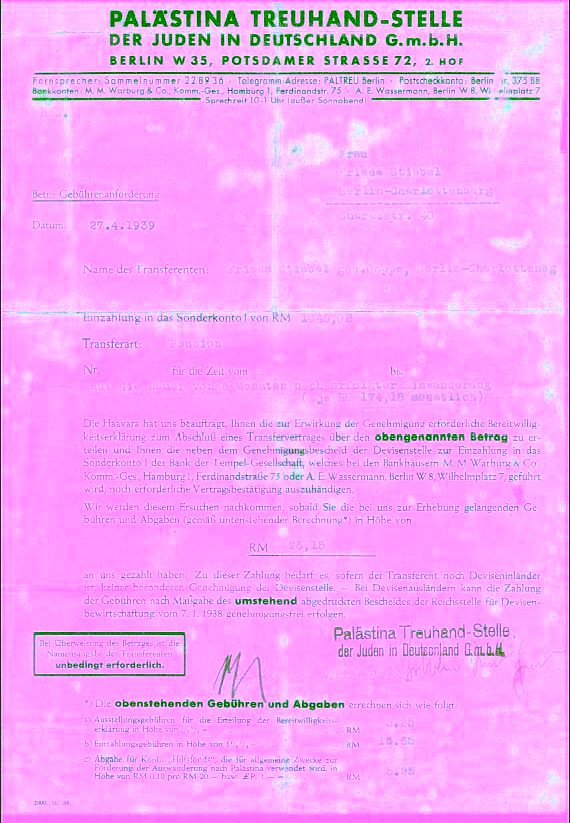
Few historical episodes generate as much controversy as the Haavara Agreement. It is frequently cited in political debates, often as proof that Zionists “collaborated” with the Nazis or, conversely, dismissed as an irrelevant footnote that has no bearing on history. Both claims oversimplify a far more complicated reality.
The historical record leaves little doubt that representatives of Nazi Germany and certain Zionist organizations negotiated and signed a formal agreement in 1933. That agreement, known as the Haavara (Transfer) Agreement, allowed thousands of German Jews to emigrate to British Mandatory Palestine while transferring a portion of their wealth through German exports. The agreement is well documented by historians and institutions including Yad Vashem, the United States Holocaust Memorial Museum, and extensive academic scholarship.
The more difficult question is not whether the agreement existed.
It is how we should understand why it existed.
Germany in 1933
Adolf Hitler became Chancellor of Germany on January 30, 1933. Within months, the Nazi government had begun dismantling democratic institutions, excluding Jews from public life, organizing nationwide boycotts of Jewish businesses, removing Jews from government employment, and introducing increasingly discriminatory laws. Although the Holocaust had not yet begun, persecution had already become official government policy.
At this stage, Nazi policy toward Jews focused primarily on forcing them to leave Germany. The regime sought what historians describe as “emigration and expulsion,” not yet the industrialized extermination that would begin years later. This distinction is historically important because decisions made in 1933 occurred before the Nazi leadership had adopted the so-called “Final Solution.”
For German Jews, the future was already becoming dangerous.
Leaving Germany was increasingly becoming a matter of survival.
What Was the Haavara Agreement?
The Haavara Agreement was signed on August 25, 1933, after negotiations between the Zionist Federation of Germany, the Anglo-Palestine Bank acting under the Jewish Agency, and the German Ministry of Economics.
Its purpose was practical rather than ideological.
Normally, Jews leaving Germany could lose nearly all of their property because of German currency restrictions and confiscation policies. Under the Haavara system, emigrants deposited assets in Germany. Those funds were used to purchase German-manufactured goods that were exported to British Mandatory Palestine. After the goods were sold there, emigrants received part of the proceeds.
The arrangement allowed many emigrants to preserve significantly more of their wealth than would otherwise have been possible while simultaneously increasing German exports.
Both sides benefited in different ways.
The Nazis wanted Jews to leave Germany and welcomed increased exports during a period of economic difficulty.
The Zionist organizations wanted to rescue Jews while strengthening the Jewish community developing in Palestine.
The agreement ultimately helped approximately 60,000 German Jews emigrate to Palestine between 1933 and 1939.
Did the Nazis and Zionists Work Together?
The factual answer is yes.
Representatives of Nazi Germany and certain Zionist organizations negotiated, signed, and administered the Haavara Agreement.
That is a matter of historical record.
The more important question concerns the nature of that cooperation.
It was not an ideological alliance.
The Nazis remained radically antisemitic and viewed Jews as a racial enemy. Their long-term goals were fundamentally incompatible. The Zionist organizations sought to rescue German Jews who were willing and able to emigrate to British Mandatory Palestine. Participants were not necessarily ideological Zionists beforehand, but the program was tied specifically to Zionist settlement in Palestine rather than to rescuing Jews through every possible destination.
Instead, historians generally describe the agreement as a pragmatic arrangement between parties with entirely different motivations.
The Nazis wanted Jews out of Germany.
The Zionist negotiators wanted Jews out of Germany and relocated to Palestine before conditions became even worse.
Sometimes history forces enemies into negotiations.
Negotiation is not necessarily endorsement.
Why Was the Agreement So Controversial?
The Haavara Agreement divided Jewish communities almost immediately.
At the same time negotiations were taking place, Jewish organizations around the world were organizing economic boycotts against Nazi Germany. Many believed refusing to purchase German products was one of the strongest available forms of resistance.
The Haavara Agreement complicated that strategy because it depended upon exporting German goods.
Critics argued that the agreement weakened the international anti-Nazi boycott.
Supporters argued that saving human lives took precedence over economic protest.
This disagreement became one of the most painful debates within Jewish communities during the 1930s. Revisionist Zionists led by Ze’ev Jabotinsky opposed the agreement, while many non-Zionist Jewish organizations criticized it as well. Even within the Zionist movement there was no consensus.
The controversy reminds us that Jewish communities were never politically uniform.
There was no single Jewish or Zionist position.
Did Zionists Know About the Holocaust?
One of the most common misconceptions surrounding the Haavara Agreement is that Zionist negotiators knowingly cooperated with a government preparing genocide.
The historical timeline does not support that claim.
In 1933, Nazi persecution was already severe, but the systematic extermination of European Jews had not yet begun. The “Final Solution” emerged years later during World War II. Most contemporary observers believed the Nazis intended to strip Jews of their rights, confiscate their property, and drive them from Germany—not to murder every Jewish man, woman, and child across Europe.
Knowing what we know today can make decisions made in 1933 appear obvious.
History rarely feels obvious while it is unfolding.
Negotiators were attempting to respond to a crisis whose full horror remained unimaginable.
Were There Other Contacts Between Nazis and Zionists?
The Haavara Agreement was not the only contact between Nazi officials and Zionist representatives.
During the 1930s, various meetings occurred concerning Jewish emigration, travel, and immigration possibilities. Some Nazi officials even visited Palestine to observe Jewish settlement, not because they supported Zionism but because facilitating Jewish emigration temporarily aligned with Nazi policy.
There was also one later episode involving Lehi, sometimes called the Stern Group. In 1940 and 1941, a small faction within the Zionist movement unsuccessfully attempted to contact Axis representatives, hoping Germany might support the creation of a Jewish state if Britain were defeated. These overtures were rejected and never represented mainstream Zionist policy. Historians consistently describe them as isolated and unsuccessful.
These events should not be generalized to the entire Zionist movement.
Just as one political faction does not represent every American or every Palestinian organization, individual groups within Zionism often disagreed profoundly with one another.
Does the Haavara Agreement Mean Zionism Supported Nazism?
The historical evidence says no.
The existence of negotiations does not establish ideological agreement.
The Haavara Agreement was an arrangement between parties pursuing entirely different objectives.
The Nazis wanted Germany free of Jews.
The Zionist negotiators wanted Jews to escape Germany while preserving as much of their lives and property as possible.
Both objectives temporarily overlapped.
The reasons behind them did not.
Many historians caution against using the Haavara Agreement to claim moral equivalence between Zionism and Nazism. Such conclusions ignore the enormous imbalance of power between the Nazi state and Jewish organizations operating under persecution. Negotiations occurred under coercive conditions in which refusal could have carried devastating consequences for German Jews.
That does not eliminate the ethical questions.
It simply places them in their historical context.
Could More Lives Have Been Saved?
This remains one of history’s most painful questions.
Approximately 60,000 German Jews escaped through the Haavara Agreement before World War II. The agreement was specifically for emigration to Palestine. It was not a general rescue program for all Jews fleeing Nazi Germany. Jews who wanted to emigrate to Britain, the United States, South America, or elsewhere generally could not use the Haavara mechanism. Millions of others across Europe would later become victims of the Holocaust.
Some non-Zionist Jewish organizations opposed the agreement, not because they opposed saving Jewish lives, but because they believed cooperating economically with Nazi Germany undermined the international anti-Nazi boycott. Organizations such as the American Jewish Congress and many Orthodox, Reform, socialist, and assimilationist Jewish groups criticized or opposed it for different reasons.
Some historians have asked whether additional agreements, expanded immigration opportunities, or greater international willingness to accept Jewish refugees might have saved more lives.
Others argue that the larger failure belonged to the international community. The Evian Conference of 1938 demonstrated that many countries were unwilling to significantly increase Jewish immigration despite mounting evidence of persecution.
History therefore raises uncomfortable questions that extend far beyond the Haavara Agreement itself.
How many lives are lost because governments fail to act before crises become catastrophes?
What Can We Learn?
The Haavara Agreement resists simple moral conclusions.
It was simultaneously a rescue effort facilitate Jewish immigration to Palestine to build the Yishuv (the pre-state Jewish community in Palestine), an economic arrangement, a political controversy, and a negotiation with one of history’s most horrendous regimes.
That combination makes many people uncomfortable.
History often does.
The agreement reminds us that moral choices during periods of persecution are rarely made under ideal conditions. Leaders facing impossible circumstances sometimes negotiate with those they oppose because every available option carries profound costs.
Understanding these events requires resisting the temptation to divide history neatly into heroes and villains.
The Nazi regime bears responsibility for creating the conditions that forced such choices in the first place.
The Zionist negotiators faced decisions made under coercion with incomplete knowledge about what was still to come.
Recognizing both realities produces a more accurate understanding than reducing the episode to either heroic rescue or willing collaboration.
Continue the Exploration
The Haavara Agreement reminds us that history is often more psychologically challenging than politically convenient. We naturally seek clear stories of good and evil, certainty and betrayal, innocence and guilt. Reality is usually more complicated.
Our book, Proof That You’re God, explores why the human mind craves simple identities and clear moral categories even when life resists them. Understanding ourselves does not erase historical responsibility, but it may help us approach difficult histories with greater humility, compassion, and a deeper commitment to truth rather than any one ideology.