The modern State of Israel did not appear suddenly on May 14, 1948. Its creation was the culmination of decades of immigration, institution-building, diplomacy, political organization, conflict, and international decision-making. Long before Israel declared independence, a growing Jewish community known as the Yishuv had established schools, farms, labor unions, newspapers, hospitals, local governments, defense organizations, and economic institutions throughout British Mandatory Palestine.
Understanding the Yishuv is essential because it explains how a dispersed movement became a functioning society before it became a sovereign state.
At the same time, understanding this history also requires recognizing that the growth of the Yishuv occurred in a land already inhabited primarily by Palestinian Arabs. The development of the Jewish national community and the growing fears, resistance, and aspirations of Palestinian Arabs became deeply intertwined. Both histories unfolded simultaneously, and both shaped the conflict that continues today.
What Was the Yishuv?
The Hebrew word Yishuv means “settlement” or “community.” Historically, it refers to the Jewish population living in Palestine before the establishment of the State of Israel in 1948.
Historians often distinguish between the Old Yishuv and the New Yishuv.
There is no single date when the Yishuv was “established,” because historians use the term in two different ways.
- The Old Yishuv refers to the long-established Jewish communities that had lived continuously in Palestine under Ottoman rule for centuries, especially in Jerusalem, Hebron, Safed, and Tiberias.
- The New Yishuv, which eventually became the foundation of the State of Israel, is generally considered to have begun with the First Aliyah (1882–1903), when Zionist-inspired Jewish immigrants from Eastern Europe and Yemen began establishing new agricultural settlements.
The Old Yishuv consisted primarily of long-established Jewish religious communities living in cities such as Jerusalem, Safed, Hebron, and Tiberias during the Ottoman period. These communities generally focused on religious life and often depended on charitable support from Jewish communities abroad.
The New Yishuv emerged during the late nineteenth century alongside the rise of modern political Zionism. Unlike the older religious communities, many of these new immigrants sought not only to live in Palestine but to build a modern Jewish society capable of political self-government and, eventually, statehood.
There wasn’t a single founder or organization. The New Yishuv developed over decades.
Some of the key organizations included:
- Hovevei Zion (Lovers of Zion) – founded in the early 1880s after the Russian pogroms. It encouraged Jewish immigration and financed some of the earliest settlements.
- The World Zionist Organization (1897) – founded after the First Zionist Congress by Theodor Herzl to coordinate the political Zionist movement internationally.
- Jewish National Fund (1901) – created specifically to purchase land in Palestine for Jewish settlement. Land acquired by the JNF was generally held as national property rather than sold to individuals.
- Palestine Office (1908) under Arthur Ruppin, which coordinated immigration, settlement planning, agricultural development, and land acquisition.
- Later, the Jewish Agency became the internationally recognized representative institution for the Jewish community in Palestine during the British Mandate.
Rather than founding a country immediately, these organizations built institutions—schools, farms, banks, labor unions, hospitals, and defense organizations—that gradually formed the infrastructure of a future state.
Who owned the land?
This is one of the most debated aspects of the history, but several facts are well established.
Before World War I, Palestine was part of the Ottoman Empire.
Land ownership fell into several categories:
- privately owned land
- communal village land
- religious trust land (waqf)
- state-owned Ottoman land (miri)
- uncultivated state land
The Ottoman Land Code of 1858 required formal registration of land ownership. In practice, many rural farmers (fellahin) did not register land in their own names because they wished to avoid taxes, military conscription, or bureaucratic involvement. As a result, some land became registered to urban landlords living in cities such as Beirut, Damascus, Jerusalem, or Jaffa rather than to the peasants farming it.
Did Zionist organizations legally buy land?
Yes. There is extensive documentation showing that Zionist organizations purchased land through legal sales under Ottoman and later British law.
Some of the principal purchasing organizations included:
- Jewish National Fund
- Palestine Jewish Colonization Association (PICA)
- Jewish Colonization Association (JCA)
- Palestine Land Development Company
These organizations bought land from:
- large absentee landlords
- local Arab landowners
- Ottoman landholders
- some private individuals
These transactions were recorded in Ottoman and later British land registries. Many deeds, contracts, tax records, cadastral surveys, and land registry entries still exist and have been studied extensively by historians.
Does that mean no Palestinians lost land?
No.
This is where the history becomes more complicated.
Many purchases were legally valid under Ottoman and British law.
However, legal ownership and actual use of the land were not always the same.
One of the best-known examples is the Sursock purchases, in which large tracts of land in the Jezreel Valley were sold by the Sursock family of Beirut to Zionist organizations beginning in the late 1890s and early 1900s. These sales were legally documented but also resulted in the displacement of numerous Arab tenant farmers
Why Did Political Zionism Develop?
Although Jewish communities had maintained religious and cultural connections to the Land of Palestine for centuries, modern political Zionism emerged in Europe during a period marked by rising nationalism and persistent antisemitism.
The movement gained momentum after repeated anti-Jewish pogroms in the Russian Empire during the 1880s and was further shaped by events such as the Dreyfus Affair in France, which convinced many that even assimilation could not fully protect Jews from persecution.
In 1896, Theodor Herzl published Der Judenstaat (The Jewish State), arguing that Jews required a state of their own in order to achieve lasting security. The following year, delegates gathered at the First Zionist Congress in Basel, Switzerland, where they established the World Zionist Organization and adopted the Basel Program, whose objective was to establish “a publicly and legally assured home for the Jewish people in Palestine.”
This marked the beginning of an organized international political movement rather than simply scattered immigration.
The First Waves of Immigration
The First Aliyah (1882–1903) brought approximately 25,000 to 35,000 Jewish immigrants, primarily from Eastern Europe and Yemen. Many were fleeing violent pogroms and worsening antisemitism. They established agricultural settlements and purchased land, often with financial assistance from philanthropists such as Baron Edmond de Rothschild.
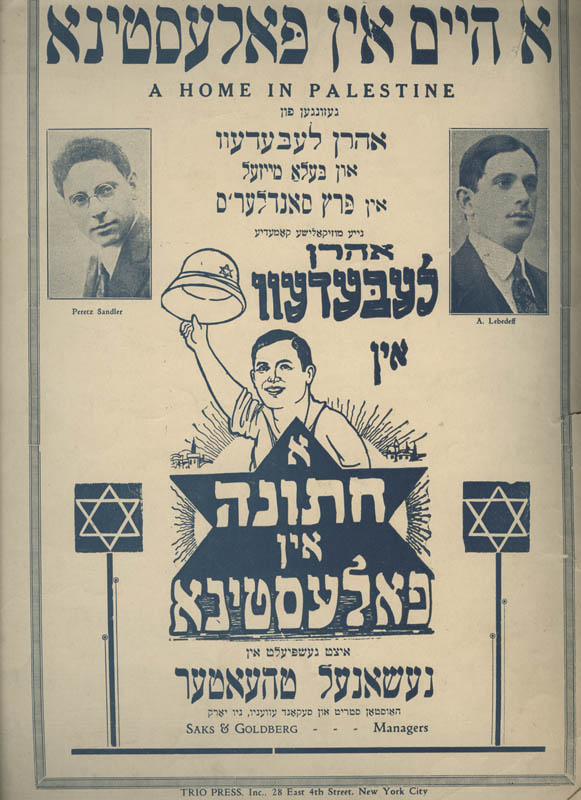
The Second Aliyah (1904–1914) introduced another wave of immigrants, many influenced by socialist ideals. During this period, collective farming communities known as kibbutzim were established, Hebrew was increasingly revived as a spoken language, and organizations dedicated to labor, education, and self-defense began to emerge. In 1909, Tel Aviv was founded as the first modern Hebrew-speaking city.
By the outbreak of World War I, the foundations of what would later become the Yishuv’s institutions were already taking shape.
The Balfour Declaration Changed Everything
World War I dramatically altered the political landscape.
The Ottoman Empire collapsed, and Britain assumed control over Palestine.
On November 2, 1917, British Foreign Secretary Arthur Balfour issued the Balfour Declaration, stating that the British Government viewed “with favour the establishment in Palestine of a national home for the Jewish people,” while also declaring that nothing should prejudice “the civil and religious rights of existing non-Jewish communities in Palestine.”
Those two commitments would prove difficult to reconcile.
For Zionists, the declaration represented the first major international endorsement of their aspirations.
For many Palestinian Arabs, it represented a promise about their homeland made without their consent.
The tensions created by those competing interpretations continue to influence political debate more than a century later.
The British Mandate
In 1922, the League of Nations formally granted Britain the Mandate for Palestine.
The Mandate incorporated the language of the Balfour Declaration while charging Britain with facilitating the establishment of a Jewish national home alongside protecting the rights of the existing population.
During the Mandate period, Jewish immigration increased significantly, especially as persecution intensified across Europe during the 1930s.
The Yishuv expanded rapidly.
Its population grew.
Its economy diversified.
Educational institutions multiplied.
Healthcare systems developed.
Political organizations became increasingly sophisticated.
What had once been scattered settlements was gradually becoming an organized society.
Building a Society Before Building a State
One remarkable feature of the Yishuv is that many institutions associated with an independent country were established before independence itself.
The Jewish Agency coordinated immigration, settlement, diplomacy, and economic development.
The Histadrut became one of the world’s most influential labor federations, providing employment services, healthcare, education, and economic infrastructure.
Hebrew-language schools spread throughout the community.
Universities, hospitals, banks, newspapers, transportation systems, and agricultural cooperatives emerged.
The Haganah, established in 1920, became the principal defense organization of the Yishuv and would later form the core of the Israel Defense Forces after independence.
By the 1940s, much of the administrative machinery necessary for statehood already existed.
Growing Conflict
The rapid growth of the Yishuv also intensified conflict.
Palestinian Arabs feared becoming a minority within their own homeland.
Many opposed increasing Jewish immigration and land purchases.
Violence erupted repeatedly during the 1920s and 1930s, including riots, attacks, reprisals, and the Arab Revolt of 1936–1939.
Britain struggled to balance its commitments to both communities.
Various commissions proposed partition or other constitutional arrangements, but none successfully resolved the competing national aspirations.
Meanwhile, Nazi persecution in Europe dramatically increased the urgency of Jewish immigration, while British restrictions on immigration became increasingly severe through the 1939 White Paper.
The humanitarian crisis and political conflict continued to escalate simultaneously.
The United Nations Partition Plan
After World War II, Britain announced that it could no longer resolve the growing conflict and referred the question of Palestine to the newly formed United Nations.
In November 1947, the UN General Assembly adopted Resolution 181, recommending the partition of Mandatory Palestine into separate Jewish and Arab states, with Jerusalem placed under an international administration.
The Jewish Agency accepted the plan despite dissatisfaction with some proposed borders.
Arab leaders within Palestine and neighboring Arab states rejected it, arguing that it violated the principle of self-determination for the Arab majority then living in Palestine.
Civil war broke out almost immediately after the vote.
From the Yishuv to Israel
On May 14, 1948, as the British Mandate ended, David Ben-Gurion proclaimed the establishment of the State of Israel in Tel Aviv.
The United States recognized the new state that same day, followed shortly afterward by additional governments.
The following day, armed forces from neighboring Arab states entered the conflict, beginning the first Arab-Israeli war.
For Israelis, this marked the realization of decades of Zionist aspirations and national self-determination.
For Palestinians, the same period became known as the Nakba, meaning “catastrophe,” during which approximately 700,000 Palestinians were displaced or fled from their homes amid the 1947–1949 war. These events remain central to Palestinian historical memory and continue to shape the conflict today.
The transition from the Yishuv to the State of Israel therefore cannot be understood from only one perspective.
It represented nation-building, independence, war, and mass displacement simultaneously.
A Timeline of the Transition
1882–1903: First Aliyah establishes new agricultural settlements.
1896: Herzl publishes The Jewish State.
1897: First Zionist Congress establishes the World Zionist Organization.
1909: Founding of Tel Aviv.
1917: Balfour Declaration supports a Jewish national home in Palestine while promising to protect existing non-Jewish communities.
1922: League of Nations establishes the British Mandate for Palestine.
1920s–1940s: Expansion of Yishuv institutions, immigration, education, agriculture, healthcare, and defense organizations.
1936–1939: Arab Revolt against British rule and Jewish immigration.
1947: UN Partition Plan adopted.
May 14, 1948: State of Israel declared.
What Can We Learn?
The history of the Yishuv demonstrates that states are rarely created overnight.
Long before independence, institutions were established, communities were organized, economies developed, and political identities took shape. The Yishuv became a functioning society before it became a sovereign nation.
Yet this history also reminds us that nation-building does not occur in a vacuum. The same developments that represented hope and self-determination for many Jews generated fear, resistance, and eventual displacement for many Palestinians. Understanding one history without the other inevitably leaves the story incomplete.
Recognizing this complexity does not require abandoning moral judgment.
It requires resisting simple narratives that flatten a deeply human history into heroes on one side and villains on the other.
Continue the Exploration
History often becomes a contest between competing identities. We inherit stories about nations, religions, and cultures, then search for evidence that confirms the version we already believe. The deeper challenge is learning to understand history without allowing identity to determine what we are willing to see.
Our book, Proof That You’re God, explores how the mind creates identities, certainty, and division—and how awareness can help us engage with difficult subjects more honestly and ““““““““““compassionately. If these questions about history, identity, and humanity interest you, we invite you to continue the exploration.