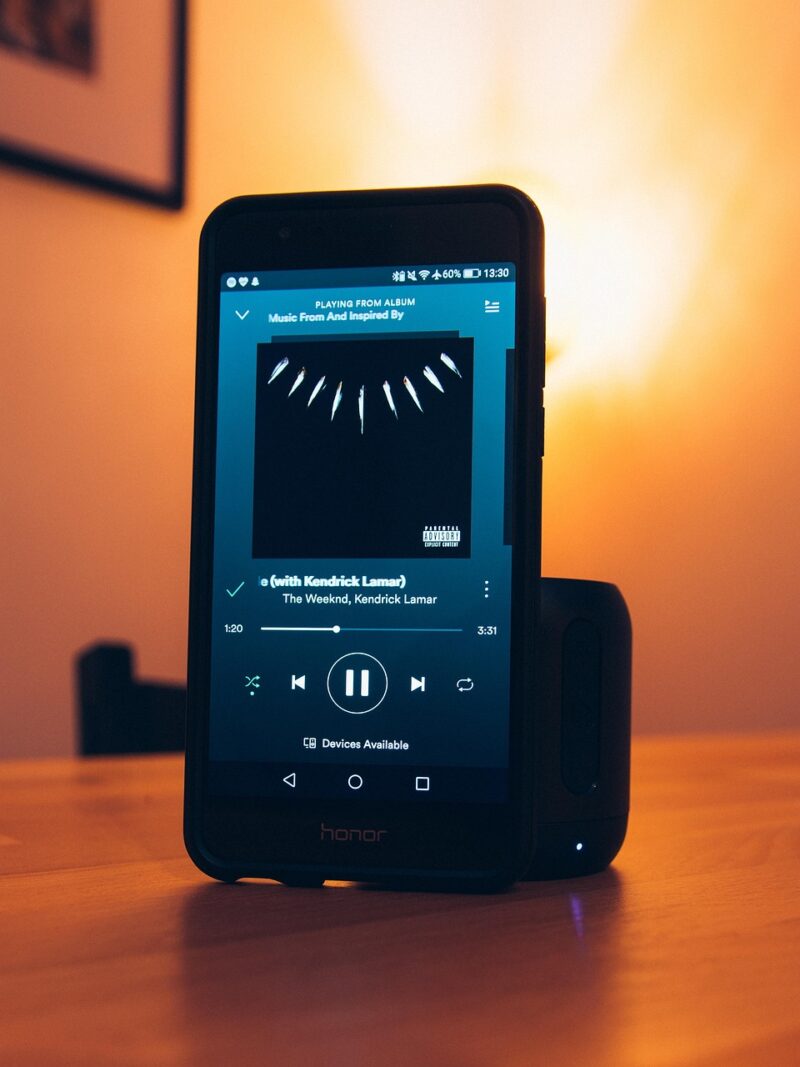
People sometimes notice that my Spotify songs aren’t organized.
There are no moods.
No genres.
No intentional arcs.
One song might be loud, heavy, and aggressive. The next might be quiet, spacious, almost fragile. Something intense followed immediately by something restrained.
For some people, this feels wrong. Jarring. Like something that should have been cleaned up but wasn’t.
But it’s not accidental.
I keep it that way on purpose.
The Comfort of Having Things Match
There’s nothing wrong with curated playlists.
They’re practical. They’re thoughtful. They meet us where we are.
A playlist for focus.
A playlist for working out.
A playlist for sadness, calm, motivation, nostalgia.
Music organized by feeling makes sense because it reflects something real: our inner states change, and it can be supportive to have something that matches what we’re experiencing.
In many ways, this mirrors how we try to organize life itself.
We like coherence.
We like consistency.
We like environments that reinforce what we’re already feeling.
There’s comfort in that. A sense that if the outer world aligns with the inner one, things will be easier to manage.
And often, they are.
At least for a while.
When Matching Turns Into Maintenance
The subtle shift happens when matching becomes maintenance.
When the point of the playlist is no longer expression, but preservation.
A playlist designed for a specific mood can quietly encourage that mood to linger longer than it otherwise would have. Not because the feeling is wrong, but because it’s being continuously reinforced.
Sadness paired with sad music can become a loop.
Anger paired with aggressive music can become a posture.
Calm curated too precisely can become something that needs to be protected.
This isn’t a problem with music.
It’s a pattern of attention.
When we surround ourselves only with what matches us, we can slowly lose tolerance for what doesn’t.
Why I Like the Randomness
In my Spotify songs, one moment might be Tool, the next Ludovico Einaudi.
There’s no narrative holding it together.
And that’s exactly why it works.
The contrast doesn’t ask me to stay where I am emotionally. It doesn’t reward coherence. It doesn’t care what mood I was in five minutes ago.
Instead, it mirrors something closer to how experience actually moves.
Inner life isn’t a playlist.
It’s a sequence of shifts.
Intensity rises and falls.
Restlessness gives way to stillness, then returns again.
Clarity appears, dissolves, and reappears in another form.
The randomness doesn’t disrupt that movement.
It reflects it.
And often, it does a better job of matching what’s actually happening internally than a playlist built to preserve a single feeling ever could.
The Role of Surprise
One of the most overlooked qualities of random music is surprise.
A song arrives that doesn’t fit the moment—and instead of feeling wrong, it interrupts the story. It breaks the spell of continuity.
Sometimes a quieter track lands precisely because it wasn’t what I would have chosen. Sometimes something heavy feels grounding rather than agitating because it shows up uninvited.
The surprise matters.
It introduces tolerance.
An ability to let experience change without needing to manage it.
And this is where the music metaphor starts pointing beyond music.
Preference, Control, and Intolerance
When we get used to having things our way, we often become less tolerant when they aren’t.
Not in dramatic ways.
In small, nearly invisible ones.
Irritation when the tone shifts.
Resistance when the environment doesn’t cooperate.
A subtle tightening when life doesn’t match our internal preference.
This isn’t a personal failing.
It’s what happens when control—especially gentle, well-intentioned control—becomes the norm.
The more curated life becomes, the more disruption feels like a problem.
Music just makes this easier to notice.
This Isn’t an Argument Against Playlists
This isn’t an argument against curated playlists.
They can be helpful.
They can be expressive.
They can be supportive.
The issue isn’t organization.
It’s exclusivity.
When we only allow ourselves one tone at a time—one mood, one genre, one version of coherence—we lose flexibility. We start relating to experience as something that needs to stay consistent rather than something that’s allowed to move.
Life doesn’t stay in genre.
Letting Experience Continue
A mixed collection of songs doesn’t ask you to decide how you should feel.
It doesn’t ask you to hold onto a moment.
It doesn’t ask you to let go either.
It simply continues.
And in that continuation, something relaxes.
You’re no longer responsible for maintaining the mood.
You’re just listening.
This applies far beyond music.
When life isn’t required to match us, we become more able to meet it.
The Larger Pattern
This preference for coherence—for things to align, match, and stay consistent—shows up everywhere.
In how we curate our feeds.
In how we manage our routines.
In how we try to regulate our inner states.
It’s understandable. But it comes with a cost.
The tighter the control, the lower the tolerance for variation.
This pattern is part of a broader cultural landscape shaped by constant stimulation, personalization, and noise—where preference is continuously reinforced and rarely challenged. That larger dynamic is explored more fully in the context of culture, media, and collective psychology here:
Music as a Mirror
My Spotify songs aren’t organized as a system.
They function more like a mirror.
They reflect how experience actually moves when it isn’t being managed. How tone changes without asking permission. How contrast can feel more honest than coherence.
Sometimes the randomness feels off.
Sometimes it feels perfect.
Sometimes it doesn’t matter.
And that, too, is the point.
Closing Reflection
There’s value in knowing what you like.
There’s value in creating environments that support you.
But there’s also value in not needing everything to match.
In music.
In mood.
In life.
Sometimes the most accurate reflection isn’t the one that fits the moment—but the one that allows the moment to change.
This same inquiry into control, tolerance, and the movement of experience is explored throughout Proof That You’re God, where attention isn’t treated as something to perfect, but something already unfolding.