
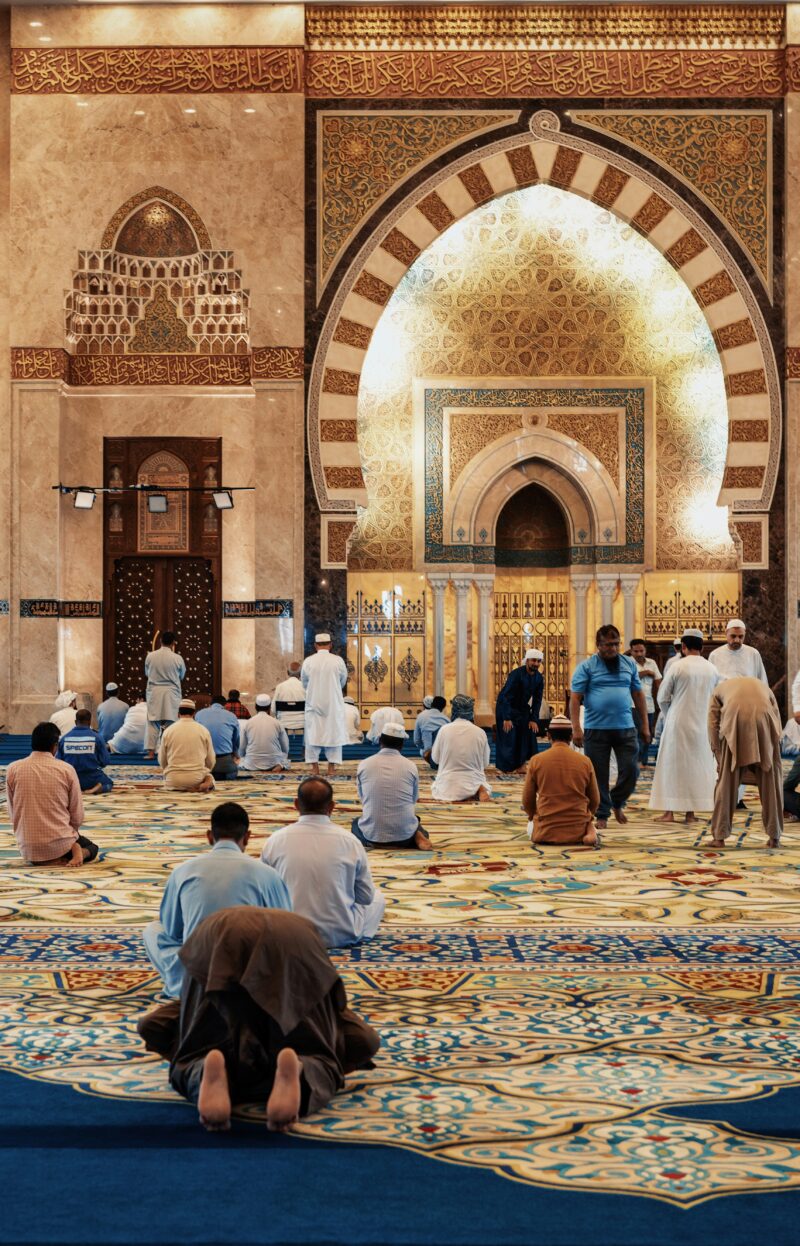
Any honest conversation about Islam has to hold two truths at once.
First: Islam has brought order, meaning, and dignity to hundreds of millions of people, often in contexts where chaos, violence, and exploitation were deeply entrenched.
Second: many Muslims experience Islam not as relief, but as pressure, fear, or constraint, particularly where obedience is emphasized without space for inner understanding or personal agency.
Both experiences are real. And neither can be understood without looking carefully at what submission actually means — and how easily it becomes something else.
Islam’s Original Strength: Orientation Before Introspection
Islam did not arise as a mystical or contemplative tradition. It arose as an intervention.
In 7th-century Arabia, the dominant challenges were not questions of identity or meaning. They were:
- tribal conflict
- cycles of retaliation
- economic injustice
- entrenched power hierarchies
- authority justified by lineage and force
Islam responded with something stabilizing and radical for its time: submission to a single transcendent authority that no human could own.
This was not abstract theology.
It was a re-orientation of power.
By asserting “there is no god but God,” Islam removed ultimate authority from tribes, rulers, and individuals. Ego — personal, tribal, or political — was no longer meant to occupy the center.
From the outside, this can look rigid.
From its historical context, it was profoundly grounding.
Why Islam Is So Strongly Outwardly Oriented
Islam emphasizes:
- visible practice
- shared ritual
- codified law
- communal accountability
This emphasis was not accidental.
Deep inward awareness does not scale easily. Structure does.
Islam externalized humility because inner transformation could not be assumed across an entire society. Submission became something enacted through form rather than discovered through introspection.
Psychologically speaking, Islam regulates ego through structure, rather than dissolving it directly through awareness.
This approach works — often impressively.
But it also carries a risk.
What Submission Is — and What It Isn’t
At this point, it’s essential to clarify what submission actually means — because misunderstanding it changes everything.
Submission is surrender.
It is not obedience.
It is not compliance.
It is not fear-based conformity.
Submission, at its root, is the relinquishing of the illusion of control — the recognition that reality does not bend to personal preference, identity, or certainty.
It is an inner yielding, not an external performance.
Obedience, by contrast, is behavioral. It is about doing what one is told — often motivated by reward, punishment, or social pressure. Obedience can happen with no inner shift at all.
Submission cannot.
How Surrender Becomes Mistaken for Compliance
Confusion arises when submission is translated primarily into outward form.
When surrender is expressed almost entirely through rules, rituals, and authority, it becomes easy to mistake:
- compliance for humility
- fear for reverence
- conformity for devotion
In this shift, the center quietly moves.
What was meant to dissolve the ego begins to discipline it.
What was meant to soften identity begins to solidify it.
The self remains intact — just constrained.
When Submission Gradually Becomes Obedience
Over time, a predictable drift can occur in any externally oriented system.
Submission to reality becomes submission to rules.
Orientation becomes compliance.
Humility gives way to fear.
This does not happen because Islam demands it. It happens because structure without awareness tends to harden.
When outward obedience is emphasized without inward recognition:
- rules replace relationship
- righteousness replaces humility
- certainty overrides compassion
For many Muslims, this creates a lived experience of religion that feels constraining rather than liberating — not because Islam is inherently coercive, but because fear becomes the most accessible motivator when surrender is misunderstood.
The Lived Cost for Some Muslims
It is possible to acknowledge real harm without reducing Islam to that harm.
In certain cultural and political contexts, Islamic authority has been used to justify:
- restrictions on women’s autonomy
- tolerance of domestic abuse
- practices like female genital mutilation (cultural, not Qur’anic, yet framed as religious)
- hostility toward religious difference
- fear-based models of divine accountability
In these environments, God is often experienced less as reality itself and more as surveillance — less as relationship and more as threat.
These harms are not unique to Islam.
They arise wherever certainty replaces presence, a dynamic explored more broadly in
why the world feels so loud, where competing certainties overwhelm nuance and humanity.
Islam does not invent this pattern.
But its strong outward orientation can make the pattern more visible when the inward dimension remains undeveloped.
The Underlying Tension: Structure Without Awareness
From the perspective explored throughout Dualistic Unity, the core issue is not Islam’s moral intent.
It is the gap between structure and recognition.
When submission is not paired with awareness:
- law becomes rigid
- obedience becomes coercive
- compassion becomes conditional
- identity hardens around being “right”
Religion, at that point, begins to serve identity rather than dissolve it — not because it was designed to, but because identity adapts to whatever structure is available.
Where Sufism Appears — Quietly, and Not Always Comfortably
It is precisely here that Sufism emerges.
Not as a rejection of Islam.
But as an inward response to its outward emphasis.
Sufis noticed something subtle and unsettling:
A person can follow every rule
and still remain psychologically intact.
So they asked a deeper question:
What happens to the self in genuine submission?
Not socially.
Not symbolically.
But experientially.
From Correct Action to Inner Dissolution
Where mainstream Islam emphasizes right practice, Sufism emphasizes inner transformation.
Sufi language speaks of:
- fanā’ — the dissolution of the separate self
- love as something that consumes identity
- God not as an external authority, but as reality itself
This is why Sufi poetry often sounds disorienting.
Rumi writes:
“Why are you so busy with this or that, with good or bad?
Pay attention to how things blend.”
And elsewhere:
“I am not Christian or Jew or Muslim…
I belong to the Beloved.”
This is not rebellion.
It is identity loosening.
Why This Was Often Uncomfortable
Mysticism challenges institutions not because it promotes disorder, but because it is difficult to regulate.
Someone whose sense of self has softened:
- fears less
- clings less tightly to certainty
- relates differently to authority
Historically, Sufism was sometimes revered, sometimes tolerated, and sometimes condemned — often depending on how threatening it appeared to existing power structures.
Not because Sufis rejected Islam, but because they internalized submission beyond form.
The Broader Pattern Religion Faces
At this point, Islam is no longer the only subject.
Religion itself comes into view.
Every religious tradition eventually faces the same temptation:
- to preserve structure at the expense of direct encounter
- to substitute belief for recognition
- to protect certainty rather than invite transformation
When that happens, religion becomes a buffer from reality rather than a doorway into it.
Not because God disappears — but because God is kept safely conceptual, never encountered directly.
This is the recognition explored in
Religion as the Final Avoidance of God.
A Closing Reflection
Islam brought coherence where fragmentation once dominated — and that achievement matters.
But coherence alone cannot free the human heart.
Without inward awareness:
- submission feels like fear
- obedience feels like constraint
- certainty eclipses relationship
Sufism did not arise because Islam failed.
It arose because Islam reached the edge of what structure alone could do.
It gave voice to a question Islam leaves largely implicit:
What happens when submission is no longer something you perform,
but something that happens to the sense of self itself?
That question does not belong to Islam alone.
It belongs to awareness — wherever humans begin to look beyond certainty.
If this reflection resonates, the same recognition — how identity loosens and reality reveals itself when the need to control finally relaxes — is explored experientially in Proof That You’re God. Not as doctrine or belief, but as what becomes obvious when the self stops trying to stand in the center of everything.