As another year turns over, the headlines feel heavier than usual.
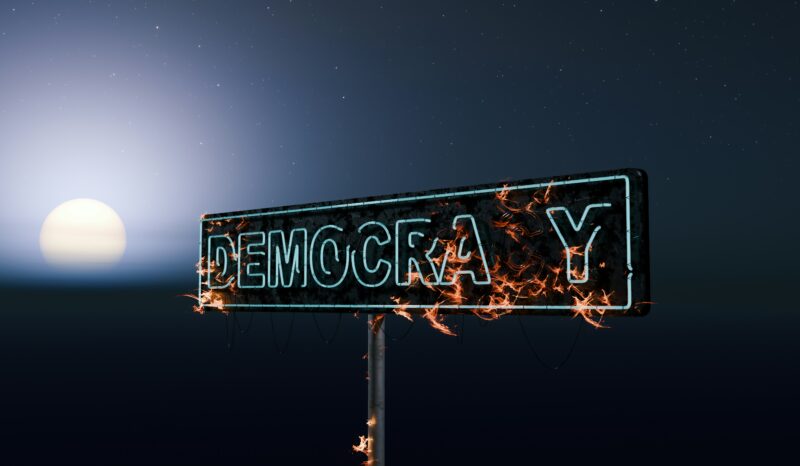
Democracy in the United States is described as fragile, eroding, or already broken. A US president openly flirts with the idea of a third term. Supreme Courts, Federal institutions, and norms that once felt immovable now feel negotiable. The word authoritarian no longer sounds hypothetical.
And beneath all of it is a quieter, more unsettling question:
If democracy fails, what’s left?
Most people are taught to believe the answer is nothing. That without governments, leaders, or systems of representation above us, society collapses into chaos.
But history—and lived human experience—suggests something else entirely.
Democracy Is a System. Human Agency Is Older.
Democracy matters. It protects lives. It constrains power. It creates shared rules for decision-making.
But it is not the source of human cooperation.
Long before constitutions, elections, or nation-states, people:
- organized locally,
- shared resources,
- protected one another,
- resolved conflict,
- and sustained life.
Communities existed before governments claimed authority over them.
Democracy was never the origin of human agency—it was an attempt to formalize and scale it.
And when the system strains or fails, that deeper layer doesn’t disappear.
It waits.
Why the Push for a Third Term Matters Symbolically
The threat of a third presidential term isn’t just about legality. It’s about permission.
It signals that power no longer feels bound by shared agreement—that rules apply only when they’re convenient. Whether or not such an attempt succeeds, the message lands:
The system will protect itself only if people believe in it.
This is how democracies don’t collapse overnight, but hollow out slowly—through exhaustion, disbelief, and normalization.
Yet here’s the paradox:
When faith in centralized systems erodes, local agency becomes more visible, not less.
The Absurdity We’ve Learned to Accept
It’s worth asking something that feels almost too obvious to say out loud:
Why have humans ever accepted monarchy at all?
Why did we agree that certain families were chosen by God, blood, or fate to rule over others indefinitely? Why did crowns, thrones, and inherited power ever feel reasonable?
The answer isn’t intelligence or ignorance.
It’s conditioning.
We were taught to confuse authority with order.
Hierarchy with stability.
Distance with wisdom.
Those stories linger even after monarchies “end.” They simply reappear as:
- political dynasties,
- corporate oligarchies,
- billionaire saviors,
- strongman leaders.
The costume changes. The psychology doesn’t.
Democracy Isn’t the Same as Agency
One of the quiet tragedies of modern life is that people have been trained to believe their power exists only at the ballot box.
Vote every few years.
Argue online.
Hope the right people win.
But most of what shapes daily life happens much closer to home:
- housing,
- food,
- education,
- safety,
- care,
- connection.
When people feel powerless nationally, they often forget how much influence still exists locally.
This confusion—between abstract systems and lived reality—is part of a broader pattern in culture and collective psychology, where attention is pulled upward toward spectacle while real power sits quietly at ground level. These dynamics are explored more deeply in why the world feels so loud.
We Have Always Been More Self-Sustaining Than We Remember
Every town, at some point, was closer to self-sustaining than it is now.
Not because people were morally superior—but because systems were smaller, slower, and closer to the body.
Food was local.
Skills were shared.
Care was relational.
Knowledge moved face-to-face.
Centralization promised efficiency and scale. And it delivered many real benefits.
But it also created dependency—on distant systems, fragile supply chains, and abstract authorities that cannot feel what they manage.
The roots of resilience were never removed.
They were simply covered over.
Roots don’t disappear because concrete is poured.
They wait for cracks.
What Walking Away Actually Means
Walking away from absurdity doesn’t mean rejecting society or retreating into isolation.
It means remembering that:
- neighbors are more real than narratives,
- care is more stabilizing than control,
- and cooperation doesn’t require permission.
It means investing attention where it can actually land.
Local food systems.
Mutual aid.
Community spaces.
Skill-sharing.
Neighborhood trust.
These aren’t utopian fantasies.
They’re ancient patterns.
They’re how humans survived long before empires—and how they’ll survive after them.
A New Year, A Different Orientation
The New Year often arrives with resolutions framed around self-improvement.
But perhaps this year calls for something quieter and more radical:
A reorientation of attention.
Less fixation on the spectacle of failing systems.
More care for the ground beneath our feet.
Less waiting for permission.
More remembering that agency was never granted—it was always exercised.
Democracy may be strained.
Institutions may falter.
Leaders may overreach.
But the capacity to relate, organize, and sustain life has never belonged to them.
It belongs to us.
It always has.
Closing Invitation
This reflection is part of an ongoing exploration into identity, power, and the deeper sources of human agency beneath political systems.
These themes are explored more fully in Proof That You’re God, a book about awareness, responsibility, and the freedom that comes from seeing clearly rather than outsourcing authority to structures that cannot know us.
As the year turns, the invitation isn’t to panic—or to wait.
It’s to notice where life is already happening…
and to grow from there.
Happy 2026.