
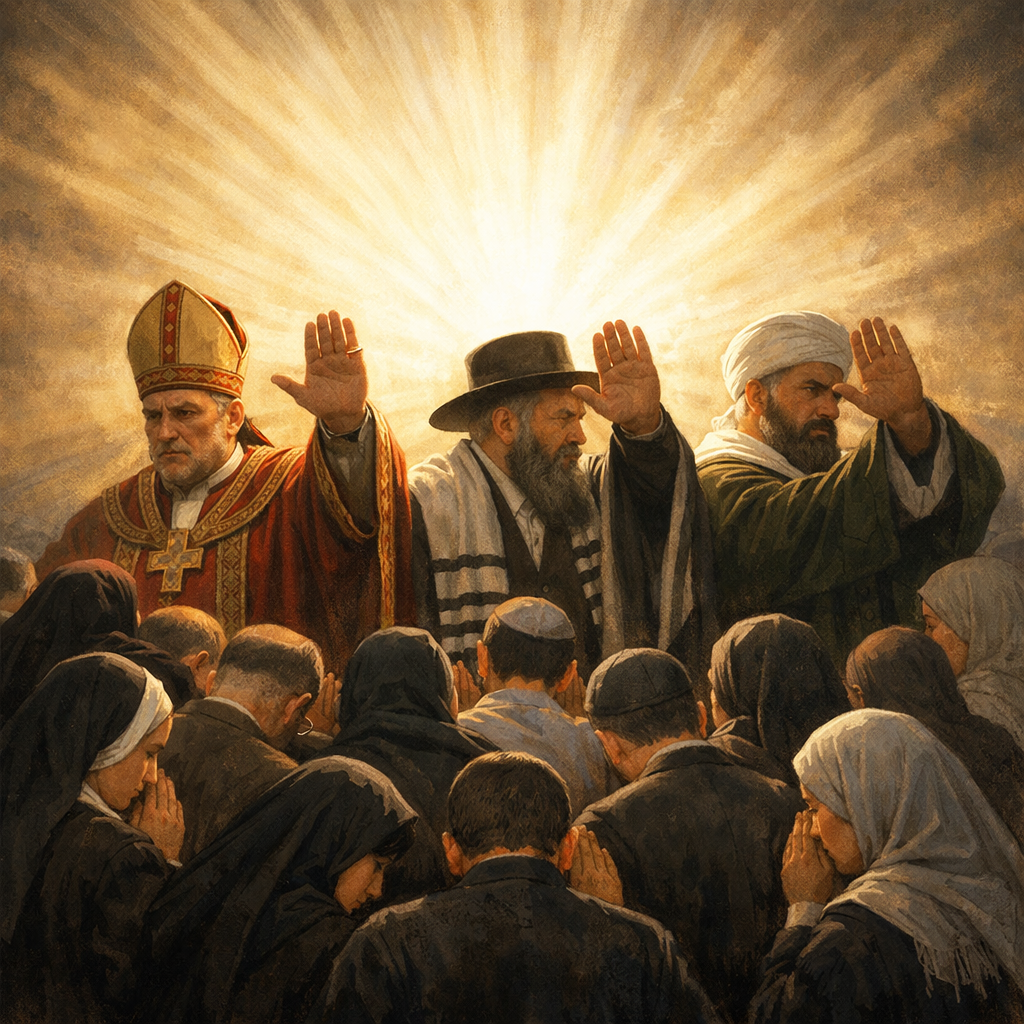
How Christianity, Judaism, and Islam Have Held the Ultimate at Arm’s Length Throughout History
Religion is usually understood as humanity’s attempt to reach God.
But if we look carefully—across Christianity, Judaism, and Islam—a different pattern emerges.
Religion does not fail because it misunderstands God.
It fails because it understands just enough to know what a direct encounter would require—and then builds systems to prevent it.
In that sense, religion is not the search for God.
It is the final and most sophisticated way of avoiding what God actually points to.
God Was Recognized Long Before Religion Took Shape
All three monotheistic traditions begin with a strikingly similar recognition:
God is not an object.
God is not contained.
God cannot be fully known, described, or represented.
This isn’t a modern critique. It’s foundational.
- God is beyond image
- beyond concept
- beyond comprehension
- beyond manipulation
Religion begins not with ignorance of mystery, but with acknowledgment of it.
The problem is not that God is denied.
The problem is what happens after that acknowledgment—when identity, fear, and survival quietly step in.
This same psychological pattern—where narrative and structure replace direct contact with experience—is explored more broadly in the self you’re trying to hold together.
Why Direct Encounter Is Intolerable
If God is not an object, then encountering God is not about acquiring knowledge.
It is about losing ground.
A genuine encounter with the Ultimate would mean:
- no protected identity
- no moral high ground
- no certainty
- no stable observer standing apart
That is not comforting.
It is annihilating.
So religion steps in—not to deny God, but to mediate God.
Mediation preserves distance.
Distance preserves the self.
Christianity: God Internalized, Then Safely Externalized Again
Christianity begins with radical intimacy.
God is near.
God is present.
God is encountered in vulnerability, surrender, and loss of control.
But this immediacy cannot be institutionalized.
So Christianity gradually relocates God:
- into doctrine
- into belief
- into metaphysical claims
- into salvation mechanics
Faith becomes belief.
Trust becomes assent.
Surrender becomes obedience.
Jesus points toward the collapse of the self.
Christianity builds beliefs that protect it.
God is affirmed—and placed safely outside.
Judaism: God Preserved Through Distance and Law
Judaism is deeply honest about God’s transcendence.
God is not named.
God is not depicted.
God is not graspable.
This protects God from idolatry—but it also creates distance.
That distance is managed through:
- covenant
- law
- practice
- communal identity
These are not mistakes. They are stabilizers.
But they also ensure that God remains approached, not fallen into.
God is honored—while the self remains intact.
Islam: God Declared Absolute, Then Buffered by Submission
Islam is uncompromising about God’s transcendence.
God has no likeness.
God cannot be compared.
God cannot be known in essence.
This clarity is powerful.
But it creates the same dilemma:
How does one relate to what cannot be known?
Religion answers with submission.
Practice becomes structure.
Obedience becomes relationship.
Submission, when systematized, quietly replaces surrender.
The self yields behavior—while remaining fundamentally separate from the Ultimate it obeys.
The Shared Pattern: God Is Always One Step Away
Across Christianity, Judaism, and Islam, the pattern is consistent:
- The Ultimate is acknowledged
- Direct encounter threatens identity
- Religion creates mediation
- Mediation preserves the self
- God remains safely “over there”
This is not hypocrisy.
It is human psychology.
Religion functions as a buffer between recognition and surrender.
Religion Does Not Preserve Faith — It Preserves the Absence of It
Faith, in its lived sense, dissolves identity.
It does not produce:
- insiders and outsiders
- believers and unbelievers
- chosen and unchosen
Religion requires all of these.
So religion does not merely fail to deliver faith.
It actively preserves the lack of it.
Where faith would dissolve boundaries, religion reinforces them.
This is why religious identity is inherently divisive—not because of bad intentions, but because identity itself requires contrast to exist.
The God Religions Follow Is Always an Image
Here is the deeper truth beneath it all:
No religion follows God at all.
Not because God is rejected—but because God cannot be followed.
To follow something, it must be:
- definable
- directional
- separate
God, as religions themselves insist, is none of those things.
So an image is formed.
Every religion ends up following a God that:
- validates its moral framework
- protects its hierarchy
- mirrors its fears
- preserves its resistance to letting go
This isn’t cynicism.
It’s inevitability.
A God who truly dissolves the self cannot be followed.
So a safer God is created—one who commands, rewards, punishes, and stays at a distance.
Ungodly Consequences Are Not Accidents
Once God is avoided but spoken about endlessly, harm becomes justifiable.
Across all three traditions—repeatedly and predictably—religion has enabled:
- abuse of women
- violence toward non-believers
- silencing of abused children
- punishment of dissenting believers
- sanctification of fear
These are not deviations from religion.
They are the logical outcomes of preserving identity while invoking God.
A living encounter with the Ultimate would collapse hierarchy.
Religion preserves hierarchy by avoiding that encounter.
Obedience Is Not Surrender
Religion often confuses obedience with devotion.
But obedience requires distance.
You can obey a command.
You can obey a law.
You cannot obey what dissolves the one obeying.
So obedience becomes the substitute for surrender—and is praised as faith.
Religion as the Final Avoidance of God
Just as philosophy can become the disease it was meant to cure, religion becomes the final refuge from surrender.
It allows acknowledgment of transcendence without yielding to it.
Religion lets us say:
“God is real.”
Without allowing God to undo the one saying it.
In that sense, religion is not humanity’s immaturity.
It is humanity’s most refined defense against annihilation.
What Remains When the Image Falls Away
When the image of God collapses:
- belief becomes unnecessary
- obedience loses meaning
- identity softens
- division dissolves
There is no God to follow.
Only what is—without distance.
Religion cannot go there.
And that is why religion endures.
The Quiet Conclusion
Religion is not the path to God.
It is the last place the self can stand without disappearing.
Not because God is absent.
But because God is finally too close to survive.
If this exploration resonates, Proof That You’re God explores what happens when the final buffer falls away—not as theology or belief, but as lived experience, where God is no longer approached, defended, or believed in… but recognized as what is.