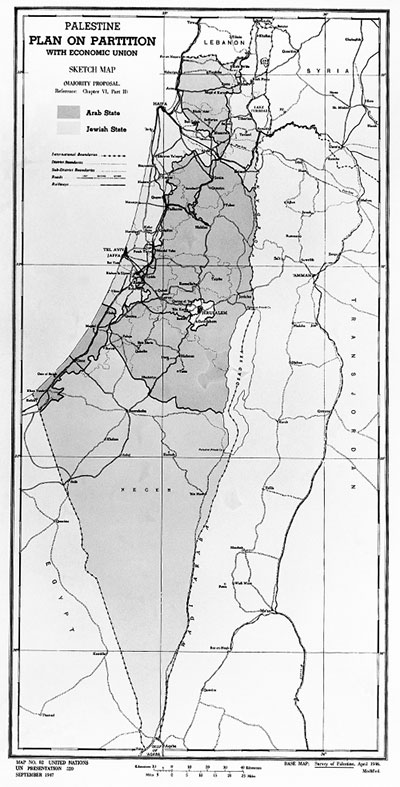
One of the most enduring questions surrounding the creation of Israel is not whether the United Nations recommended partitioning Mandatory Palestine in 1947. That is well documented. The more difficult question is whether the governments voting in favor of Resolution 181 understood that much of the Arab population living in Palestine opposed the proposal.
The historical evidence leaves little room for doubt.
They knew.
The deeper question is why they voted for it anyway.
Understanding that decision requires examining the information available to governments at the time, the legal framework inherited from the League of Nations, the aftermath of World War II, and the competing principles of self-determination that confronted the international community.
Resolution 181 Did Not Occur in a Vacuum
When the United Nations General Assembly adopted Resolution 181 on November 29, 1947, it was not acting without years of investigation.
Britain had announced that it intended to terminate its Mandate over Palestine and referred the issue to the United Nations because it could no longer reconcile the competing demands of Jewish and Arab communities.
The UN responded by creating the United Nations Special Committee on Palestine (UNSCOP) in May 1947. The committee consisted of representatives from eleven countries that were not among the major powers directly involved in administering Palestine. UNSCOP spent months studying conditions in the territory, reviewing historical documents, receiving testimony, visiting Palestine, and consulting numerous organizations before issuing its report.
The committee’s findings became the foundation for Resolution 181.
Did the UN Know the Arab Majority Opposed Partition?
Yes.
This is not a matter of speculation.
UNSCOP’s report explicitly documented that the overwhelming majority of Palestinian Arab political organizations opposed partition and instead demanded an independent unitary state governed according to majority rule. The committee also recorded the Arab Higher Committee’s refusal to cooperate formally with UNSCOP because it rejected the committee’s legitimacy, although many Arab individuals, municipal leaders, and organizations still communicated their views through other channels.
British officials administering Palestine also repeatedly informed the United Nations that Arab opposition to partition was widespread and that implementing such a proposal would almost certainly produce violence.
These reports were available to the governments participating in the General Assembly debate.
The permanent members of the Security Council—the United States, the Soviet Union, the United Kingdom, France, and China—had diplomatic services, intelligence capabilities, foreign ministries, and extensive communications with British officials.
There is no credible historical evidence suggesting these governments were unaware that significant Arab opposition existed.
The debate was never about whether opposition existed.
It was about whether partition remained the least harmful available solution despite that opposition.
Why Did Governments Support Partition?
The motivations differed from country to country.
The United States, under President Harry Truman, supported partition for several reasons. Humanitarian concern for Holocaust survivors was an important factor. Domestic political considerations also influenced policy, as did strategic interests in the emerging postwar world. Historians continue to debate the relative importance of each factor.
The Soviet Union also supported partition, although for very different reasons. Soviet leaders viewed weakening British influence in the Middle East as strategically advantageous and initially believed a new Jewish state might adopt socialist economic policies.
Britain, despite administering Palestine, abstained from the final vote. British officials had concluded that they could no longer govern Palestine effectively and refused to enforce partition after the Mandate ended.
France supported partition, influenced by postwar sympathy for Jewish survivors and broader diplomatic considerations.
China, then represented by the Republic of China government rather than the People’s Republic of China, abstained from the vote.
The permanent members therefore did not vote as a unified bloc.
Their decisions reflected different political calculations rather than a single coordinated strategy.
Two Competing Principles of Self-Determination
Much of the debate centered on two competing understandings of self-determination.
Arab representatives argued that self-determination should follow the principle of majority rule. Since Arabs constituted roughly two-thirds of Palestine’s population in 1947, they maintained that the future of the country should be determined by its existing majority population.
Zionist representatives argued that the Jewish people also constituted a distinct nation entitled to self-determination. They emphasized decades of legally recognized immigration under the British Mandate, the League of Nations’ commitment to establishing a Jewish national home, and the humanitarian crisis facing Jewish survivors after the Holocaust.
The United Nations attempted to accommodate both claims through partition.
Whether that approach respected or violated self-determination remains one of the central legal debates surrounding Resolution 181.
Why Didn’t the UN Simply Hold a Referendum?
This question naturally follows.
If the United Nations knew that large segments of the Arab population opposed partition, why not allow the inhabitants of Palestine to vote directly?
Several proposals involving elections or other forms of consultation were discussed during the Mandate period, but no comprehensive referendum on partition was ever held.
Supporters of partition feared that a simple majority vote would permanently deny Jewish national aspirations despite decades of internationally recognized immigration and institution-building.
Arab leaders argued that majority rule was precisely how self-determination should function.
The United Nations ultimately chose negotiation through international recommendation rather than direct popular referendum.
That decision remains controversial among historians and legal scholars.
Why Palestine? Could the International Community Have Chosen a Different Solution?
Another question has continued to surface in historical discussions for decades.
If the international community recognized the desperate situation facing Holocaust survivors after World War II, why was the principal political solution the creation of a Jewish state in Palestine rather than a coordinated international effort to permanently resettle and protect survivors across many countries?
This question deserves careful consideration because it is often overlooked.
The Holocaust displaced hundreds of thousands of surviving Jews across Europe. Many had lost their homes, families, citizenship, and livelihoods. At the same time, much of the world had already demonstrated a reluctance to accept Jewish refugees before and during the war. The 1938 Evian Conference is frequently cited by historians as an example of this failure, as most participating countries expressed sympathy for Jewish refugees but declined to substantially increase immigration quotas.
By the end of the war, many governments believed that establishing a Jewish state offered a long-term political solution to a humanitarian catastrophe. Zionist leaders had spent decades advocating for a Jewish homeland in Palestine, and many Holocaust survivors themselves chose to immigrate there, believing that Jews would never be truly secure as minorities dependent on the protection of other governments.
Yet critics have long argued that this solution came at a profound cost to another population.
Many Palestinian Arabs asked a different question: if European antisemitism culminated in the Holocaust, why should the political consequences be borne primarily by the people of Palestine? Why should a community that had not committed the crimes of Nazi Germany face the partition of its homeland and the prospect of becoming a minority within part of it?
This criticism did not arise only after 1948. Arab representatives expressed similar concerns throughout the British Mandate and during the United Nations debates leading to Resolution 181. They argued that the international community had alternatives. Countries that had closed their borders to Jewish refugees before and during the Holocaust could have accepted far greater numbers afterward. A broader international resettlement effort, they argued, might have provided safety for survivors without partitioning Palestine against the wishes of much of its Arab population.
Supporters of partition reached a different conclusion. They argued that dispersing Holocaust survivors among other countries would not solve what they viewed as the underlying problem: the absence of Jewish self-determination. In their view, the Holocaust demonstrated that Jews required not merely refuge but sovereignty—a state capable of protecting its own citizens rather than depending upon the goodwill of others.
These competing perspectives reveal that the debate was never simply about where Holocaust survivors should live.
It was about two fundamentally different visions of justice.
One emphasized repairing the consequences of centuries of antisemitic persecution through Jewish national self-determination.
The other argued that achieving justice for one persecuted people should not require overriding the political aspirations and self-determination of another.
That tension remains one of the central moral and historical questions surrounding the creation of Israel, and it continues to shape international debate today.
Could the UN Have Predicted Violence?
Again, the documentary evidence suggests yes. UNSCOP acknowledged that partition would likely encounter violent resistance.
British intelligence assessments warned of escalating conflict.
Military planners anticipated unrest.
Many diplomats privately expressed concern that implementation would be extraordinarily difficult. In other words, the possibility of violence was not unforeseen.
What governments disagreed about was whether any realistic alternative would produce less violence.
Some believed partition offered the only remaining political compromise.
Others believed partition itself guaranteed war.
History ultimately showed that civil war began almost immediately after the General Assembly vote, followed by the broader Arab-Israeli war after Israel declared independence in May 1948.
Does Knowing Change the Moral Question?
Knowing that governments were aware of Arab opposition does not automatically answer whether Resolution 181 was morally or legally justified.
It does, however, change the historical conversation.
The issue is not whether the international community acted without information.
The documentary record demonstrates that governments possessed substantial information regarding political conditions in Palestine.
The question becomes how they weighed competing moral obligations.
Should majority rule have prevailed?
Why did Jewish self-determination after centuries of persecution take priority?
Could both have been reconciled differently?
Could additional negotiations have succeeded?
Could international guarantees have reduced violence?
These questions remain open because history cannot be rerun under different conditions.
What Can We Learn?
Resolution 181 illustrates one of the most difficult challenges in international politics.
Sometimes every available option carries profound costs.
The United Nations knew that many Palestinian Arabs rejected partition.
It also knew that hundreds of thousands of Jews sought national self-determination and that Holocaust survivors faced uncertain futures in a world that had often refused to admit Jewish refugees before and during the war.
The recommendation reflected an attempt to reconcile competing national claims.
Whether it succeeded—or whether it created conditions for decades of conflict—is a question that continues to divide historians, legal scholars, diplomats, and ordinary citizens.
One lesson is clear.
History is rarely shaped by ignorance alone.
More often, it is shaped by people making decisions with incomplete certainty, competing values, and consequences they cannot fully control.
Continue the Exploration
History invites us to ask who was right, who was wrong, and who should have acted differently. Beneath those questions lies another: why do human beings become so attached to identities, borders, and certainty that compromise becomes almost impossible?
Our book, Proof That You’re God, explores the nature of identity, division, and awareness—not to erase history or responsibility, but to better understand the psychological patterns that shape individuals, nations, and the stories we inherit. If these questions resonate with you, we invite you to continue the exploration.