
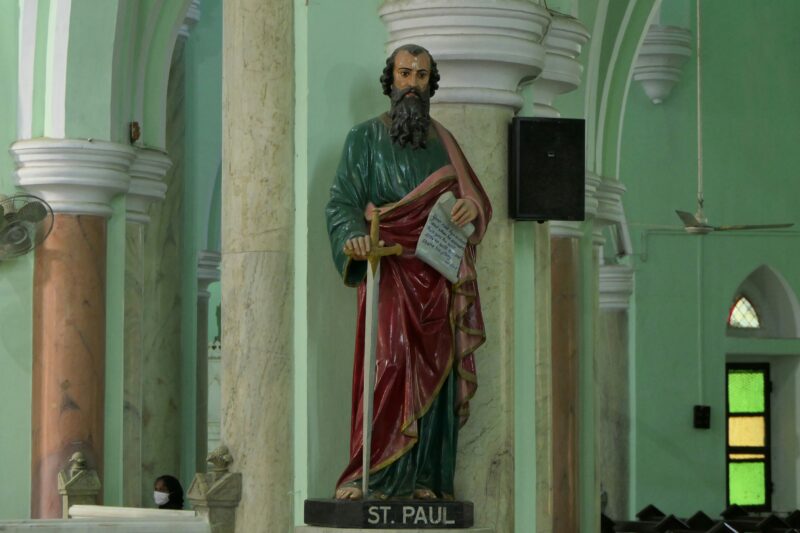
And What That Defense Is Really Protecting
When people react strongly to the idea that Paul reshaped Christianity, the response is rarely neutral.
It’s not just disagreement.
It’s urgency.
Sometimes anger.
Sometimes fear.
Often moral certainty.
This isn’t because Paul is merely a historical figure.
It’s because Paul sits at the structural center of how many people understand truth, authority, and themselves.
To question Paul doesn’t feel like an academic exercise.
It feels like an existential threat.
This Isn’t About Paul — It’s About Stability
For many believers, Paul isn’t simply an apostle.
He is:
- the interpreter of salvation,
- the architect of doctrine,
- the bridge between belief and identity.
Paul provides a framework where:
- meaning is defined,
- belonging is secured,
- and uncertainty is minimized.
When that framework is challenged, what’s threatened isn’t a man—it’s orientation.
And the nervous system reacts accordingly.
Paul Protects the Self-Story
Most modern Christian identity is built less on imitation of Jesus’s way of life and more on alignment with a belief structure.
Paul’s writings support that structure:
- belief over behavior,
- doctrine over discernment,
- certainty over ambiguity.
This allows people to know they are right without needing to live the tension Jesus embodied.
If Paul’s authority weakens, something uncomfortable emerges:
What if belief alone isn’t enough?
That question destabilizes the self-story.
And self-stories are defended fiercely.
Certainty Feels Like Safety
Paul’s theology offers answers.
Clear ones.
Portable ones.
Repeatable ones.
In a chaotic world, certainty feels like refuge.
Jesus’s teachings, by contrast, often:
- resist systematization,
- demand lived response,
- confront power directly,
- refuse clean answers.
Paul makes faith administrable.
Jesus makes it personal.
It’s far easier to defend a system than to embody a way of life.
Authority Needs a Voice That Can’t Be Questioned
Paul’s authority rests on revelation.
That matters.
A revelation:
- can’t be cross-examined,
- can’t be replicated,
- can’t be corrected by lived contradiction.
This makes Paul uniquely useful to institutions.
Once authority is rooted in divine access rather than communal discernment, disagreement becomes rebellion.
And when authority feels threatened, defenders don’t argue calmly.
They guard the gate.
Why Scripture Is Often Used as a Shield
Many defenses of Paul rely on citing texts that affirm Paul.
But this is circular.
Paul’s authority is defended using texts shaped by Pauline theology.
That doesn’t invalidate faith—but it does explain the intensity.
When the foundation and the defense are the same thing, questioning feels like collapse.
This dynamic—how identity hardens around narratives that protect coherence—is part of a broader pattern explored in reflections on the self you’re trying to hold together.
Paul Absorbs the Tension People Don’t Want to Carry
Jesus’s teachings leave little room for outsourcing responsibility.
They ask for:
- forgiveness without guarantee,
- compassion without reward,
- humility without hierarchy.
Paul’s system allows those demands to be:
- deferred,
- spiritualized,
- or managed through belief.
Defending Paul often protects people from having to sit with the unresolved tension Jesus invites.
And tension is uncomfortable.
This Isn’t Hypocrisy — It’s Human
It’s important to say this clearly:
People don’t defend Paul because they’re dishonest.
They defend Paul because identity seeks stability.
When belief systems hold someone together—through grief, fear, or meaning loss—any threat to that system feels personal.
Understanding this doesn’t require agreement.
It requires empathy.
What Changes When This Is Seen Clearly
Once this dynamic is visible, the conversation shifts.
It’s no longer:
“Who’s right — Jesus or Paul?”
It becomes:
“What am I protecting when I insist on certainty?”
That question doesn’t demand deconversion.
It invites awareness.
And awareness doesn’t destroy meaning.
It loosens the grip of what no longer needs defending.
Closing Invitation
This reflection is part of an ongoing exploration into how identity, authority, and belief systems form—and why humans so often confuse certainty with truth.
These themes are explored more deeply in Proof That You’re God, a book about awareness, selfhood, and the freedom that comes from seeing clearly rather than defending automatically.
You don’t have to abandon faith to question structure.
But questioning structure may reveal what faith was always meant to point toward.
Reflection
What beliefs in your life feel non-negotiable—not because they’ve been examined, but because losing them would feel like losing yourself?