One of the most comforting questions we can ask ourselves is, “Who am I?”
One of the most unsettling discoveries we can make is that the answer keeps changing.
As children, our identities are often given to us before we ever choose them. We become “the quiet one,” “the smart one,” “the athletic one,” “the difficult one,” or “the responsible one.” Later, we gather new identities through our experiences. We become parents, partners, entrepreneurs, artists, skeptics, spiritual seekers, survivors, leaders, caregivers, or retirees. Each identity helps us make sense of our place in the world.
There is nothing inherently wrong with identity. In fact, developmental psychology suggests that forming a coherent sense of self is an important part of healthy psychological development. Identity provides continuity, belonging, and direction. It helps us navigate an incredibly complex world by answering questions like, “What matters to me?” and “How do I relate to other people?”
The difficulty begins when we forget that identity is meant to serve life.
Instead, we begin serving our identity.
Identity Gives Us Stability
Life is constantly changing. Our bodies age. Relationships evolve. Careers begin and end. Our beliefs mature. New opportunities appear while familiar routines disappear. Amid all this uncertainty, identity offers something deeply reassuring: consistency.
When someone says, “I’m a teacher,” “I’m a father,” “I’m an atheist,” “I’m a Christian,” “I’m an artist,” or “I’m an entrepreneur,” they are not simply describing what they do. They are organizing countless experiences into a story that feels stable enough to carry into tomorrow.
Stories reduce complexity.
Without them, every day would require us to rediscover ourselves from the beginning.
Identity allows us to recognize ourselves across time. It creates continuity between yesterday’s experiences and today’s decisions. It is one of the mind’s most remarkable tools for navigating change.
But like every useful tool, it has limits.
Life Refuses to Stay Inside the Story
Imagine a successful entrepreneur who has spent twenty years building a business. Their work has shaped not only their income but also their friendships, routines, confidence, and sense of purpose. Then retirement arrives.
Who are they now?
Or imagine a parent whose children grow into independent adults. Parenting may remain deeply meaningful, but it no longer occupies every hour of the day. The role changes.
Who are they now?
Consider someone who spent years identifying as “the survivor.” That identity may have carried enormous strength during unimaginably difficult experiences. It may even have saved their life. Yet after years of healing, new possibilities begin emerging that do not fit within the original story.
Who are they now?
These questions are not signs that something has gone wrong.
They are signs that life continues moving while identity tries to stand still.
Every Identity Solves One Problem and Creates Another
Identity helps answer uncertainty by giving us a stable reference point. Yet every answer quietly creates new boundaries.
If I am “the strong one,” admitting vulnerability may begin feeling like failure.
If I am “the successful one,” making mistakes becomes increasingly threatening.
If I am “the spiritual person,” moments of anger or doubt may feel like evidence that I am doing spirituality incorrectly.
If I am “the skeptic,” openness to wonder may begin feeling intellectually dishonest.
If I am “the helper,” asking for help may become almost impossible.
The identity that once provided freedom gradually begins limiting what we allow ourselves to experience.
Not because the identity is wrong.
Because life is always larger than any single description.
The Cage Is Invisible
The most powerful cages rarely have walls.
They have stories.
The reason identities become restrictive is that they often feel invisible from the inside. We stop recognizing them as interpretations and begin experiencing them as reality itself. Instead of noticing that we are holding a particular story about ourselves, we conclude that the story simply is who we are.
This explains why change can feel so threatening.
When life challenges one of our identities, it rarely feels like an idea is being questioned. It feels like we are being questioned.
A career change becomes an identity crisis.
A divorce becomes an identity crisis.
Losing faith becomes an identity crisis.
Retirement becomes an identity crisis.
The problem is not the external event alone. The problem is that the story we relied upon is no longer large enough to contain what life is asking of us now.
Even Positive Identities Can Become Prisons
We often assume that only negative identities create suffering.
Research and experience suggest otherwise.
Someone known as “the dependable one” may struggle to rest because reliability has become inseparable from self-worth. The person admired for always remaining calm may feel ashamed whenever they experience anxiety. The compassionate caregiver may neglect their own health because caring for others has become the only acceptable version of themselves.
Even identities built around admirable qualities can become exhausting if they leave no room for change.
Healthy growth requires flexibility.
Not because consistency lacks value, but because life continually introduces situations that our previous identities never anticipated.
You Are More Than Your Best Chapter
Many people unconsciously organize their entire lives around the chapter that affected them most.
For some, it is their greatest success.
For others, it is their deepest heartbreak.
Some remain the gifted athlete long after leaving competition.
Others remain the rejected child decades after finding loving relationships.
Some continue seeing themselves primarily as trauma survivors, while others never stop identifying as the ambitious young entrepreneur even after discovering entirely new passions.
Our most significant experiences deserve respect.
They do not deserve ownership over every chapter that follows.
The most meaningful moments in your past helped shape you.
They were never meant to permanently define you.
Identity Works Best When It Breathes
Perhaps the healthiest identities are the ones we hold lightly.
Instead of saying, “This is who I am,” we might quietly recognize, “This is how I relate to life right now.”
That small shift changes everything.
It allows curiosity to replace certainty.
It allows growth without feeling like betrayal.
It allows contradiction without assuming hypocrisy.
You can become more confident without abandoning humility.
You can become less religious without abandoning wonder.
You can become less skeptical without abandoning critical thinking.
You can become stronger without pretending you never need support.
The goal is not to eliminate identity.
The goal is to stop confusing it with the totality of who you are.
The Larger Life Waiting Beyond the Label
There is a reason every identity eventually feels too small.
Life never stops unfolding.
Every year introduces experiences your previous self could not fully imagine. New relationships reshape your priorities. Unexpected hardships reveal strengths you never knew you possessed. Joy arrives in unfamiliar forms. Loss changes what you value. Curiosity leads you into places your former identity would never have explored.
Life is not asking you to become someone else.
It is asking whether you are willing to become larger than yesterday’s description of yourself.
The child grows into the adult.
The parent rediscovers the individual.
The entrepreneur becomes the mentor.
The survivor becomes the creator.
The skeptic discovers awe.
The spiritual seeker learns to simply be.
None of these erase what came before.
They simply reveal that life has always been bigger than the label.
Continue the Exploration
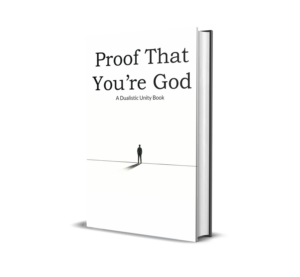
If this reflection resonated with you, continue exploring these ideas in Proof That You’re God, where we examine identity, awareness, and the stories that shape the way we experience ourselves and the world. Rather than encouraging you to replace one identity with another, the book invites you to discover what remains present beneath every label you’ve ever worn.
You’re also invited to join our Patreon community for our live Sunday group call at 11:00 AM PST, where we explore these questions together through open conversation. Sometimes the greatest freedom doesn’t come from finding a better identity—it comes from realizing that life has always been larger than the story you were trying to fit inside.