
One of the most fascinating questions people ask when their beliefs begin to wobble is this:
“If I make up my own reality, how do I know that you’re real and I didn’t make you up?”
At first glance, it sounds like a profound philosophical challenge. It points toward solipsism, the idea that only your own mind can be known to exist. Philosophers have debated versions of this idea for centuries. René Descartes questioned everything he could doubt in search of certainty, while later philosophers explored whether we can ever truly prove that other minds exist. These questions remain intellectually interesting, but notice when this particular question usually appears in everyday conversation. It rarely arrives out of simple curiosity. More often, it surfaces precisely when another belief is being questioned.
Someone begins examining the stories they tell themselves about identity, religion, politics, relationships, or meaning. As familiar assumptions loosen, the mind suddenly leaps to an extreme possibility: What if none of this is real? The shift is revealing because the original conversation often wasn’t about whether reality exists at all. It was about a specific belief. Instead of examining that belief more closely, attention moves toward an impossible question that cannot be conclusively answered. The discussion changes from exploring one assumption to questioning every assumption simultaneously.
The Escape Into Infinite Doubt
Psychologists have long recognized that uncertainty creates discomfort. Research in cognitive psychology shows that people generally prefer a stable explanation over endless ambiguity because predictable mental models help us navigate everyday life. This tendency is sometimes called the need for cognitive closure, a well-documented motivation to reach firm conclusions and avoid prolonged uncertainty.
When deeply held beliefs begin to crack, that discomfort becomes difficult to ignore. One response is genuine curiosity, allowing uncertainty to reveal something new. Another response is to ask a question that has no practical endpoint. “If I can’t prove you’re real, why should I question anything else?” At that point, the conversation enters a loop where no evidence can settle the matter because every observation can simply be dismissed as part of the imagined reality. The question becomes less about discovery and more about postponing the discomfort of letting a familiar belief change.
What Would the Answer Actually Change?
Imagine, for a moment, that someone could somehow prove every person around you is independently real. What changes tomorrow morning? You would still wake up, eat breakfast, experience joy, grief, embarrassment, excitement, love, frustration, and wonder. Now imagine the opposite. Suppose someone somehow proved that everything around you was generated by your own consciousness. Again, what changes tomorrow morning? You would still wake up and navigate your experiences. Your choices would still have consequences, kindness would still strengthen relationships, and carelessness would still create suffering. Whatever conclusion you reached about the ultimate nature of reality, the experience of living would continue demanding your participation.
The deeper question is not whether reality originated inside or outside your mind. The deeper question is why the answer feels so essential in the first place. If your daily experience remains fundamentally the same, what exactly are you hoping certainty will provide?
Life Doesn’t Wait for Philosophy
Another detail often goes unnoticed. When someone asks whether everyone else is real, nothing around them actually changes. The room doesn’t vanish, friends don’t evaporate, gravity continues doing its job, and the conversation carries on uninterrupted. The coffee still tastes like coffee, the dog still wants attention, and tomorrow’s responsibilities still arrive whether you’ve solved consciousness or not.
None of this proves that reality is objective, subjective, or something beyond either category. It simply reveals that life continues unfolding while we wrestle with these questions. Experience does not pause until philosophy catches up.
We Already Live Without Absolute Certainty
It’s easy to assume that certainty comes first and living comes second, but our lives suggest the opposite. You cannot mathematically prove another person loves you, nor can you demonstrate that your closest friend experiences consciousness exactly as you do. Even your own memories are imperfect reconstructions rather than flawless recordings. Yet none of that prevents you from building relationships, extending trust, forgiving others, or continuing to grow.
Science itself reflects this humility. Scientific knowledge is built not on absolute proof but on evidence that remains open to revision as better information becomes available. Everyday life works much the same way. We move forward with reasonable confidence while accepting that complete certainty may always remain beyond our reach. Absolute certainty has never been a prerequisite for participating in life. It has only ever been a desire.
The Search for Ground
Human beings naturally search for stable ground beneath uncertainty. Some find it in religion, others in science, political ideologies, personal identities, or spiritual philosophies. Another way of looking at this is that even radical skepticism can become another form of certainty. “Nothing can be known” may sound like the rejection of belief, but it can become just as fixed as any other worldview.
The difficulty begins when certainty itself becomes more valuable than understanding. Instead of allowing uncertainty to expand our perspective, we rush to replace one fixed story with another. Whether we cling to the belief that everything is unquestionably real or the belief that everything is unquestionably imagined, the mind often achieves the same goal: escaping uncertainty as quickly as possible.
Living Before Knowing
Children don’t wait until they’ve solved consciousness before playing with friends. Parents don’t pause to verify objective reality before comforting their children. Musicians don’t need a complete theory of awareness before being moved by a song. Love rarely begins with philosophical certainty. It begins with participation.
Over time, life teaches us that many of our most meaningful experiences arrive before we can fully explain them. Music moves us before we understand neuroscience. Beauty captures our attention before we define aesthetics. Friendship changes us long before we can explain consciousness itself. Living comes first. Explanation follows.
The Question Behind the Question
It may be that the real question isn’t, “Did I make up reality?” It may be something much more personal: “Can I trust myself if I stop clinging to certainty?”
That question reaches far deeper than philosophy. If the beliefs you’ve inherited begin falling away, who are you without them? If your worldview changes, do you disappear, or do you simply become available to see more than you could before? The fear often isn’t that reality will collapse. The fear is that our identity might.
Appreciating Life Without Solving It
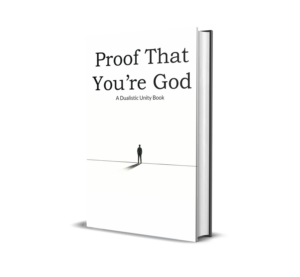
One of the central themes explored throughout Proof That You’re God is that experience itself deserves our attention more than our conclusions about where it came from. Whether another person is independently real or inseparable from the larger reality you participate in, your encounter with them still matters. Their laughter still affects you, their suffering still invites compassion, their ideas still challenge your assumptions, and their presence still shapes your life.
You don’t need a final answer about the origin of existence to appreciate existence itself. You don’t need certainty about consciousness before choosing kindness, and you don’t need to solve reality before participating in it. The search for proof can become so consuming that we overlook the very thing we were trying to understand all along: this moment, this conversation, and this extraordinary opportunity to be alive.
Instead of asking whether everyone else is real enough to matter, another question quietly waits beneath it:
Are you present enough to notice that they already do?
Continue the Exploration
If this article resonated with you, Proof That You’re God explores these questions in much greater depth, examining identity, awareness, certainty, and what it means to live fully without clinging to fixed beliefs. Rather than offering another system to believe, the book invites you into a deeper relationship with your own direct experience and the mystery of being alive.
You’re also invited to join our Patreon community discussion this Sunday at 11:00 AM PST. Together, we explore questions like these in an open, thoughtful conversation where curiosity matters more than certainty and where every perspective is welcomed. Whether you arrive with answers, doubts, or simply a willingness to look more deeply, we’d love to continue the exploration with you.