
One of the greatest misunderstandings about letting go is believing it means giving up.
For many people, the phrase itself triggers a frightening image. If I let go, I’ll stop caring. I’ll become irresponsible. I’ll lose my ambition. I’ll get fired. I’ll fall behind. I’ll disappoint people. I’ll become homeless. I’ll fail.
The mind quickly fills in the rest of the story.
If I stop clenching, everything will fall apart.
This fear runs surprisingly deep because it isn’t simply about work or money. It touches something even more fundamental: our belief about what keeps us safe.
Many of us quietly assume that stress is protecting us.
The deeper question is whether it actually is.
We Confuse Tension with Responsibility
Imagine two people preparing for an important job interview.
One spends the night rehearsing every possible question, sleeping poorly, catastrophizing every possible outcome, and arriving exhausted. The other prepares thoroughly, gets a full night’s sleep, and walks into the interview rested, attentive, and fully present.
Who was more responsible?
From the outside, both prepared.
The difference is that one confused internal tension with external effort.
This confusion follows many of us throughout life. We begin believing that worrying is evidence of caring, that anxiety proves commitment, and that relaxing somehow signals laziness. Over time, our nervous system learns to associate chronic stress with responsibility itself.
Yet these are not the same thing.
Preparing for tomorrow and suffering through tonight are two entirely different activities.
Why Holding On Feels Safer
Our minds evolved to anticipate danger.
From an evolutionary perspective, noticing potential threats before they happened increased the chances of survival. The brain became remarkably good at imagining what could go wrong because failing to notice genuine danger sometimes carried enormous consequences.
Today, that same ability often turns inward.
Instead of scanning for predators, we scan for mistakes.
Instead of watching for storms, we anticipate rejection.
Instead of preparing for famine, we worry about losing our careers, disappointing our families, or falling behind everyone else.
The problem is not that the brain predicts.
The problem is that it struggles to distinguish between useful preparation and endless mental rehearsal.
Holding on feels safer because the mind mistakes constant vigilance for control.
The Illusion of Control
It is easy to believe that our worrying is what keeps our lives together.
“If I stop thinking about work, I’ll make mistakes.”
“If I stop stressing about money, I’ll become irresponsible.”
“If I relax, I’ll lose my motivation.”
Notice the hidden assumption in every one of these thoughts.
It assumes that your stress is doing the work.
But is it?
Think about everything you’ve accomplished in your life. Learning to drive. Building relationships. Developing skills. Solving problems. Navigating loss. Finding new opportunities.
Were these accomplishments created by anxiety?
Or were they created by your ability to learn, adapt, practice, communicate, and respond to changing circumstances?
Stress may have accompanied many of those moments.
That doesn’t mean it caused them.
We often mistake the passenger for the driver.
You Already Trust Yourself More Than You Realize
Consider how much uncertainty you’ve already survived.
Every job you’ve accepted was once unfamiliar.
Every meaningful friendship began with uncertainty.
Every difficult conversation carried risk.
Every challenge you’ve overcome once looked impossible from a distance.
The person reading these words has already lived through thousands of moments they couldn’t predict.
You adapted.
Not because you controlled every outcome.
Because you responded to what actually happened.
This is a different kind of trust.
It is not trust that life will always unfold according to your plans.
It is trust that you will continue learning, adapting, asking for help when needed, and discovering possibilities that cannot be seen from where you currently stand.
Letting Go Doesn’t Mean Letting Life Happen to You
One of the biggest misconceptions about letting go is that it means becoming passive.
It doesn’t.
You can still update your résumé.
You can still attend job interviews.
You can still save money, study, exercise, apologize, negotiate, plan for retirement, or work toward your goals.
The external actions remain.
What changes is the internal relationship with those actions.
Instead of acting from panic, you begin acting from presence.
Instead of trying to guarantee an outcome, you participate as fully as you can while accepting that no one controls every variable.
This isn’t giving up responsibility.
It is giving up the impossible responsibility of controlling reality itself.
The Fear Beneath the Fear
When people imagine letting go leading to homelessness or failure, the fear often isn’t really about losing a job.
It is about losing identity.
Many of us have quietly built our sense of worth around being productive, dependable, successful, or needed. If those identities were threatened, it can feel as though we ourselves are disappearing.
The psychological story quickly becomes absolute.
“If I fail at work, I am a failure.”
“If I lose this relationship, I am unlovable.”
“If I lose this income, I have no value.”
What often goes unnoticed is that these conclusions are not facts.
They are stories attempting to create certainty in uncertain situations.
You have always been more than your current role, your current salary, or your current circumstances.
Those things influence your life.
They do not define your existence.
The Cost of Never Letting Go
Ironically, many of us fear that letting go will destroy our lives while overlooking what constant tension is already doing.
Chronic stress is associated with increased risk for cardiovascular disease, anxiety, depression, sleep disruption, impaired immune function, and burnout. It narrows attention, reduces creativity, and makes flexible problem-solving more difficult. The very mental state we believe is protecting us often leaves us less capable of responding wisely when challenges actually arise.
Holding on is not free.
It asks us to pay with our peace.
Over time, that becomes an extraordinarily expensive bargain.
Trust Is Not Blind Optimism
Trust is often misunderstood as believing everything will work out exactly the way we hope.
Life offers no such guarantee.
People lose jobs.
Relationships end.
Unexpected illness happens.
Economies change.
Plans fail.
Trust is something quieter than optimism.
It is the recognition that whatever arrives, you will meet it with the same human capacities that have carried you this far: curiosity, resilience, creativity, learning, courage, and connection.
You are not trusting that uncertainty will disappear.
You are trusting that you are larger than the stories uncertainty creates.
The Life You’re Trying to Protect
Notice the paradox.
Many of us spend years protecting ourselves from imagined futures that never arrive while sacrificing the only life that is actually unfolding.
We postpone rest until everything feels secure.
We postpone joy until every goal is accomplished.
We postpone peace until uncertainty disappears.
That day never comes.
Life keeps asking us to participate now, not after we’ve solved existence.
The irony is that the person who believes they cannot let go because everything depends on them is already demonstrating something remarkable. They believe they possess enough power to hold reality together through worry alone. Yet the evidence of everyday life points somewhere else. The sun rises whether we worry or not. Seasons change without our permission. Other people make choices we cannot control. Our hearts continue beating while we sleep.
Life has always been moving with us, not because of us.
Letting Go Is Trusting Your Capacity to Meet Life
Perhaps letting go is not releasing your responsibilities.
It is releasing the belief that your anxiety is what fulfills them.
You are still free to work hard.
Still free to save money.
Still free to plan wisely.
Still free to care deeply about your family, your future, and your goals.
The difference is that these actions no longer have to be fueled by fear.
They can arise from clarity instead.
From presence.
From the quiet confidence that you have navigated uncertainty before and will continue to do so again.
You do not need to become careless in order to become peaceful.
You do not need to abandon responsibility in order to release unnecessary suffering.
And you do not need to earn the right to let go.
You already possess everything required to meet this moment.
The same life that has carried you through every uncertainty you’ve ever survived is still carrying you now.
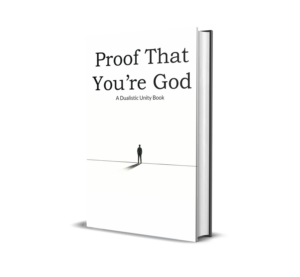
If this reflection resonates with you, we invite you to continue exploring the relationship between identity, control, awareness, and trust in our book, Proof That You’re God. Rather than offering another system to control life, it explores a different possibility: that peace does not come from finally mastering uncertainty, but from recognizing the deeper intelligence that has always been living through you. When we stop trying to carry the whole world on our shoulders, we often discover that life has never asked us to.