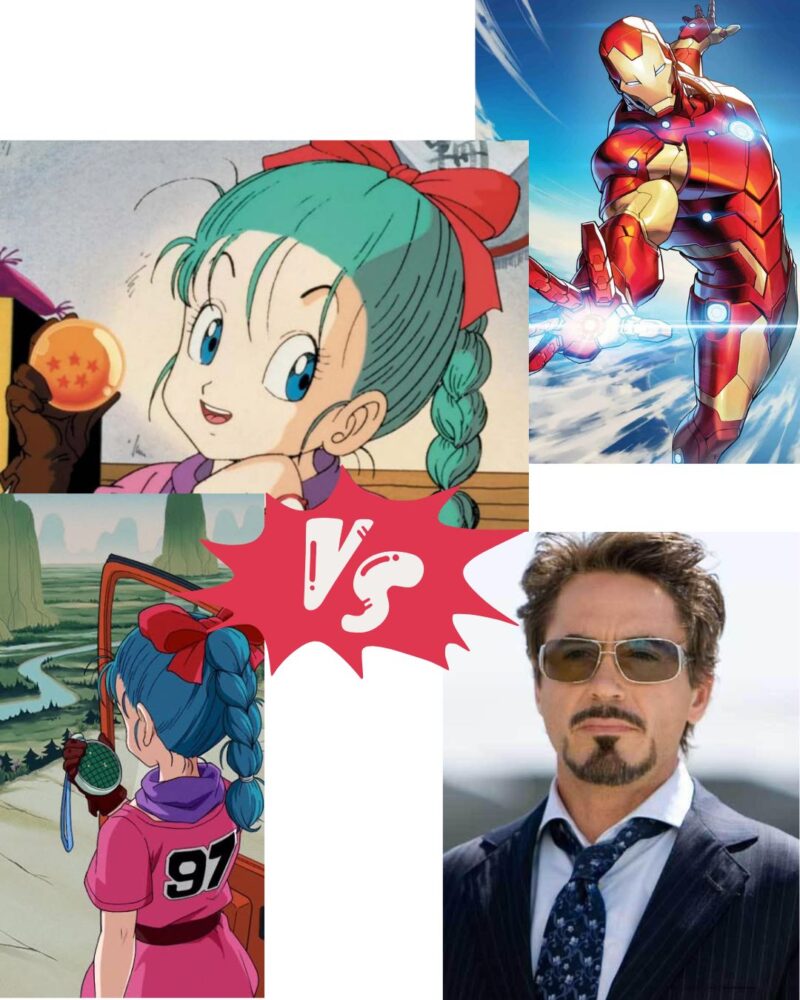
Comic books and anime are full of brilliant minds, but few debates are as surprisingly difficult as this one.
Who is actually smarter: Bulma from Dragon Ball or Tony Stark from Iron Man and The Avengers?
The internet has argued this question for years, and the answer often depends on what someone values most. Fans of Tony Stark point to the Iron Man suits, artificial intelligence, nanotechnology, clean energy breakthroughs, and perhaps most famously, his solution to quantum time travel in Avengers: Endgame. Bulma supporters respond with an equally staggering list of accomplishments that spans multiple alien civilizations, advanced robotics, interstellar engineering, and one of fiction’s most impressive inventions: a fully functional time machine.
The deeper question is not simply who built cooler gadgets. It is how we measure intelligence in the first place.
Tony Stark: The Ultimate Engineer
Tony Stark is undoubtedly one of Marvel’s greatest scientific minds. He combines physics, engineering, computer science, materials science, artificial intelligence, and business leadership into one remarkably capable individual.
Among his greatest achievements are:
- Building the first Iron Man suit while imprisoned with limited resources.
- Creating increasingly sophisticated powered armor systems.
- Developing nanotechnology armor capable of assembling almost instantly.
- Creating highly advanced AI systems such as JARVIS and later FRIDAY.
- Making breakthroughs in clean energy through the Arc Reactor.
- Solving the navigation problem required for quantum time travel in Avengers: Endgame.
That final accomplishment deserves special attention because it is frequently used as the strongest evidence that Tony surpasses nearly every fictional scientist.
However, context matters.
Tony did not wake up one morning and independently decide that time travel through the Quantum Realm was possible. Scott Lang returned from the Quantum Realm after experiencing only a few hours while several years had passed on Earth. Scott proposed that time functions differently there and suggested the possibility of using that difference to travel through time. Tony initially rejected the idea before later investigating it himself.
Tony’s breakthrough was extraordinary because he solved the mathematical and engineering problem of navigating the Quantum Realm safely. Without his algorithm, the mission could not have succeeded.
But Scott Lang supplied the initial insight.
That distinction may seem small, yet it changes how we evaluate the achievement. Tony perfected an idea that already existed rather than discovering the possibility entirely on his own.
That is still an astonishing accomplishment.
It simply isn’t the whole story.
Bulma Began Making Scientific Breakthroughs as a Teenager
Bulma’s résumé is almost unbelievable when you stop to examine it.
Before most teenagers finish high school, Bulma had already invented the Dragon Radar.
This wasn’t merely a GPS device.
The Dragon Balls are mystical artifacts scattered across an entire planet, emitting unique energy signatures that nobody had successfully tracked scientifically. Bulma designed, built, and calibrated a device capable of detecting and locating them despite having no confirmed proof they even existed when she began developing it.
Nobody appears to have handed her the idea.
Nobody gave her existing blueprints.
Nobody demonstrated that the problem could even be solved.
She simply believed it might be possible and invented the technology herself.
That achievement alone would place her among the greatest inventors in most fictional universes.
Reverse Engineering the Universe
One pattern appears repeatedly throughout Dragon Ball.
Whenever impossible alien technology appears, Bulma figures it out.
She successfully reverse engineered Saiyan battle armor despite it originating from an extraterrestrial civilization.
She decrypted alien Scouter technology after encountering devices unlike anything ever developed on Earth.
She repaired and reconstructed Frieza Force spacecraft that represented generations of engineering beyond human civilization.
She routinely adapts technologies created by completely different species, each presumably operating under different scientific assumptions and engineering standards.
In the real world, reverse engineering advanced human technology is already enormously difficult.
Reverse engineering equipment built by entirely different civilizations would be exponentially harder.
Bulma treats it like another Tuesday at Capsule Corporation.
Matching Dr. Gero
One of Bulma’s most overlooked accomplishments involves Androids 17 and 18.
Dr. Gero dedicated decades of his life to robotics, cybernetics, artificial intelligence, energy systems, and biological engineering to create some of the most powerful androids ever imagined.
Bulma eventually designed a remote control capable of shutting them down.
Although the remote itself originated from Dr. Gero’s lab in the original story, Bulma repeatedly demonstrates an ability to analyze, repair, modify, and understand his Android technology at a level comparable to its creator. Later in the series, she also works extensively with Android 16’s systems and continues solving engineering problems involving technology far beyond contemporary Earth science.
Consider what this implies.
She isn’t merely operating advanced machines.
She understands them.
Understanding another genius’s life’s work well enough to repair, adapt, and improve it is itself a remarkable measure of intelligence.
Then She Invented Time Travel
This may be Bulma’s strongest argument.
Unlike Tony Stark, Bulma did not use Infinity Stones.
She did not rely on a Quantum Tunnel.
She did not borrow technology developed by another civilization.
She invented an actual functioning time machine.
Future Bulma developed the technology under catastrophic conditions after most of humanity had already been destroyed by the Androids. Resources were scarce. Friends were gone. Civilization had largely collapsed.
Despite those conditions, she built a machine capable of traveling through time itself.
Even more fascinating is the narrative paradox.
She left notes, research, and guidance for earlier versions of herself, allowing knowledge to move across timelines and improving future scientific development through information created by…future Bulma.
It becomes a loop where Bulma is simultaneously teacher and student.
Science fiction rarely explores intelligence in quite this way.
Breadth Versus Specialization
Another way of looking at this debate is through versatility.
Tony Stark is unquestionably one of Marvel’s greatest engineers.
Bulma appears to excel across nearly every scientific discipline she encounters.
Throughout Dragon Ball, she demonstrates mastery of mechanical engineering, electrical engineering, computer science, aerospace engineering, robotics, physics, chemistry, mathematics, materials science, communications technology, and advanced energy systems. Whenever the story requires a technological breakthrough, Bulma is almost always capable of producing one regardless of the field.
She rarely needs years of study before making progress.
She simply learns.
Then invents.
Intelligence Is More Than Cool Gadgets
This debate also reveals something interesting about how audiences judge intelligence.
Tony’s brilliance is highly visible.
The Iron Man suits fly through the sky.
Nanotechnology unfolds dramatically on screen.
His inventions are weapons, armor, and spectacular displays of engineering.
Bulma’s work often happens quietly in laboratories.
She repairs.
Studies.
Calculates.
Designs.
Builds.
Many of her greatest accomplishments solve problems before anyone else even realizes those problems can be solved.
Visibility is not the same as intelligence.
Sometimes the quieter genius is simply easier to overlook.
So…Who Wins?
Reasonable people can disagree.
Tony Stark is unquestionably among fiction’s greatest inventors, and his ability to integrate engineering, artificial intelligence, and practical problem-solving under immense pressure is almost unmatched.
Yet when the accomplishments are viewed side by side, Bulma’s case becomes remarkably strong.
She invents groundbreaking technology from an earlier age. She repeatedly masters technologies originating from civilizations thousands of years beyond Earth’s development. She adapts across an astonishing range of scientific disciplines instead of remaining primarily within one domain. Most importantly, she independently creates a functioning time machine under conditions that would have made continued scientific research nearly impossible.
Tony solved one of history’s hardest engineering problems after Scott Lang introduced the possibility and with substantial computational assistance from his AI systems.
Bulma imagined possibilities that no one had demonstrated were real, then built the tools to prove herself right.
That difference may explain why so many fans ultimately place her at the top.
Of course, debates like this are part of the fun. Fictional universes operate under different rules, different technologies, and different storytelling priorities. Comparing them can never produce a definitive scientific answer.
But it can reveal something fascinating about ourselves.
We don’t just admire intelligence because of what it creates.
We admire the curiosity that refuses to accept that something is impossible.
Whether that curiosity belongs to Tony Stark in a workshop or Bulma in Capsule Corporation’s laboratory, it reminds us that every breakthrough begins with someone willing to ask a question nobody else thought to ask.
If you enjoy exploring questions that challenge assumptions—not only about fictional characters but about intelligence, identity, consciousness, and the way we understand ourselves—consider reading Proof That You’re God. Like the best thought experiments in science fiction, it invites readers to look beyond familiar answers and discover that the most interesting questions are often the ones hiding in plain sight.