
About twenty-five years ago, I went through a phase where I would sometimes introduce myself as God.
Not because I thought I was special.
Not because I believed I was the God.
It was usually said with a smile. Sometimes with humor. Sometimes with deliberate awkwardness. Occasionally with just enough seriousness to make people pause.
The point wasn’t the statement.
The point was what happened after it.
Making the Sacred Touchable
For most people, the word “God” arrives pre-loaded.
It’s heavy. Untouchable. Reverent. Protected.
Something you don’t say lightly. Something you don’t question. Something you don’t play with.
And yet, that very protection often turns the word into something distant — sealed off from direct experience.
By calling myself God, I wasn’t trying to elevate myself. I was trying to bring the word back into contact with life.
To make it obvious that it’s a word.
A symbol.
A pointer.
And like all pointers, it only works if it stays connected to what it’s pointing at.
This tension — between clarity and the way understanding slips through our fingers when we try to hold it too tightly — is part of the broader pattern explored in why clarity often feels harder the more we understand.
The more sacred a word becomes, the easier it is to stop relating to it.
Why the Reaction Mattered More Than the Statement
The responses were always revealing.
Some people laughed immediately. They heard the humor.
Some people bristled. They felt offended or threatened.
Some people paused — unsure whether to take it seriously or not.
And that pause was the whole point.
Because in that pause, the word “God” loosened. It stopped functioning as a fixed object and started acting like a mirror.
What does this person think God is?
Why does this word feel dangerous here?
Why does it feel absurd there?
The reaction said far more than the statement ever could.
God as a Living Word
Words are not neutral containers. They’re relational.
A word only has meaning in relationship to the one using it.
When that relationship becomes rigid — when a word is frozen into doctrine, definition, or taboo — it stops doing what language is meant to do: mediate experience.
It becomes a relic.
This is why sacred words so often lose their power. Not because they were wrong, but because they were removed from lived inquiry.
A word without a living, changing relationship with the one using it becomes dead. And dead words can’t help us understand life — or our place in it.
“Yahweh” and the Refusal to Be Named
This isn’t a new insight.
In the Hebrew tradition, the divine name “Yahweh” is often understood not as a proper name at all, but as something closer to “I Am” — or even more accurately, the refusal to be defined.
It’s not a label.
It’s an evasion.
A way of saying: whatever you think this is, it isn’t that.
Similarly, in Taoism, the Tao Te Ching opens with a warning:
“The Tao that can be told is not the eternal Tao.”
Not because words are bad — but because fixing reality into language ends the relationship.
Both traditions, in their own way, are pointing at the same thing:
The ultimate cannot be held as an object without losing what makes it ultimate.
Why Saying “I Am God” Wasn’t a Claim
When I introduced myself as God, I wasn’t making a metaphysical assertion.
I wasn’t saying, “Believe this.”
I was saying: notice what this word does inside you.
If God is something distant, separate, and sacred, the statement feels blasphemous.
If God is something abstract and meaningless, the statement feels silly.
If God is something intimate, immediate, and alive, the statement feels… oddly obvious.
And that’s the uncomfortable edge.
Because if God points to the ultimate — to reality, infinity, what is — then excluding yourself from that reality starts to feel artificial.
Not because you are God.
But because nothing is outside what the word is pointing at.
When Words Replace Relationship
Religion often begins as a living inquiry.
But over time, the inquiry becomes a statement.
The statement becomes a belief.
The belief becomes an identity.
And once identity is involved, the word must be defended.
At that point, God is no longer a question.
God is an answer.
And answers, when they’re no longer allowed to breathe, stop being useful.
This isn’t a failure of religion.
It’s a human pattern.
We do the same thing with:
- “self”
- “meaning”
- “purpose”
- “truth”
We turn living questions into static positions — and then wonder why life feels flat.
Reality Doesn’t Need to Be Protected
One of the reasons the statement “I am God” can feel so threatening is that it seems to diminish something sacred.
But if what the word is pointing at is truly infinite, it doesn’t need protection.
Reality doesn’t get smaller because it’s spoken casually.
Infinity doesn’t shrink because it’s laughed at.
If anything, humor and irreverence can bring us closer — because they loosen the grip of certainty.
They remind us that we’re relating, not possessing.
The Difference Between Saying and Seeing
Eventually, I stopped introducing myself that way.
Not because it was wrong — but because the work it was doing had already been done, internally.
The point was never to say the words out loud.
The point was to notice what happens when the boundary between the sacred and the ordinary softens.
When “God” stops being a noun and starts behaving more like a verb.
When the ultimate isn’t somewhere else, but what’s happening now.
At that point, the words matter less.
The relationship matters more.
An Invitation Back to the Question
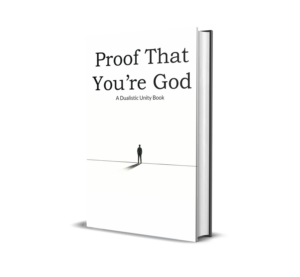
Proof That You’re God was written from within this same tension — not to redefine God, and not to replace religion with philosophy, but to explore what becomes possible when sacred words are allowed to point again, rather than conclude.
If this reflection resonates, you may find Proof That You’re God meaningful. Not as a claim about who you are, but as an invitation to restore a living relationship with the words we use to describe what can’t be captured — but can be lived.