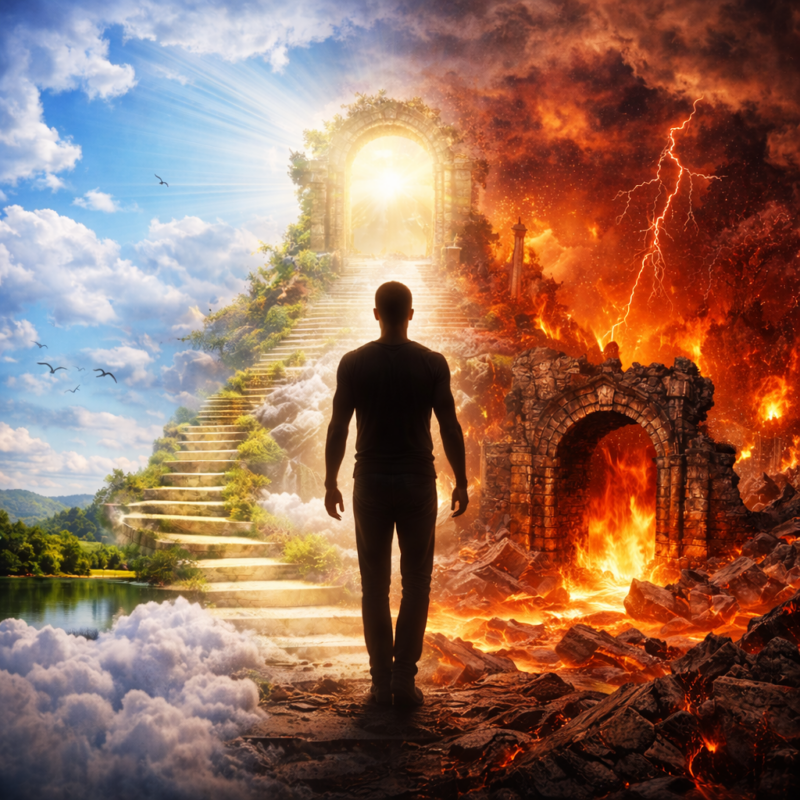
For most of human history, Heaven and Hell have been treated as destinations—reward and punishment deferred until after death. For many people encountering these ideas today, the question remains simple and sincere: Are Heaven and Hell real? Entire moral frameworks have been built around the hope of reaching one and the fear of avoiding the other. Yet despite centuries of belief, humanity has not grown more peaceful, more unified, or more at ease with itself. If anything, anxiety about salvation and judgment has intensified our sense of separation.
What if Heaven and Hell were never meant to describe where we go, but how we are responding to life—right now?
This reframing does not dismiss spiritual tradition—it completes it. Heaven and Hell describe very real, lived experiences available in every moment: the felt difference between selflessness and selfishness, connection and separation, being and resistance. They are not future states imposed upon us, but present realities generated through our relationship with what is.
Heaven and Hell Are Not Places
For someone unfamiliar with contemplative or non-dual language, this reframing can feel unsettling. If Heaven is imagined as a place without suffering, conflict, or lack, it can quietly begin to resemble something sterile—a static perfection where empathy, creativity, and growth have no reason to exist. A place where nothing hurts, but nothing truly matters either.
When we look closely at our own experience, Heaven and Hell are already familiar.
- Heaven is the sense of openness when nothing is being defended.
- Hell is the contraction that arises when life is judged, resisted, or feared.
Both happen without any change in external circumstances. The same relationship, the same job, the same world can feel radically different depending on whether reality is being accepted or opposed.
This is why Heaven and Hell make sense psychologically, emotionally, and spiritually. They are responses, not locations.
Sin as Missing Reality
The word sin has accumulated centuries of moral weight, but its original meaning was far simpler: to miss the mark. Not moral failure—misalignment. Missing what is actually happening.
When reality is resisted—when the present moment is denied, judged, or postponed—the mark is missed. Life is no longer met directly. This resistance fragments experience, producing the inner sense of conflict we call suffering.
In Proof That You’re God, this misunderstanding is described clearly:
“Suffering isn’t caused by life—it’s caused by resisting what life is already doing.”
Hell is not punishment for missing the mark. Hell is the experience of missing it.
Heaven: God Is Always Present
In Heaven, God is not distant, pleased, or displeased. God is simply present.
This presence is not earned. It is not granted as a reward for correct belief or moral effort. It is what remains when self-rejection ends.
Heaven is the lived experience of self-acceptance—not as a positive self-image, but as the absence of inner opposition. Nothing needs to be fixed before being allowed. Nothing must be justified to exist.
In this sense, Heaven is not special. It is ordinary life, undivided.
Hell: When God Appears as Judge
In Hell, God seems absent—or worse, condemning. Yet nothing has changed except perception.
Judgment does not come from God; it arises from the mind judging itself. That judgment is then projected outward—onto other people, circumstances, and even reality itself.
When the inner courtroom is active, everything becomes evidence. Life feels hostile. God feels watchful. Existence feels conditional.
This dynamic is captured in the famous line attributed to the devil: “I’d rather reign in Hell than serve in Heaven.”
Control feels safer than surrender. Identity feels preferable to openness. To reign is to maintain authorship over the story—to decide who is right, who is wrong, and who we are within it. But this reign is Hell itself.
Serving Heaven, by contrast, does not mean submission to authority. It means participation with reality rather than opposition to it. Service here is not subservience—it is alignment. A state of being with life instead of against it.
Hell is what it feels like to live under constant self-evaluation.
The Cruel Irony of Afterlife Fixation
Ironically, fearing Hell or striving for Heaven in the afterlife creates the very experience one hopes to avoid.
- Fear of punishment rejects the present moment.
- Striving for reward postpones wholeness.
Both say: This isn’t it yet.
That postponement is the maintenance of Hell.
This is also where belief-based images of the afterlife can quietly keep the whole thing abstract. When Heaven and Hell are treated primarily as explanations—ideas to hold reality still long enough to feel oriented—we can miss the lived experience they’re pointing to. That dynamic is the same one explored in Why Clarity Often Feels Harder the More We Understand: how interpretation can step in so quickly that direct contact with experience gets filtered out. when eternity is misunderstood as a future achievement, the present moment becomes intolerable. Time itself becomes the prison.
The Cost of Waiting to Be God
Another layer of Hell hides inside identity itself.
Hell is not just suffering—it is the belief that we are the identity we are attached to, that the perception we are currently inhabiting is all there is and all there will ever be. The story feels final. The role feels absolute. The self feels trapped inside its own narration.
From within that belief, fighting becomes inevitable. The identity must be defended. The story must be justified. And the more it is fought for, the more fighting seems required. Resistance multiplies itself.
This is why Hell feels endless while it is happening.
Eventually, something gives. Not because the story is resolved, but because it is seen through. What lets go is not life—but the belief that the story is life.
This release is often named in spiritual language as God’s forgiveness. Not because something was wrong, but because something false is no longer being held against reality. When the story loosens, life feels newly granted—not changed, but unobstructed.
This is the moment Heaven quietly enters experience.
And something remarkable happens when even one person stops waiting to be what they already are.
A single person in Heaven changes the experience for everyone.
Presence is contagious. Acceptance alters relational space. The willingness to let go interrupts cycles of fear and projection. Heaven on Earth cannot happen anywhere else—because Earth is where resistance is occurring.
Faith as Letting Go
Faith, in this light, is not belief in an idea. It is the willingness to stop defending separation.
It is the quiet trust that nothing essential is missing, and nothing needs to be added before life can be met directly.
Heaven appears not through effort, but through the end of postponement.
Hell dissolves not through escape, but through the end of judgment.
Heaven and Hell Are Always Available
When it comes down to it, we have access to both extremes.
We are capable of being God and the Devil—not as literal beings, but as lived orientations toward reality. One dissolves separation. The other fortifies it. One moves with life. The other insists on ruling it.
This is not a cosmic battle happening elsewhere. It is an intimate, moment-by-moment possibility available to everyone. Each life becomes a personal chance to make Heaven or Hell—not later, not symbolically, but experientially.
And this is why the stakes feel so high.
Because the world is not separate from this choice. Relationships, cultures, and entire societies subtly reorganize themselves around how reality is being met. The world reflects—not as an abstract mirror, but as a lived consequence of our individual lives. The more presence, integrity, and selflessness there is in us, the more our societies organize around those qualities. The world catches up to what we are. It mirrors whether separation is being defended or whether there is a relaxation into being—an ease that naturally expresses itself as empathy, connection, and intelligence.
Heaven and Hell are not earned, avoided, or deserved.
They are embodied—either as openness or as resistance.
At every moment, reality is offering itself without condition. The question is not where we will go when we die, but how we are meeting life now.
To explore this understanding more deeply, and its implications for identity, suffering, and freedom, you can explore Proof That You’re God.