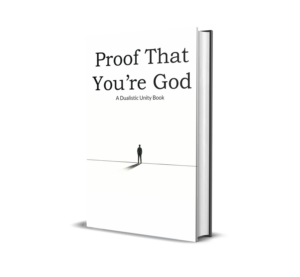
One of the most common reactions to the title of our book, Proof That You’re God, is immediate dismissal.
“If you’re God, create a planet.”
“Turn water into wine.”
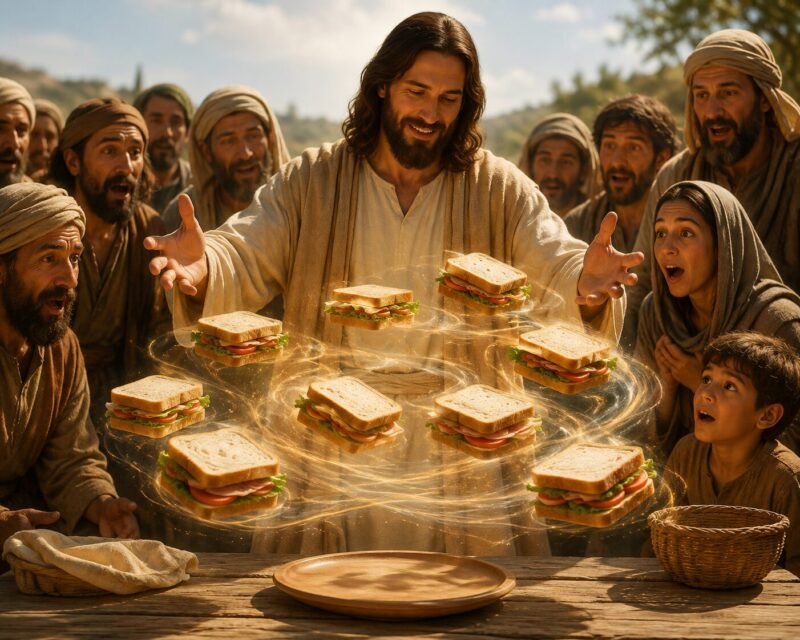
“Make a sandwich appear out of thin air.”
At first glance, these responses seem like clever challenges. They appear to expose an obvious contradiction. If someone claims to be God, shouldn’t they possess unlimited supernatural abilities? Yet the deeper question is why that assumption feels so obvious in the first place.
Notice what happens before the conversation has even begun. The word God already carries a very specific image for many people. It refers to an all-powerful being separate from humanity who creates universes, performs miracles, answers prayers, judges souls, and exists outside space and time. Once that definition is accepted, every other possibility becomes impossible by definition. The discussion ends before it has even started because the meaning of the word has already been decided.
The Challenge Assumes a Particular Definition
When someone says, “If you’re God, make a sandwich appear out of thin air,” they are not actually investigating the claim being presented. Instead, they are comparing it to a definition they already hold.
Imagine telling someone that consciousness is fundamental to reality, and they reply, “If consciousness is fundamental, why doesn’t it shoot lasers?” The response doesn’t address the idea being discussed. It substitutes an entirely different concept and then argues against that instead.
The same thing often happens with the title Proof That You’re God. Our book is not arguing that every human being secretly possesses comic-book superpowers. It is not claiming you can suspend gravity, teleport across galaxies, or summon lunch with your thoughts. The criticism often attacks a claim that was never made because the title is interpreted through an inherited definition rather than the ideas the book actually explores.
Why a Sandwich?
Consider the example itself. Why is creating a sandwich out of thin air considered the ultimate test? Has anyone ever witnessed sandwiches regularly materializing from empty space? Have planets been appearing spontaneously in front of crowds throughout recorded history?
The answer is no.
Interestingly, even within Christianity, these are not ordinary expectations. Christians generally do not expect God to create planets every Tuesday afternoon or produce sandwiches on command. Miracles are understood as extraordinary events, not everyday demonstrations designed to settle internet debates. So why is this impossible demonstration treated as the standard by which every idea about God should be judged?
It may be because the challenge is not really about sandwiches at all. It is about preserving a familiar picture of God. If that picture remains unquestioned, then any alternative understanding can be dismissed before it is even heard.
The God We Inherit
Every culture inherits stories about reality. Some inherit many gods, some inherit spirits or ancestors, while others inherit a single Creator existing beyond the universe. These stories become so familiar that they stop feeling like interpretations and begin feeling like reality itself.
When someone hears the word God, they rarely encounter it as a blank canvas. They encounter thousands of years of theology, paintings, sermons, children’s stories, films, traditions, and family beliefs condensed into a single word. By adulthood, the definition often feels so natural that questioning it can feel like questioning reality itself.
The difficulty begins when someone uses the same word differently. People may think they are debating evidence when, in reality, they are debating definitions.
Another Way of Looking at “God”
The title Proof That You’re God invites readers to entertain a radically different possibility. Not that you are an individual human secretly capable of unlimited magic, nor that your personality is the supreme ruler of the universe. Instead, it asks whether our sense of being completely separate from existence deserves closer examination.
Consider the possibility that existence is not divided into isolated pieces as completely as we imagine. Every human being, every animal, every tree, every star, and every atom exists within one unfolding reality. We give names to different parts of that reality because names help us communicate, but naming something does not necessarily separate it from the whole.
A wave has a recognizable shape and can be distinguished from the ocean, yet no one imagines the wave exists independently of the water beneath it. Another way of looking at this is to ask whether human beings relate to existence in a similar way. We appear distinct, yet we remain expressions of the same reality that gives rise to everything else.
That is the direction our title points.
We Already Participate in Creation
One of the great ironies of this conversation is that human beings create extraordinary things every single day. Not from absolute nothingness, but through transformation.
Every meal begins with sunlight, soil, water, seeds, microorganisms, and countless living systems interacting over time. Every building begins as trees, metals, stone, and human cooperation. Every scientific breakthrough, every piece of music, every friendship, every language, and every civilization emerges through relationships unfolding across generations.
Nothing appears from absolute nothingness.
Everything changes form.
Human creativity has always involved participating in those transformations rather than creating reality from outside it. When people demand instantaneous creation from nothing as proof of divinity, they often overlook the astonishing creativity already happening everywhere around them.
Why Is It Easier to Imagine One God Than All of Us?
The deeper question is not whether one person can create a sandwich from thin air. The deeper question is why it feels more believable that one invisible being outside the universe created everything than that existence itself expresses itself through everything.
Neither position can currently be demonstrated through empirical science. Both involve philosophical assumptions about the nature of reality, consciousness, and existence. One imagines God as separate from creation. The other understands creation and the divine as inseparable aspects of the same reality.
Throughout history, traditions such as Advaita Vedanta, certain schools of Buddhism, Taoism, Neoplatonism, Stoicism, Indigenous spiritual traditions, and forms of Christian mysticism have explored ideas that blur the line between humanity and the sacred. Although these traditions differ in significant ways, many challenge the assumption that God must exist only as a distant supernatural individual entirely separate from the world.
This conversation is much older than social media.
Fear of the Word
It is easy to assume resistance comes from evidence alone. What often goes unnoticed is how much of that resistance begins with language itself.
If the book had been titled Proof That You’re Part of Reality, many readers would likely approach it with curiosity. If it were called Proof That Consciousness Is Connected, fewer people might react emotionally. Replace those words with God, however, and centuries of inherited meaning arrive all at once.
The word itself becomes the obstacle.
That is precisely why we chose it. Not to provoke people for its own sake, but to reveal how much meaning we automatically attach to a single concept before we have even asked what the author intends by it. The immediate reaction often tells us more about the assumptions we already carry than it does about the ideas being presented.
The Invitation
Our title is not asking readers to believe they possess supernatural powers. It is asking them to question the assumptions hidden inside a single word.
Who decided that God must mean a separate being watching over the universe? Why is that definition treated as obvious while other understandings are dismissed without consideration? Why does the suggestion that existence itself could be sacred seem more difficult to entertain than the idea of an invisible being existing outside of it?
Whether someone ultimately agrees with our perspective is less important than their willingness to examine the assumptions they bring into the conversation. Real inquiry begins there—not by defending inherited definitions or replacing them with new ones, but by recognizing that our definitions are maps rather than reality itself.
Continue the Exploration
If the title Proof That You’re God immediately triggered agreement, disagreement, curiosity, or frustration, that reaction is itself worth exploring. The book is not an attempt to win an argument or replace one belief system with another. It is an invitation to investigate the assumptions we inherit about identity, God, consciousness, and existence, and to discover what remains when those assumptions are examined rather than simply defended.
If you’d like to continue the conversation, read Proof That You’re God and join us for our live Patreon discussion every Sunday at 11:00 AM PST. Together we explore philosophy, psychology, spirituality, science, and the human experience through thoughtful, open dialogue. Whether you arrive convinced, skeptical, religious, atheist, or simply curious, you’re welcome to investigate these questions with us.