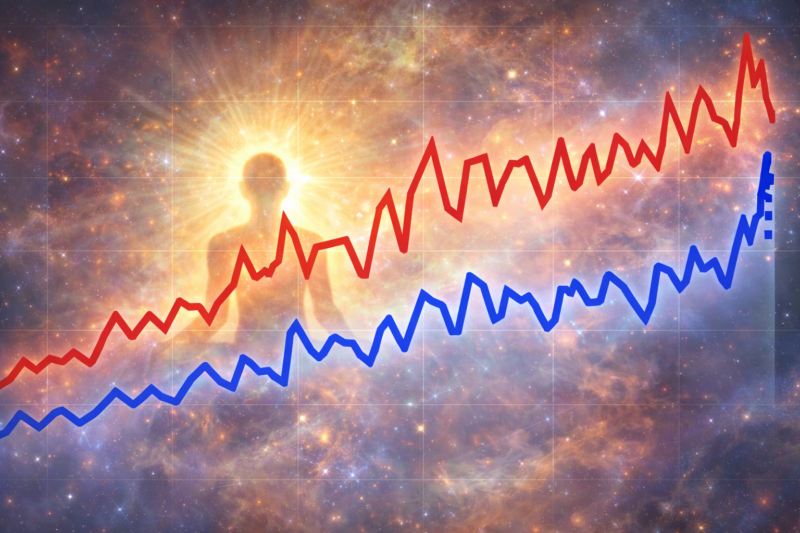
Over the past two decades, two questions have been quietly rising in online search behavior:
Are we God?
What is consciousness?
They appear in different places, among different people, and with very different tones. One sounds spiritual, even confrontational. The other sounds neutral, analytical, almost scientific.
At first glance, they seem to belong to opposite camps — theistic spirituality and scientific atheism.
But when you look at the data over time, something more interesting emerges. These questions are not appearing in sequence, and they are not competing explanations. They are parallel expressions of the same inquiry, emerging from different worldviews as inherited explanations begin to strain.
Their shared rise doesn’t point to a new belief system.
It points to a growing pressure on how we understand identity, agency, and reality itself.
One Question, Two Worldviews
When someone searches “Are we God?”, they are usually standing inside a theistic or spiritual worldview. God is already assumed to be real. The question isn’t whether there is something ultimate, but where it is located.
Is it separate from us?
Or is it closer than we were taught to believe?
When someone searches “What is consciousness?”, they are often standing inside a scientific, atheistic worldview. God is not part of the explanatory framework. Meaning is expected to arise from matter, biology, or systems—not divinity.
And yet something destabilizing is being noticed.
Awareness cannot be found as an object.
It cannot be stepped outside of.
And nothing is ever experienced without it.
Both questions arise when inherited explanations stop working.
One asks in religious language.
The other asks in empirical language.
But both circle the same tension:
the assumed separation between the observer and what is observed.
This is part of a broader pattern explored in why clarity often feels harder the more we understand—the more deeply reality is examined, the harder it becomes to locate a solid boundary between “self” and “world.”
Why These Questions Are Rising Together
What makes this moment distinct isn’t curiosity—it’s convergence.
People now have unprecedented access to:
- inner experience (through meditation, therapy, psychedelics, introspection)
- outer explanation (through neuroscience, physics, philosophy, and systems theory)
Historically, these domains were culturally separated. Today, they collide inside the same individual.
And when they collide, they strain the old models.
The spiritual worldview struggles to explain why the divine feels inseparable from ordinary awareness.
The atheistic worldview struggles to explain why awareness cannot be reduced to anything observable.
So the same pressure appears in different language:
- “Are we God?” — from within devotion, meaning, and inherited spirituality
- “What is consciousness?” — from within materialism, analysis, and disbelief
Different vocabularies.
Same fracture.
Identity Under Pressure
As these questions rise, something else intensifies alongside them: identity polarization.
This isn’t accidental.
When the foundations of identity begin to loosen—when the sense of being a separate, self-contained individual starts to feel unstable—the nervous system looks for certainty. And certainty is often found not in openness, but in stronger identification.
So while inquiry deepens privately, identity hardens publicly.
People cling more tightly to:
- political identity
- moral certainty
- spiritual labels
- scientific allegiance
- cultural tribes
This is why deeper existential questioning and sharper cultural division are happening at the same time. They are not opposites. They are responses to the same destabilization.
One response turns inward, toward inquiry.
The other turns outward, toward defense.
The Intuition Beneath Both Questions
What neither question states outright—but both are orbiting—is an intuition that resists easy framing:
That awareness is not something we have.
And not something we observe from the outside.
It is the condition of observing anything at all.
From a theistic lens, this feels like intimacy with what was once called God.
From an atheistic lens, it feels like an explanatory gap that refuses to close.
From either direction, the idea that reality is composed of separate, independently existing parts begins to feel inadequate.
Something more seamless starts to suggest itself.
Not a creator standing apart from creation.
Not randomness accidentally producing mind.
But reality as intelligence manifest—not intelligently designed, but intelligently expressed.
A single movement, appearing as many.
Infinite potential experienced as a shared world.
When Observer and Observed Blur
At a certain depth of inquiry, the distinction between observer and observed begins to feel conceptual rather than experiential.
There is seeing, but no clear boundary where “the seer” ends.
There is knowing, but nothing outside awareness that performs the knowing.
This isn’t a belief to adopt.
It’s an experiential impasse.
And it’s where both worldviews quietly converge when pushed far enough.
Spiritual language says, “God is everywhere.”
Atheistic language says, “Everything appears in consciousness.”
Different metaphors.
Same recognition pressing to be noticed.
Why This Is So Unsettling
The moment this recognition is put into language, it tends to fracture.
If framed spiritually, it can sound like ego inflation.
If framed atheistically, it can sound abstract or evasive.
If framed philosophically, it can feel disconnected from daily life.
So people retreat back into safer identities.
But the pressure doesn’t disappear.
Because the recognition isn’t asking to be believed.
It’s asking to be seen.
And seeing it doesn’t make anyone special.
It makes identity less central.
Which is precisely why it feels threatening in a world built on identity.
Convergence Without Agreement
What’s emerging now isn’t consensus.
It’s convergence.
Not everyone will use the same language.
Not everyone will interpret what they notice the same way.
And polarization may continue as long as identity is treated as something that must be defended.
But beneath the surface conflict, something quieter is happening:
More people are sensing that reality is not divided the way our concepts suggest.
That agency and intelligence are not located in isolated individuals.
That what we call “self” may be a perspective, not a partition.
This doesn’t erase difference.
It reframes it.
An Invitation to Stay With the Question
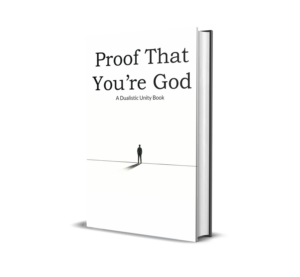
Proof That You’re God was written for this exact convergence point—not to reconcile spirituality and atheism, not to replace one worldview with another, but to remain with the lived tension where both begin to fail.
If this exploration resonates, you may find Proof That You’re God meaningful. Not as an answer to whether we are God or what consciousness is—but as a companion for noticing what remains when observer and observed no longer feel separate, and identity no longer needs to be held so tightly.