
built a public presence around clarity sharpened into opposition.
Clear lines.
Strong stances.
Arguments framed not as shared inquiry, but as contests to be won.
For many supporters, this felt grounding. In a world that feels unstable, confusing, and constantly shifting, his messaging offered certainty. It told people where to stand, who they were up against, and what counted as truth.
For critics, the same messaging felt provocative.
For the culture at large, it became another accelerant in an already overheated environment.
Charlie Kirk’s death shocked the public not only because it was tragic, but because — if we’re honest — it felt like a place we’ve been moving toward.
Not because of one man.
But because of the world we’ve been collectively building.
That broader pattern — the way discourse hardens, identities polarize, and emotional intensity replaces understanding — is explored more fully in our reflection on why the world feels so loud. Charlie Kirk didn’t create that pattern. But his life and death reveal it with uncomfortable clarity.
This article isn’t about blame.
It’s about mechanics.
Why Certainty Feels Like Safety
To understand Charlie Kirk’s impact, you have to understand why his messaging worked.
Certainty is calming.
When people feel overwhelmed — by cultural change, economic precarity, loss of trust in institutions, or a general sense that the future is unclear — the nervous system looks for stability. It looks for orientation. It looks for something that reduces ambiguity.
Messaging that offers clean answers does exactly that.
It simplifies.
It stabilizes.
It relieves anxiety.
This doesn’t require manipulation or malice. It’s simply how human psychology responds to uncertainty.
But certainty has a cost.
When Clarity Hardens Into Identity
At first, certainty is just a position.
Over time, it becomes something else.
Beliefs stop being tentative.
Opinions stop being flexible.
Arguments stop being about ideas.
They become about who you are.
When identity fuses with belief, disagreement stops being informational and starts feeling personal. Opposition feels threatening. Nuance feels like weakness. Listening feels dangerous.
This is how rhetoric escalates without anyone intending harm.
Once argument becomes identity, backing down feels like self-erasure.
Argument as Emotional Regulation
There’s another layer here that often goes unnoticed.
For many people, argument itself becomes regulating.
Debate provides adrenaline.
Outrage provides focus.
Conflict provides meaning.
In a fragmented world, antagonism offers coherence.
Charlie Kirk’s messaging didn’t just persuade intellectually — it organized emotion. It gave anger somewhere to go. It gave frustration a target. It converted anxiety into action.
This pattern isn’t unique to one ideology. It shows up anywhere conflict is rewarded and certainty is framed as strength.
But when cultures normalize this form of regulation, escalation stops being accidental.
It becomes structural.
The Environment This Creates
A culture that amplifies confrontation doesn’t need villains to produce consequences.
It only needs:
- platforms that reward engagement over understanding
- audiences conditioned to equate certainty with truth
- incentives that favor outrage over curiosity
Charlie Kirk operated effectively inside this ecosystem. He didn’t invent it — he learned how to speak its language fluently.
But environments don’t distinguish between intention and outcome.
They amplify patterns until something breaks.
When Rhetoric Meets Reality
Violence does not come from words alone.
But words shape emotional climates.
And emotional climates shape what feels thinkable.
When opponents are consistently framed as existential threats…
When disagreement is treated as moral failure…
When escalation is normalized and restraint is framed as weakness…
…the distance between enemy and person quietly erodes.
Most people never cross that line.
But some do.
And when they do, the outcome feels shocking — even though the conditions that made it possible have been visible for years.
Fear, Change, and the Search for Meaning
One reason this pattern keeps repeating is fear.
Periods of rapid social change destabilize identity. People feel unmoored. When the future feels uncertain, the mind looks for explanations — and for conflict that provides structure.
Certainty offers relief.
Opposition offers belonging.
But belonging built on antagonism is fragile. It requires constant reinforcement. The conflict has to stay sharp. The lines have to stay clear.
And the emotional cost keeps rising.
Collective Responsibility Without Condemnation
Acknowledging these dynamics doesn’t mean collapsing into moral judgment.
Charlie Kirk did not deserve to die.
No rhetoric justifies violence.
But cultures do shape outcomes. And the kinds of messages we reward matter — not morally, but mechanically.
The question isn’t who’s to blame.
It’s what kind of environment are we reinforcing — and what that environment reliably produces over time.
What This Moment Asks of Us
If Charlie Kirk’s death becomes just another data point in partisan storytelling, nothing changes.
But if it becomes a moment of reflection — about how we speak, what we reward, and how easily clarity hardens into certainty — then something else becomes possible.
Not agreement.
Not unity.
But de-escalation.
That begins with noticing when certainty is serving understanding — and when it’s serving fear.
Closing Reflection
“Those who live by the sword die by it” isn’t an accusation.
It’s an observation about systems.
Worlds built on antagonism don’t remain rhetorical forever. Eventually, consequences appear — not because anyone deserves them, but because the structure makes them increasingly likely.
Charlie Kirk’s death is not a verdict on his character.
It’s a mirror held up to a culture that has learned to mistake conflict for clarity and opposition for meaning.
Mirrors don’t accuse.
They show.
Invitation
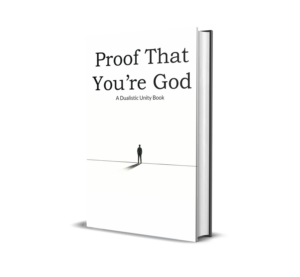
Proof That You’re God explores this same terrain beyond politics — how certainty forms under pressure, how identity hardens around fear, and how clarity becomes possible when we stop mistaking opposition for understanding. The book isn’t about taking sides, but about seeing the patterns we participate in before they escalate into outcomes no one wants.