
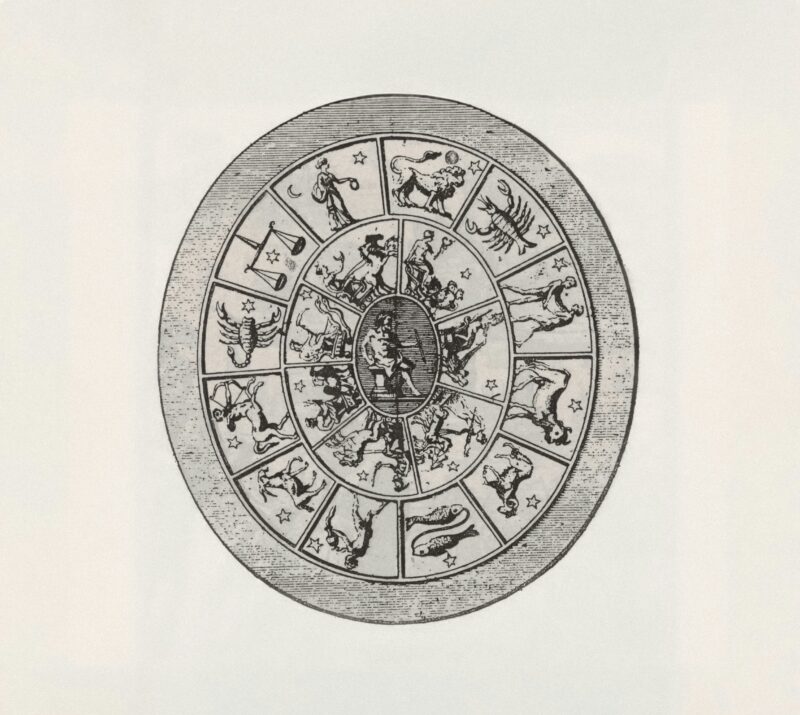
Long before gods had names, temples had walls, or doctrines had language, human beings looked upward.
The sky moved. The stars returned. The seasons repeated.
Against the chaos of early human life—hunger, weather, death, uncertainty—the heavens offered something rare: reliability. Patterns that did not care who you were. Movements that continued regardless of fear or desire. In that vast regularity, the human mind found not just wonder, but relief.
Astrology did not begin as superstition. It began as orientation.
And in that orientation, something subtle happened—something that would repeat throughout human history in countless forms. Meaning was no longer discovered within experience. It was located out there.
This is why astrology is sometimes described as the earliest form of idolatry—not because stars were worshipped, but because authority was projected outward.
Early in humanity’s search for meaning, this projection shows up again and again: when life feels unmanageable, certainty is externalized. That deeper pattern—why meaning so often feels just out of reach even when symbols feel compelling—is explored more fully in our hub article on why meaning often feels just out of reach.
What Idolatry Actually Is
Idolatry is often misunderstood as a religious error—worshipping the wrong object instead of the right one. But psychologically, idolatry has nothing to do with statues or rituals.
Idolatry happens when something symbolic replaces direct relationship.
An idol is not an object. It’s a role.
The role of the idol is to:
- Hold certainty
- Explain causality
- Relieve responsibility
- Stabilize identity
In that sense, astrology didn’t need belief to function. It only needed trust.
The Sky as the First Authority
For early humans, the sky was the most convincing authority imaginable.
It was distant. Unreachable. Unchanging.
Unlike animals, leaders, or tribes, the stars did not argue. They did not contradict themselves. They moved with precision and predictability.
To a nervous system desperate for coherence, that regularity felt like intelligence.
So meaning was assigned.
Movements became messages. Cycles became causes. Patterns became explanations.
Not because humans were naïve—but because uncertainty was unbearable.
From Observation to Attribution
There is an important distinction between observing patterns and attributing agency.
Observation is relational. Attribution is interpretive.
Astrology crossed that threshold quietly. The sky was no longer just something happening—it was something deciding.
Fate. Destiny. Influence.
With that shift, something profound occurred: human experience became secondary to symbolic interpretation.
Life events were no longer fully lived first and understood later. They were filtered through celestial meaning as they occurred.
The idol had been installed.
Why External Meaning Feels Safer
External meaning feels safer than internal ambiguity.
If the stars determine character, failure isn’t personal. If cycles dictate outcomes, uncertainty isn’t terrifying—it’s scheduled. If destiny governs life, responsibility softens.
Astrology offered reassurance without intimacy.
You didn’t have to sit with fear—you could explain it. You didn’t have to feel loss—you could contextualize it. You didn’t have to not know—you could calculate.
And for a time, that worked.
The Cost of Projection
The cost of any idol is subtle but cumulative.
When authority lives outside experience:
- Inner listening weakens
- Direct perception is doubted
- Meaning becomes conditional
Life is no longer trusted unless confirmed by symbol.
This doesn’t make people foolish—it makes them dependent.
Astrology as Psychological Technology
Astrology functioned as one of humanity’s earliest psychological technologies.
It organized fear. It explained suffering. It stabilized identity.
In that sense, it was effective.
But like all symbolic technologies, it carried a hidden assumption: meaning must come from somewhere else.
Awareness and the Collapse of Idols
As awareness deepens, idols don’t need to be destroyed.
They simply lose authority.
The sky still moves. The stars still return. Patterns still appear.
But they no longer decide who you are.
Meaning stops being outsourced.
In Proof That You’re God, this shift is described as the moment when explanation relaxes and direct contact resumes—when experience no longer requires cosmic permission to be valid.
What Remains When the Sky Stops Explaining You
When astrology loosens its grip, something quieter emerges.
Not disbelief. Not rejection.
But intimacy.
Life is experienced before it is interpreted. Uncertainty is felt instead of solved.
The need for idols fades—not because meaning disappears, but because it no longer needs a mediator.
The Pattern That Keeps Repeating
Astrology was not the last idol.
Science. Psychology. Spiritual frameworks. Identity narratives.
The form changes. The function remains.
Whenever certainty is projected outward, idolatry is at work.
An Invitation Beyond the Stars
If astrology resonates with you, that resonance deserves respect. It points to a sincere desire for order, understanding, and meaning.
But if you’ve noticed that explanations no longer satisfy the way they once did, that may not be disillusionment—it may be maturation.
Meaning doesn’t vanish when idols fall.
It becomes immediate.
Proof That You’re God explores this transition not as the rejection of symbols, but as the return of authority to lived experience—where meaning was always quietly waiting.