
There’s a familiar story we tell about aging.
As people get older, they “find God.”
They “settle down.”
They “gain wisdom.”
They “make peace with uncertainty.”
It sounds noble. Mature. Almost comforting.
But beneath that story, another pattern quietly repeats itself — one that’s far less flattering and far more human.
What often looks like spiritual awakening is actually something else entirely:
Fear getting louder as time gets shorter.
Fear of death.
Fear of wasted years.
Fear that the life they defended wasn’t actually lived.
And instead of turning toward that fear honestly, many people wrap it in certainty, doctrine, and moral narratives — mistaking belief for courage and calling it faith.
The Shift Isn’t Toward God — It’s Away From Uncertainty
If you pay attention, you’ll notice something interesting.
Most people don’t become curious as they age.
They become certain.
They stop asking big questions and start answering them loudly.
They stop tolerating ambiguity and start defending conclusions.
They stop exploring and start explaining.
This isn’t spiritual growth.
It’s existential triage.
As the horizon of time narrows, the nervous system wants closure. And certainty — especially metaphysical certainty — feels like relief.
This is why conversations about meaning and purpose so often feel brittle later in life. The beliefs aren’t held lightly. They’re gripped.
And when beliefs are gripped, they aren’t guiding life — they’re protecting the self from looking back too closely.
This dynamic sits at the center of the existential tension we explore more deeply in our reflection on why meaning so often feels just out of reach, where the drive for certainty quietly replaces honest engagement with uncertainty.
Religion as Emotional Insurance
This isn’t an argument against religion.
It’s an argument against pretending motivation doesn’t matter.
Religion can be an expression of humility and wonder — or it can be an emotional insurance policy purchased late in life to avoid reckoning.
The difference isn’t belief.
It’s relationship.
When belief becomes a way to:
- Avoid regret
- Rewrite personal history
- Sanctify avoidance
- Reframe fear as virtue
Then something subtle but important has happened.
God isn’t being encountered.
God is being used.
And the tragedy is that this coping strategy often masquerades as wisdom, making it socially untouchable.
No one wants to be the person who says,
“That peace looks rehearsed.”
The Unspoken Fear: “What If I Wasn’t Noble?”
One of the most uncomfortable realizations a human being can face isn’t mortality.
It’s authorship.
The question that quietly stalks people as they age isn’t:
“Will I die?”
It’s:
“What did I do with the life I was given?”
And more specifically:
Where did I avoid responsibility and call it humility?
Where did I choose comfort and call it virtue?
Where did I comply and call it sacrifice?
These are not abstract questions.
They are deeply personal and deeply threatening.
Because answering them honestly means letting go of the story that one’s life was guided by principle rather than fear.
So instead, many people choose a different route:
They outsource judgment.
If God forgives, then self-examination becomes optional.
If destiny had a plan, then choice becomes irrelevant.
If everything happens for a reason, then avoidance can be reframed as fate.
This is how religion stops being a doorway and becomes a curtain.
False Peace Is Loud — Real Peace Is Quiet
One of the clearest tells is tone.
False peace announces itself.
It preaches.
It reassures.
It insists.
Real peace doesn’t need to convince anyone.
When someone has genuinely made peace with uncertainty, they don’t need others to agree with them. They don’t need to moralize doubt or pathologize questioning.
They’re not threatened by ambiguity.
They’re not offended by discomfort.
They’re not recruiting validation.
They’re present.
By contrast, when peace is false — when it’s layered over unresolved fear — it leaks.
It shows up as:
- Moral rigidity
- Spiritual superiority
- Impatience with nuance
- A need to label questioning as “lost” or “immature”
The irony is that this behavior is often invisible to the person enacting it — but painfully obvious to everyone else.
Coping is never invisible.
It only feels invisible from the inside.
The God That Protects vs. The God That Reveals
There’s a crucial distinction most people never examine:
Are you relating to God as protection from truth — or as exposure to it?
A false god:
- Soothes anxiety
- Explains away regret
- Justifies the past
- Promises reward without transformation
A real encounter with the unknown does the opposite.
It destabilizes.
It humbles.
It strips away narratives.
It doesn’t resolve fear — it makes fear honest.
That’s why genuine spiritual experiences often make people quieter, not louder.
More curious, not more certain.
More compassionate, not more righteous.
And that’s also why many people unconsciously avoid them.
Because you can’t stand naked in uncertainty and keep pretending your life was noble by default.
Why This Gets Worse With Age
Time changes the stakes.
When you’re young, there’s room to pivot.
When you’re older, the past feels heavier.
So the psyche looks for ways to soften the impact:
- Reinterpretation
- Justification
- External validation
Religion — especially when absorbed late and rigidly — can become the perfect mechanism.
It offers:
- Moral framing for choices already made
- Forgiveness without confrontation
- Meaning without mourning
But meaning that hasn’t passed through grief isn’t meaning.
It’s anesthesia.
And anesthesia always wears off.
“At Least I Believed in Something”
This is one of the saddest defenses people make — and one of the most revealing.
Because it quietly admits the alternative:
“I didn’t live fully.”
“I didn’t choose bravely.”
“I didn’t face myself honestly.”
Belief becomes a consolation prize for presence never practiced.
But believing in something is not the same as engaging with life.
Conviction is not the same as courage.
Certainty is not the same as integrity.
And no amount of spiritual language can make avoidance noble.
Seeing the Pattern Without Becoming Cruel
This is where many conversations fail.
Naming this pattern isn’t about mocking faith or shaming people for fear.
Fear is human.
Avoidance is human.
Coping is human.
What matters is honesty.
When fear is denied, it doesn’t disappear.
It hardens.
And hardened fear doesn’t bring peace — it demands agreement.
The invitation isn’t to tear down belief.
It’s to notice why belief is being held the way it is.
Is it opening you?
Or closing you?
Is it making you more present?
Or more defended?
Is it helping you face uncertainty?
Or helping you hide from it?
What Real Peace Actually Requires
Real peace doesn’t come from answers.
It comes from contact.
Contact with:
- Fear
- Regret
- Uncertainty
- Responsibility
It comes from letting the story of who you were crack — without immediately replacing it.
This is not comfortable.
It’s not socially rewarded.
And it can’t be rushed.
But it’s the only place where something real can emerge.
Not salvation.
Not certainty.
Not righteousness.
Just honesty.
And honesty, unlike belief used as armor, doesn’t need to be protected.
A Final Invitation
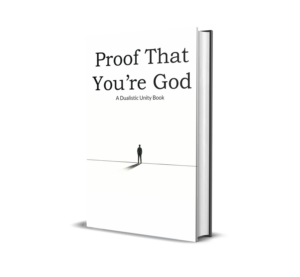
If this reflection resonates, the deeper exploration continues in Proof That You’re God, where peace is reframed not as certainty about the unknown, but as the willingness to stay present with experience — even when no story arrives to save us.
Not to become better.
Not to become pure.
But to become honest enough to stop hiding from the life we’re already in.