What if the need for validation isn’t a lack of confidence—but a hesitation to trust your own experience?
Almost everyone seeks validation. We ask friends what they think before making a decision. We reread messages, hoping for reassurance. We check how many people liked our post.
We ask, “Do you think I did the right thing?” “Was that okay?” “Am I overreacting?”
There’s nothing unusual about wanting another perspective. Human beings have always learned through one another. The difficulty begins when another person’s agreement becomes more important than our own understanding. Before asking how to stop seeking validation, perhaps we should ask something deeper.
What are we hoping validation will give us?
Validation Feels Like Proof
Imagine you’re standing at a crossroads. You know which direction feels right yet before taking a step, you ask someone else. “What would you do?”
Their answer doesn’t necessarily make the decision easier. It makes that decision feel safer. Validation often feels like proof. Proof that you’re making the right choice.
Proof that your feelings make sense. Proof that you’re not making a mistake.
Unfortunately, proof and understanding are not the same thing.
The Mind Doesn’t Like Uncertainty
One of the mind’s greatest strengths is its ability to recognize patterns.
Predict outcomes. Imagine possibilities. Solve problems.
It helps us navigate an unpredictable world. But uncertainty has no final solution. No matter how carefully you think… No matter how many opinions you collect… You can never become completely certain about tomorrow.
Validation can temporarily quiet uncertainty.
It cannot eliminate it.
Borrowing Someone Else’s Confidence
Sometimes we ask for advice because we’re genuinely curious. Other times we ask because we’re hoping someone else will carry the weight of uncertainty for us. If they agree…I’ll finally relax. If they approve.. we won’t have to worry anymore.
The problem is that borrowed certainty has an expiration date. Soon another decision arrives. Another doubt appears. Another opinion is needed. Validation becomes a cycle instead of a solution.
Your Experience Doesn’t Become Real Because Someone Agrees
Imagine telling a friend you’re feeling overwhelmed. They respond, “You’re overthinking.” Does their disagreement erase your experience? Of course not. Likewise, if someone tells you you’re brilliant, that compliment doesn’t create or increase your intelligence. Other people can help us understand ourselves. They cannot become the authority on our experience.
Validation is valued. Dependency is exhausting.
Social Media and the Economy of Validation
Never before have so many people had access to immediate feedback.
Likes. Shares. Comments. Followers.
Algorithms quietly reward visibility. Soon it’s easy to mistake attention for meaning. Approval for connection. Engagement for understanding. The more frequently we check for validation, the easier it becomes to forget that none of these numbers can answer the questions we’re really asking.
“Am I enough?”
“Do I belong?”
“Does my life matter?”
No notification can answer those.
Trust Isn’t the Opposite of Doubt
Many people believe they need complete confidence before trusting themselves. But trust rarely begins with certainty. It begins with participation.
You make the decision. Learn from it. Adjust. Grow.
Understanding develops through experience.
Not through collecting enough opinions to eliminate uncertainty.
Validation Has Its Place
This doesn’t mean you should ignore everyone else.
We all have blind spots.
Wise friends.
Teachers.
Partners.
Consultants.
Communities.
They offer perspectives we might never discover alone. Seeking perspective isn’t weakness. The difference lies in the relationship. Perspective expands understanding. Validation often seeks permission.
One encourages learning.
The other postpones living.
Questions Worth Sitting With
The next time you find yourself seeking validation, ask:
- What am I hoping this person will give me?
- Am I looking for perspective or permission?
- What uncertainty am I trying to escape?
- If no one could answer this question for me, what already feels true?
- What would trusting my own experience look like right now?
These questions aren’t about becoming independent of everyone else.
They’re about learning to remain connected to yourself while remaining open to others.
Final Thoughts
Consider this, the deepest validation isn’t something another person can offer. Perhaps it’s the willingness to remain present with your own experience, even before anyone else understands it. Other people can encourage you. Challenge you. Support you. Help you grow.
But they cannot permanently remove uncertainty.
Life has never promised certainty. Only the opportunity to participate.
Maybe the question isn’t how to stop seeking validation.
Maybe it’s how to stop expecting another person’s agreement to replace your own understanding.
That’s a very different kind of freedom.
Continue the Exploration
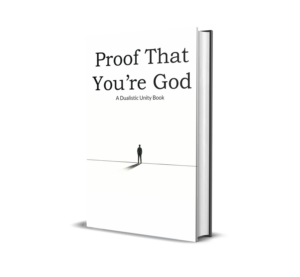
If this article resonated with you, you’ve encountered another thread in the larger conversation explored throughout Proof That You’re God.
The search for validation is often a search for certainty—a hope that someone else can confirm who we are, what we should do, or whether our experience is “right.” But what if the answers we’ve been chasing through approval, comparison, and validation were never meant to come from outside us?
Proof That You’re God explores how identity, awareness, fear, uncertainty, and meaning are deeply interconnected. Rather than offering another system for becoming more confident, it invites a different relationship with yourself—one where understanding gradually replaces the need for constant reassurance, and curiosity becomes more valuable than certainty.
If you’ve found yourself searching for permission to trust your own experience, this book is the next step in that exploration.