Atheism is often positioned as the rational alternative to religion.
It rejects superstition, authority, blind belief, and the idea of a supernatural being controlling the universe from somewhere outside it. It prides itself on intellectual honesty and freedom from dogma.
And in many ways, atheism is right.
The problem is not what atheism rejects.
The problem is what it never looks at.
Because in rejecting God as a concept, atheism often assumes that once the concept is dismantled, the inquiry is finished. What it rarely questions is the deeper framework that made the concept seem necessary in the first place.
Atheism Is Exceptionally Good at Disproving a Story
Most atheistic arguments target a very specific image of God:
- a separate supernatural agent
- a cosmic person with intentions
- a moral overseer who rewards and punishes
- an external authority who could intervene, but often doesn’t
This God collapses immediately under scrutiny.
There is no evidence for it.
It produces endless contradictions.
It fails catastrophically when confronted with suffering.
Atheism is correct to say: this God does not exist.
But that conclusion quietly assumes something crucial:
That God was ever meant to be understood as a thing in the first place.
The Unquestioned Assumption: A Separate Self in a Separate Universe
Most contemporary atheism rests on an unexamined metaphysical picture:
- there are separate individuals
- living in an objectively external universe
- to whom things happen
- often unfairly
- without inherent intelligence or meaning
From within this frame, atheism’s conclusions are not just reasonable — they are inevitable.
If there is:
- a separate “me”
- in a universe that acts upon me
- through random forces
- causing undeserved suffering
Then the idea of a benevolent God is absurd.
But notice what’s doing the real work here.
Not logic.
Separation.
Why Suffering Becomes the Central Argument
Atheistic critiques often return to the same examples:
- children born blind
- cancer
- natural disasters
- random tragedy
These are presented as evidence that:
- there is no God
- or that God is not good
This argument only functions if suffering is understood as something happening to separate selves.
It assumes:
- victims and perpetrators
- an external universe imposing itself
- a moral authority who should have intervened
In other words, it shares the same basic metaphysical structure as religion — just without the comforting conclusion.
Both positions imagine:
- a world happening to us
- overseen (or not) by an external authority
They disagree about whether the manager exists.
They agree about everything else.
Why Most Atheism Never Fully Questions the Self
It’s often said that many atheists accept the idea that the self is an illusion.
Sometimes this is true conceptually.
But existentially, most atheistic worldviews still operate from the felt sense that:
- life happens to me
- the universe is unfair to us
- suffering is imposed on individuals
That posture only makes sense if there is still an assumed someone at the center of experience.
Fully questioning the separate self isn’t just an intellectual move.
It dissolves:
- victimhood
- cosmic grievance
- moral outrage aimed at reality
- the sense of being wronged by existence
That’s far more destabilizing than rejecting a deity.
So most atheism never goes that far.
Why Intelligence Is Missed Entirely
If you assume:
- a dead universe
- composed of separate parts
- governed by blind forces
Then intelligence must be:
- accidental
- local
- confined to brains
Anything else sounds mystical.
But many people don’t believe the universe is intelligent.
They experience it that way.
They notice:
- coherence without a controller
- order without a planner
- responsiveness without intention
- intelligence without a thinker
They are not seeing a cosmic person.
They are seeing intelligence as process.
And then they are taught the word “God.”
At that moment, the experience collapses into a concept.
How Religion and Atheism Make the Same Mistake
Religion takes a moment where the sense of separation briefly dissolves and turns it into:
- a being
- a story
- a doctrine
- an authority
God becomes something to believe in, obey, and defend.
Atheism then dismantles that construction — correctly.
But neither side returns to the original experience that preceded the story.
Both argue about a narrative.
Both miss what the narrative was pointing to.
Why God Is So Easily Misused
The failure of religious descriptions of God is not primarily intellectual.
It’s ethical.
Or more precisely: it’s structural.
When what people later call “God” is noticed, it happens in moments where:
- the sense of being a separate self drops away
- there is no agenda
- no authority
- no identity to protect
There is simply what is.
But the self always returns.
And when it does, it wants to:
- explain the experience
- preserve it
- teach it
- use it
- wield it
The very selfishness that momentarily dissolved now reclaims the insight and turns it into a tool.
Not maliciously.
Inevitably.
This is why God becomes an idea instead of a reality.
Why Atheism Reacts — and Still Misses the Point
Atheism sees this corruption clearly.
It sees:
- manipulation
- hypocrisy
- coercion
- power disguised as holiness
And it rejects the entire structure.
But atheism often assumes the failure lies in the idea of God itself, rather than in what happened after the idea was formed.
So it discards both:
- the institution
- and the experience
Not realizing the experience was never dependent on the idea in the first place.
“There Is No God” and “There Is No Separate Self” Are Not the Same Insight
Here is the critical distinction.
Saying:
“There is no God”
…is not the same as seeing:
“There is no separate self to whom life is happening.”
Most atheism is comfortable with the first.
Very little is comfortable with the second.
Because once separation is questioned experientially, something changes:
The universe no longer looks like a thing acting on you.
Experience no longer feels imposed on a subject.
Reality is no longer divided into controller and controlled.
And the entire framework of cosmic injustice dissolves.
Not because suffering disappears —
but because the lens through which it is interpreted collapses.
What Remains When No One Is in Control
When there is:
- no inner controller
- no outer controller
- no cosmic manager
Yet experience continues.
Perception happens.
Intelligence functions.
Order unfolds.
Without an owner.
At that point:
- the God religion argues for disappears
- the God atheism rejects disappears
What remains is simply what is, happening.
Calling that God is optional.
Understanding why the word arose is not.
“We Are God” Is Not Ego Inflation
This phrase sounds offensive because it’s heard as:
“You, the person, are in charge.”
But it means the opposite.
It means:
- there is no separate you
- no inner ruler
- no external ruler
Just reality, being itself, appearing as experience.
No belief required.
No authority granted.
No one in charge.
Why This Argument Never Ends
Both religion and atheism are identity positions:
- “I believe”
- “I don’t believe”
Each stabilizes a sense of self.
As long as God is treated as an object to accept or reject, the inquiry never reaches the level where identity itself is questioned.
This is why the exploration of the self you’re trying to hold together sits at the center of this entire discussion.
Until the self is examined, God will always appear either absurd or authoritarian.
The Question That Remains After Belief and Disbelief
Atheism clears the ground.
It removes superstition.
It dismantles authority.
But clearing the ground is not the same as looking at what remains.
What remains is the question no belief system can answer for you:
What is this, really?
The Quiet Invitation Beyond the Argument
This isn’t an argument for God.
Or against atheism.
It’s an invitation to notice that both sides often argue about a story while standing on the same unexplored ground:
Direct experience.
Intelligence without an owner.
Reality without a center.
You don’t need to call that God.
But if you’ve ever wondered why people did — this is where to look.
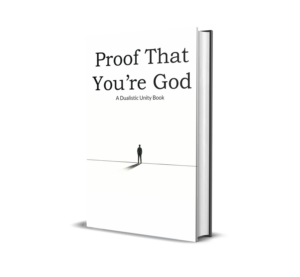
If this inquiry resonates, Proof That You’re God explores this territory directly — not by asking you to believe anything, but by dismantling the assumptions that make belief and disbelief seem like the only options.