
There is a moment in any honest inquiry into free will where the question quietly changes.
It stops being:
“Do I have free will?”
And becomes:
“What exactly is it that was supposed to be choosing?”
That shift matters, because once it happens, the usual arguments about determinism, control, and agency start to feel oddly misplaced. Not wrong—just aimed at the wrong target.
Modern neuroscience didn’t create this confusion.
It exposed it.
And what it points to is not meaninglessness, but something far more destabilizing and far more intimate:
That what we call “me”, “choice”, and “God” may all be different ways of talking about the same underlying movement—misunderstood as separate.
The Experiments That Cracked the Story of Choice
The disruption is usually traced back to the work of Benjamin Libet.
In his experiments, participants were asked to press a button whenever they felt like it, while reporting the moment they became consciously aware of their intention. Brain activity was monitored throughout.
What Libet found was simple and unsettling:
Neural activity associated with the action appeared before participants reported the conscious decision to act.
Later research expanded this finding:
- Patrick Haggard refined the timing
- Martin Eimer replicated related effects
- Chun Siong Soon demonstrated that decisions could sometimes be predicted seconds before conscious awareness
The conclusion many drew was stark:
Conscious will does not cause action.
Free will, it seemed, was an illusion.
But that conclusion rests on an assumption that was never examined.
The Assumption Beneath the Debate
The discomfort around free will comes from a single, deeply embedded idea:
That there is a personal author inside experience, issuing commands.
The experiments didn’t disprove free will.
They showed that this author never existed.
In direct experience, no one actually finds a chooser directing life from behind the scenes. What’s found instead is:
- Experience arising
- Action unfolding
- Awareness noticing
- A story forming afterward: “I chose this.”
The sense of authorship is real—but it is retrospective.
And here’s the part that’s almost always missed:
This structure is not unique to you.
What Happens Everywhere at Once
The readiness potential doesn’t appear in one brain.
It appears in every brain.
Everywhere, the same pattern holds:
- Movement first
- Narrative second
- Identity last
Which means whatever is happening is not happening privately.
No one is choosing before reality moves.
No one is lagging behind it either.
The same process is unfolding everywhere, simultaneously, from every point of view.
This is where the question of free will stops being psychological and becomes cosmological.
Collective Consciousness Without a Controller
When people hear “collective consciousness,” they often imagine a shared mind or a metaphysical network connecting individuals.
That’s not what’s being described here.
There is no shared experience.
There is shared structure.
Every experience is centered.
Every perspective experiences itself as the only place awareness happens.
And every perspective discovers the same thing when examined closely:
that action was already underway before the personal story arrived.
Not because there is a central controller.
But because there is no separation between awareness and what is happening.
God Without an Entity
This is where the word “God” becomes unavoidable—and where it’s usually misunderstood.
God is not:
- A being making decisions
- A force intervening in outcomes
- A manager of individual lives
God is not behind experience.
God is the fact that experience is happening at all.
Action arises.
Narrative follows.
Awareness remains.
Everywhere.
When understood this way, God is not something you believe in.
God is what remains when the idea of a personal author falls apart.
Why Manifestation Breaks Here
This perspective quietly dismantles most manifestation models.
Manifestation assumes:
- A personal will
- A private consciousness
- A world that responds to my intention
But if:
- Action arises before personal intention
- Every perspective is equally central
- Experience is mutually reflective
Then no one is manifesting over anyone else.
Reality is not responding to your vibration.
Reality is expressing what it is, everywhere, at once.
You are not attracting a world.
The world is appearing as you—and you as it.
And the same is true for everyone else.
Why “Other People” Matter So Much
Seen this way, other people are no longer interruptions or obstacles.
They are how this moment appears from there, just as you are how it appears from here.
As you change, what shows up changes.
As others change, you appear differently to them.
Not because anyone is coordinating.
But because observer and observed are inseparable.
The reflection is mutual, immediate, and unavoidable.
Responsibility Without Control
None of this erases responsibility.
It relocates it.
Responsibility doesn’t come from authorship.
It comes from where experience is known.
Care still matters.
Harm still matters.
Choices still unfold.
But they unfold as expressions of the whole, not as gambits of a private self.
This dissolves:
- Moral superiority
- Spiritual hierarchy
- The idea of being “ahead”
- The fear of being “behind”
Nothing is out of place.
Why This Is So Hard to Accept
The idea of personal authorship is deeply tied to identity.
To question it feels like annihilation.
But what actually dissolves is not existence—it’s isolation.
The sense of being a separate chooser falls away, and what remains is coherence.
This is why clarity often feels harder the more we try to understand it conceptually. The mind keeps searching for a controller that was never there.
We explore this pattern more deeply in our hub article on why clarity often feels harder the more we understand.
Free Will Reconsidered
So do we have free will?
Not as personal authorship.
Freedom shows up instead as:
- The absence of separation
- The end of internal conflict
- The release of needing to control what is already happening
Freedom is not choosing reality.
Freedom is recognizing you were never outside it.
Closing Reflection
Neuroscience didn’t disprove free will.
It revealed that no one was ever choosing alone.
What you call “me” is reality, locally experienced.
What you call “others” are the same reality, from another angle.
What you call “choice” is the story that follows movement.
Everything is happening.
Everywhere.
As itself.
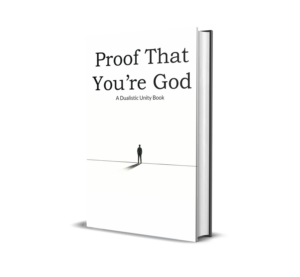
That recognition—of God not as belief, but as lived structure—is at the heart of Proof That You’re God. The book explores what becomes obvious when the idea of personal authorship dissolves—not as philosophy, but as direct experience.