
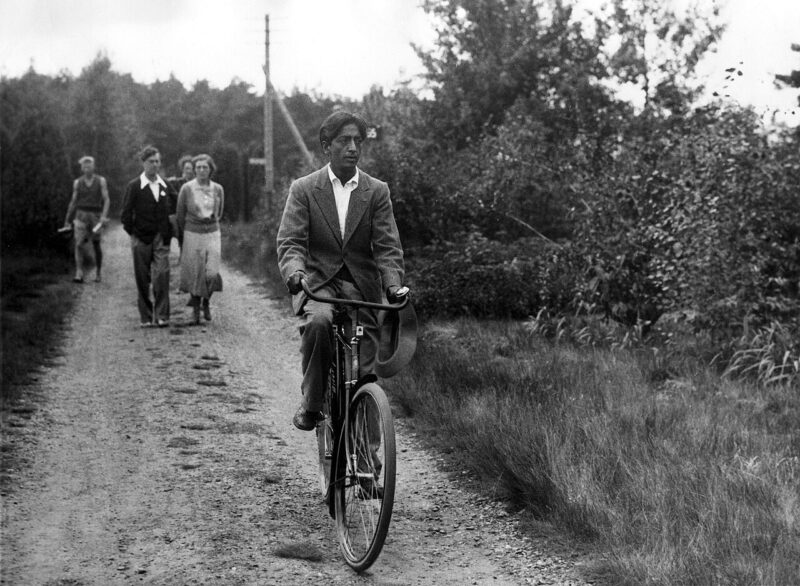
There is a strange irony surrounding Jiddu Krishnamurti.
He spoke for decades, across continents, to enormous audiences. His talks were recorded, transcribed, published, quoted, studied, and discussed endlessly. And yet, despite all of that attention, very few people actually understood what he was pointing to.
Not because his words were obscure.
Not because his ideas were abstract.
But because what he was describing could not be approached in the way people habitually approach understanding.
Krishnamurti was not offering a better path.
He was pointing to the end of the path altogether.
The Central Misunderstanding: Time as Psychological Movement
At the heart of Krishnamurti’s work is a deceptively simple insight:
psychological change does not happen in time.
This statement alone is enough to destabilize almost every spiritual, psychological, and self-improvement framework we’re familiar with. Because nearly all of them are built on the assumption that:
- understanding accumulates
- awareness develops gradually
- insight unfolds step by step
- transformation takes time
Krishnamurti wasn’t denying physical time.
He was pointing to something far more unsettling: the illusion of psychological time.
The idea that “I am this now, and I will become something else later” is itself the structure of the self trying to continue.
Why His Message Couldn’t Be “Practiced”
One of the most common responses to Krishnamurti’s talks was the question:
“How do I live this?”
He consistently refused to answer it.
Not because he was evasive, but because the question itself missed the point.
The moment you ask how, you’ve already turned insight into a method.
The moment you turn insight into a method, you’ve reintroduced time.
And the moment time is reintroduced, the self has a future in which to survive.
Krishnamurti wasn’t describing a practice.
He was describing the collapse of the one who practices.
Intelligence Without Accumulation
When Krishnamurti spoke about intelligence, he wasn’t referring to intellect, knowledge, or even wisdom as it’s usually understood.
He meant something much more immediate.
Intelligence, in his usage, was the capacity to see clearly what is happening without distortion, without the interference of memory, identity, or desire.
This kind of intelligence cannot be cultivated over time.
It appears only when there is no movement toward becoming.
That’s precisely why it was so difficult to hear.
The Self’s Inability to Hear Its Own Ending
Most people listening to Krishnamurti were doing so with the same structure that listens to everything else: the self.
And the self is always listening for:
- improvement
- reassurance
- direction
- continuity
But Krishnamurti wasn’t offering continuity.
He was describing the immediate cessation of the psychological center.
Not as an achievement.
Not as an experience.
But as a fact that becomes obvious when it is seen.
The problem is that the self cannot understand its own nonexistence.
It can only reinterpret it as an ideal.
Why People Turned Him Into a Philosophy
Because his message couldn’t be used, it had to be contained.
So people did what they always do when confronted with something unassimilable:
- they intellectualized it
- they systematized it
- they quoted it
- they debated it
- they made it into a worldview
Krishnamurti became a philosopher instead of a pointer.
And once that happened, his words could be admired safely — without threatening the structure he was exposing.
Change Without Time Is Not Gradual Insight
One of the most radical things Krishnamurti pointed to was this:
Seeing is the change.
Not seeing leads to change.
Not seeing starts a process.
Seeing ends the problem immediately — because the problem was sustained by not seeing.
This is not dramatic.
It’s not mystical.
It’s not even spiritual in the conventional sense.
It’s simply that when illusion is seen as illusion, it no longer has energy.
Why This Feels Impossible From the Inside
From within psychological time, this sounds absurd.
We feel like:
- understanding builds
- habits weaken slowly
- conditioning dissolves gradually
But that sense of gradualness is itself produced by the very structure Krishnamurti was pointing to.
The self must experience change as slow, because slowness guarantees its survival.
Immediate insight would leave nothing to manage.
The Trap of “Living in the Present”
Ironically, even phrases like “live in the present” became distortions of Krishnamurti’s message.
Living in the present was turned into:
- a practice
- a discipline
- a state to maintain
But Krishnamurti wasn’t describing a state.
He was describing what remains when psychological time drops away, not when attention is forced to stay here.
Presence is not something you do.
It is what’s left when the effort to become ends.
Why His Talks Were Both Simple and Inaccessible
Krishnamurti’s language was remarkably clear.
There was no jargon.
No technique.
No authority claimed.
And that clarity was the problem.
There was nothing to hold onto.
Without a path, the listener felt lost.
Without progress, the listener felt pointless.
Without becoming, the listener felt annihilated.
So the mind translated his words back into time — inevitably.
This Pattern Appears Everywhere
What happened with Krishnamurti happens whenever something points beyond identity.
The insight is heard.
The insight is admired.
The insight is misunderstood.
The insight is turned into something manageable.
That broader pattern — how understanding itself becomes an obstacle when it’s used to secure identity — is explored more fully here:
https://dualisticunity.com/why-clarity-often-feels-harder-the-more-we-understand/
Clarity threatens the self not because it is difficult, but because it leaves nothing to protect.
Why This Still Matters
Krishnamurti’s work isn’t outdated.
If anything, it’s more uncomfortable now than it was then — because modern culture is built almost entirely on psychological time:
- optimization
- progress
- self-improvement
- identity narratives
- future-oriented meaning
His message cuts through all of that with one uncompromising observation:
You cannot become free.
You can only see the structure that is unfree.
And that seeing is not tomorrow.
Not a Teaching, But an Exposure
Krishnamurti didn’t fail to communicate.
What he pointed to simply couldn’t be received in the way people wanted.
Because it required the listener to stop being the listener — not eventually, but immediately.
That isn’t inspiring.
It’s disarming.
Where This Points
Dualistic Unity doesn’t exist to explain Krishnamurti or defend his ideas.
It exists to explore the same territory from lived experience: what happens when psychological time is seen rather than managed, and identity is allowed to loosen without being replaced.
Proof That You’re God explores this directly — not as philosophy, not as practice, but as an inquiry into what remains when the movement to become finally runs out of steam.
Nothing needs to be added.
Nothing needs to be improved.
Only something needs to be seen.
And that seeing does not take time.