
Some movies are funny because they’re exaggerated.
What About Bob? is funny because it’s exaggerated and uncomfortably accurate.
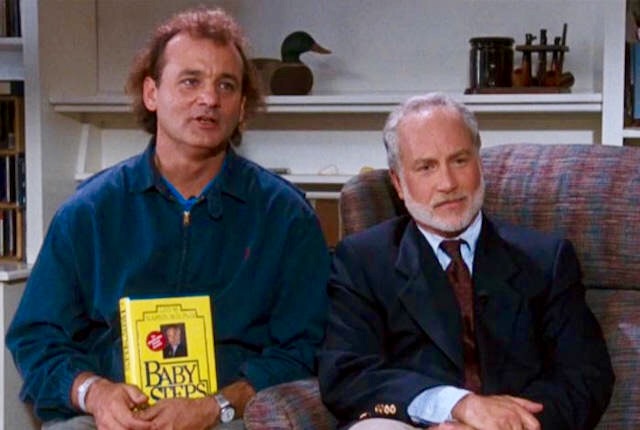
On the surface, it’s a 1991 comedy starring Bill Murray and Richard Dreyfuss. Bob Wiley is a man paralyzed by phobias who latches onto his new therapist, Dr. Leo Marvin, and—through a series of boundary-obliterating misadventures—ends up following him into what was supposed to be a calm family vacation.
It’s slapstick. It’s absurd. It’s uncomfortable.
And beneath all of that, it’s a remarkably clean illustration of a pattern most of us are living inside without realizing it:
The more invested you are in maintaining an identity, the more distorted reality becomes—and the more conflict you experience.
The brilliance of What About Bob? is that it never explains this. It simply lets two different versions of ego collide with real life and shows what happens when control works… until it doesn’t.
Two Characters, One Mechanism
The movie is structured around a quiet symmetry. Bob and Dr. Marvin appear to be opposites, but they’re actually two expressions of the same thing.
Bob represents the negative identity:
I’m broken. I have problems. I can’t handle the world.
Dr. Marvin represents the positive identity:
I’m accomplished. I’m composed. I know what’s best.
One identity is socially rejected. The other is socially rewarded.
But both are still identities—and both create distortion.
This is the same tension explored more broadly in how the self you’re trying to hold together quietly becomes the source of strain rather than stability.
The movie’s genius is showing how these two poles don’t cancel each other out. They trade places.
Bob: The Ego of “Something Is Wrong With Me”
Bob’s suffering is obvious from the first scene. His world is organized around fear, ritual, and self-reference. Every action is filtered through a mental narrative about what might go wrong and how he might fail.
What makes Bob interesting, though, isn’t just that he’s anxious. It’s that he’s identified with his anxiety.
Even his honesty reinforces the story. He’s open, vulnerable, and upfront—but always in service of listing what’s wrong with him. The vulnerability is real, but the identity remains intact.
This is a familiar trap: sincerity doesn’t automatically free you from self-obsession. You can be honest and still be circling the same story.
At the same time, Bob desperately wants relief. He’s searching for the right explanation, the right authority, the right missing piece that will finally make everything make sense. That’s why he clings so tightly to Dr. Marvin. It’s not just attachment—it’s salvation-seeking.
“If someone else can just tell me what’s wrong, I’ll finally be okay.”
Dr. Marvin: The Ego of “I Know What I’m Doing”
Dr. Leo Marvin’s suffering is invisible—at first.
He’s successful. Respected. Confident. He has credentials, a family, a book, and a clear sense of who he is in the world. He believes he’s calm. He believes he’s above emotional reactivity. He believes he’s in control.
This is the most seductive form of ego because it looks like health.
But the movie slowly exposes what that stability is built on: control, image maintenance, and resistance to being challenged.
Dr. Marvin doesn’t just want things to go well. He needs them to go a certain way in order to preserve his sense of self. When reality cooperates, he feels fine. When it doesn’t, the cracks appear.
And Bob is the ultimate non-cooperative force.
“Take a Vacation From Your Problems”
One of the most revealing moments in the film comes early, almost as a throwaway line. Dr. Marvin gives Bob a simple instruction: take a vacation from your problems.
It sounds like generic therapeutic advice, but what it actually does is interrupt the self-reinforcing loop that keeps Bob trapped.
Bob doesn’t solve his fears. He doesn’t analyze them away. He simply stops constantly orienting around them.
This shift is subtle but profound.
As Bob stops thinking about himself all the time, he becomes more involved with what’s actually happening—people, situations, moments. His attention moves outward. His inner narration quiets. The identity loosens.
Healing, in the movie, doesn’t come from fixing the self. It comes from no longer centering the self.
The Pedestal Problem
One of the strangest dynamics in the film is that Bob, despite being emotionally sensitive, can’t see something obvious: Dr. Marvin hates him.
The reason isn’t lack of awareness. It’s idealization.
Bob has put Dr. Marvin on a pedestal. He sees him as the perfect therapist—above ordinary human reactions. That pedestal isn’t admiration; it’s distortion. It prevents Bob from perceiving Dr. Marvin as a human being.
At the same time, Dr. Marvin needs that pedestal. His identity depends on being seen as exceptional. He doesn’t correct Bob’s illusion because the illusion is feeding him.
This mutual distortion is subtle and painfully real. When someone needs to be seen a certain way—and someone else needs them to be that way—truth quietly disappears from the relationship.
Vulnerability Without Performance
Bob is chaotic, anxious, and socially awkward—but he’s also unusually undefended. He isn’t performing competence. He isn’t trying to manage how he’s perceived. He just shows up as he is.
That openness has an unexpected effect: people relax around him.
Dr. Marvin’s family doesn’t feel managed or evaluated by Bob. They feel met. His presence creates an environment where vulnerability feels safer—not because he’s wise, but because he’s not posturing.
Dr. Marvin, by contrast, relates through roles and techniques. Even his attempts at connection feel scripted. Parenting becomes performance. Communication becomes strategy.
The movie exaggerates this for humor, but the point lands:
When identity is busy managing itself, genuine connection gets filtered out.
Scripts, Control, and Collapse
One of the clearest illustrations of ego in the film is how each character handles unpredictability.
Dr. Marvin rehearses. He plans. He scripts. He prepares for how things are supposed to go.
Bob doesn’t.
So when reality deviates—as it always does—Dr. Marvin freezes. His sense of self depends on the script working. Bob, having no script, adapts.
This isn’t about intelligence or competence. It’s about flexibility.
Identity creates brittle stability. Presence allows improvisation.
When Resistance Turns the World Hostile
As Dr. Marvin’s control erodes, the movie shows a psychological shift that many people recognize instantly: resistance turns neutral events into enemies.
A ticket feels personal.
A breakdown feels targeted.
A passing car feels malicious.
This is what happens when identity is under threat. Everything becomes evidence that the world is against you.
Dr. Marvin’s rage isn’t random. It’s the predictable result of a self that requires reality to cooperate.
The Handkerchief and the World in Your Head
Bob’s handkerchief—used to avoid touching doorknobs and surfaces—is played for laughs, but it’s one of the movie’s most precise metaphors.
The handkerchief isn’t protecting Bob from the world.
It’s protecting him from the world he imagines.
As Bob’s identity loosens, the handkerchief fades. Not because he forces himself to be brave, but because the imagined threat no longer dominates his experience.
The more present he becomes, the less protection he needs from his own thoughts.
Baby Steps and the Intelligence of Small Movements
Bob’s obsession with “baby steps” is ridiculous—and effective.
Instead of chasing a dramatic breakthrough, he engages with tiny, symbolic actions. The symbol bypasses the ego’s demand for perfection and allows movement to happen without self-judgment.
This is one of the movie’s quiet insights: transformation rarely happens through grand resolutions. It happens through small interruptions of the loop.
Society, Sanity, and the Need to Contain
As Dr. Marvin unravels, the social response shifts quickly from admiration to containment. Once the performance collapses, empathy disappears.
The film doesn’t sermonize about mental health, but it shows a familiar reflex: when someone no longer fits the expected role, the priority becomes restoring order, not understanding.
Which raises an uncomfortable question:
How much of what we call “sanity” is simply successful identity performance?
Knots, Explosives, and the Final Image
The movie’s climax is absurd: Bob literally wrapped in explosives, tied in knots, while Dr. Marvin loses control completely.
Symbolically, it’s perfect.
Identity is knots.
Thoughts tied to thoughts.
Meaning tied to meaning.
Self tied to protection.
Bob escapes by unraveling.
Dr. Marvin explodes by tightening.
And in one of the film’s most subversive moves, Bob doesn’t vilify Dr. Marvin afterward. He doesn’t elevate himself morally. He simply doesn’t need to create a new identity out of opposition.
Because healing, in the movie, isn’t about becoming better than someone else.
It’s about needing less to be someone at all.
Final Reflection
What About Bob? works because it shows, rather than tells, how ego operates at both ends of the spectrum.
The ego that knows it’s suffering.
The ego that believes it’s above suffering.
Both create distortion.
But only one can soften.
The movie’s deeper suggestion is quietly radical: the problem isn’t that we’re broken or that we need to perfect ourselves. The problem is the effort to hold a self together in the first place.
Proof That You’re God explores this same pattern across anxiety, control, meaning, and connection—not by offering a better identity, but by pointing to what relaxes when identity is no longer doing all the work.
Sometimes healing looks like progress.
Sometimes it looks like collapse.
And sometimes, it looks like a man with phobias accidentally finding freedom while the expert loses his grip.