Imagine you’re standing at the edge of a dense forest. Two paths stretch before you.
A stranger points toward the left path and confidently says, “This is the only way. Don’t question it.” Another person standing nearby says, “I don’t know which path is correct. Let’s explore together.”
Which person would you trust?
Most of us would probably choose the second person. Not because they claim certainty, but because they’re willing to investigate reality instead of demanding belief.
Yet in many areas of life—including religion, politics, science, health, finance, and even our personal relationships—we’re often encouraged to accept claims without asking questions.
This is where blind faith begins.
What Is Blind Faith?
Blind faith is accepting a belief, authority, or claim as true without sufficient evidence, critical examination, or a willingness to question it.
The key word is blind.
Faith itself is not necessarily irrational. Every day we place reasonable trust in people, institutions, and systems based on experience, evidence, or demonstrated reliability. We trust that a bridge will hold because engineers designed and tested it. We trust a close friend because they’ve repeatedly shown honesty.
Blind faith is different.
It asks us to stop asking questions.
It asks us to believe first and investigate later—or never.
A Story We’ve All Lived
When Maya was eight years old, she asked her grandfather why the sky was blue.
He smiled and replied, “Because that’s how God made it.”
For years, that simple and unverified answer satisfied her.
Then, in high school, a science teacher explained how Earth’s atmosphere scatters sunlight. The explanation didn’t erase wonder—it deepened it. Understanding the mechanism behind the blue sky didn’t diminish its beauty.
That experience taught Maya something important.
Questions didn’t destroy meaning.
They expanded it.
Many of us have similar moments. Whether about religion, politics, family traditions, or our understanding of ourselves, we eventually encounter information that challenges what we’ve always believed.
The question becomes: Do we explore—or do we retreat into certainty?
Why Humans Are Drawn to Blind Faith
Psychologists have long studied our need for certainty.
The human brain is constantly trying to reduce uncertainty. Clear and unverified answers feel safer than unanswered questions, even when those answers are incomplete.
Research in cognitive psychology has identified several common tendencies that reinforce unquestioned beliefs:
- Confirmation bias encourages us to notice evidence that supports what we already believe.
- Authority bias makes us more likely to accept claims from people we perceive as experts or leaders.
- Social conformity creates pressure to agree with our communities to maintain belonging.
- Cognitive dissonance makes conflicting information uncomfortable, leading us to dismiss or rationalize it rather than reconsider our views.
None of these tendencies make us irrational or unintelligent. They are simply part of being human.
Blind faith often grows not from ignorance, but from our natural desire for certainty, belonging, and stability.
Blind Faith Is Not Limited to Religion
Many people associate blind faith exclusively with religion. But blind faith can appear anywhere. A political ideology can become unquestionable.
A conspiracy theory can become unquestionable.
A scientific claim can become unquestionable when treated as beyond criticism.
A charismatic influencer or an elected official can become unquestionable.
Even our own opinions can become unquestionable.
The problem is not the subject.
The problem is believing something cannot be questioned.
Whenever questioning becomes forbidden, curiosity begins to disappear.
Faith and Blind Faith Are Not the Same
Faith is often misunderstood. Healthy faith can coexist with humility. It recognizes uncertainty while choosing to move forward.
Parents have faith their child will learn despite no guarantee children will learn.
Entrepreneurs have faith their business can succeed despite uncertainty.
Researchers have faith that continued investigation may reveal better explanations.
This kind of faith welcomes new information.
Blind faith resists it.
One remains open.
The other closes the door.
History Shows the Cost of Blind Faith
History offers many examples of societies that discouraged questioning. Religious institutions have at times persecuted individuals whose discoveries challenged accepted doctrine.
Political regimes have demanded unquestioning loyalty while suppressing dissent.
Financial bubbles have convinced millions that prices could only rise.
Medical misconceptions have persisted for generations because they were accepted as common knowledge rather than tested. Progress has rarely come from refusing to ask questions.
It has almost always come from asking better ones.
What If We Treated Every Belief as a Working Hypothesis?
Imagine approaching every belief—not as an absolute truth—but as your current best understanding. That small shift changes everything.
Instead of defending beliefs as part of our identity, we become curious investigators.
Instead of asking, “How do I prove I’m right?” we begin asking, “What would change my mind?”
This doesn’t weaken conviction. It strengthens integrity. Because genuine confidence doesn’t fear evidence.
Practical Ways to Avoid Blind Faith
Question your strongest beliefs with the same honesty you question ideas you disagree with.
Seek out thoughtful perspectives that challenge your assumptions.
Separate your identity from your opinions. Changing your mind is not the same as losing yourself.
Ask, “What evidence would convince me otherwise?”
Be willing to say, “I don’t know.”
Some of humanity’s greatest discoveries began with those three words.
Curiosity Is Stronger Than Certainty
Blind faith isn’t dangerous because it involves belief.
It’s dangerous because it can end questioning.
Curiosity, on the other hand, keeps learning alive.
The goal is not to eliminate faith.
The goal is to cultivate a faith that is humble enough to question itself, courageous enough to follow evidence wherever it leads, and compassionate enough to recognize that every person is navigating uncertainty in their own way.
Perhaps the opposite of blind faith isn’t skepticism.
Perhaps it’s honest curiosity.
And curiosity has always been one of humanity’s greatest strengths.
Continue the Conversation
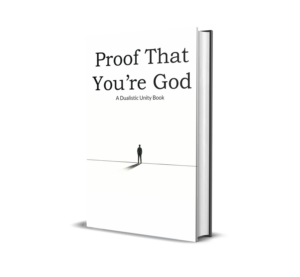
If this article challenged the way you think about faith, certainty, and reality, you’ll find these ideas explored much more deeply in our book, Proof That You’re God.
The book invites readers to examine the assumptions we inherit, the stories we tell ourselves, and the possibility that understanding reality begins not with certainty—but with awareness.
If you’d like to explore these questions with others, we also invite you to join our live community conversation every Sunday at 11:00 AM PST on Patreon. Together, we examine philosophy, psychology, spirituality, and the human experience through open dialogue—where questions are welcomed, and curiosity always comes before certainty.
Because understanding reality isn’t about having all the answers.
It’s about never losing the courage to keep asking better questions.