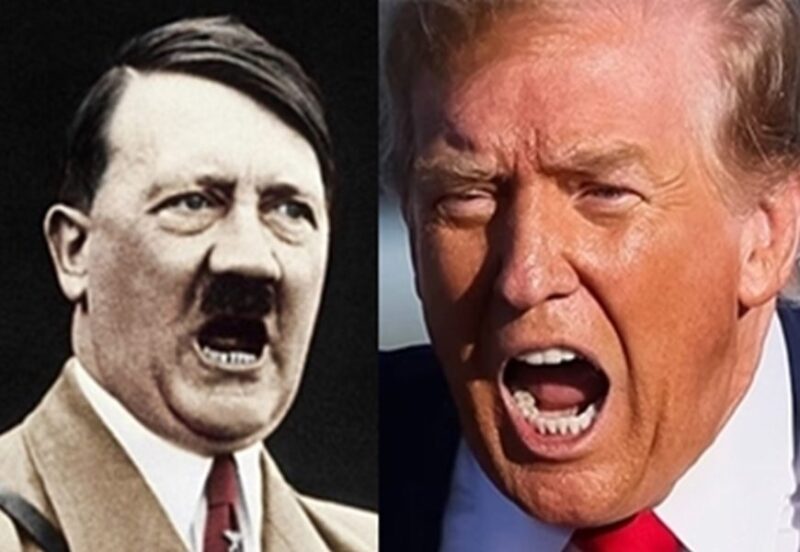
Comparing the Rise of Nazism in Germany With Trump’s Rise in the United States
Comparisons between Donald Trump and Adolf Hitler provoke unusually intense reactions. Some people believe that invoking Hitler is hysterical, offensive, or historically ignorant. Others argue that refusing to examine the resemblance is itself dangerous because authoritarian movements are easiest to resist before they have completely dismantled democratic government.
Both concerns deserve to be taken seriously.
Donald Trump is not Adolf Hitler, the United States is not Nazi Germany, and contemporary America has not reproduced the industrialized genocide, one-party state, territorial conquest, racial laws, concentration-camp system, and total suppression of civil society that defined Hitler’s regime. Treating the two men as identical would erase crucial historical facts and diminish the specific horror of Nazism.
Yet historical comparison does not require claiming that two people, movements, or countries are identical. We compare events to identify recurring political methods, social conditions, institutional vulnerabilities, and warning signs. The responsible question is not simply, “Is Trump Hitler?” It is: Which features of Hitler’s rise resemble Trump’s political rise, which do not, and what can those similarities and differences teach us about the health of American democracy?
Scholars themselves remain divided. Some historians see important similarities between Trumpism and interwar fascism, while others believe the Hitler analogy exaggerates the role of one leader and obscures more distinctly American traditions of racism, nativism, plutocracy, religious nationalism, and authoritarian populism. The debate has never produced a universal scholarly verdict.
The evidence does, however, justify serious concern.
How Hitler and the Nazi Party Rose
The Nazis did not appear in a stable and prosperous Germany and immediately persuade an entire country to embrace genocide. Their rise occurred within a society traumatized by war, political violence, national humiliation, economic upheaval, and declining confidence in democratic institutions.
Germany’s defeat in World War I was followed by the collapse of the imperial government and the creation of the Weimar Republic. The new democracy faced severe difficulties almost immediately: political assassinations, attempted coups, street violence, hyperinflation, resentment over the Treaty of Versailles, and intense conflict between revolutionary communists and the political right. The Nazi Party emerged in this environment as a small, ultranationalist, antisemitic, anti-communist, and explicitly anti-democratic movement.
The early Nazi movement was not initially successful. Hitler’s attempted coup in Munich in 1923 failed, and the party remained electorally marginal for much of the 1920s. Its fortunes changed after the Great Depression began in 1929. Mass unemployment and economic desperation weakened moderate parties and increased public receptiveness to radical solutions. The Nazis promised national restoration, economic revival, social order, military strength, and revenge against the people they blamed for Germany’s suffering.
Their explanations were largely false, but emotionally powerful. Instead of asking Germans to understand banking failures, international debt, industrial contraction, political fragmentation, or the structural consequences of war, Nazi propaganda identified enemies: Jews, communists, democratic politicians, intellectuals, trade unionists, foreigners, and supposed internal traitors.
This was one of Hitler’s central political achievements. He converted social anxiety into identity, identity into grievance, and grievance into loyalty to a leader.
The Nazis also created an imagined national community. Supporters were told that they belonged to a morally pure and biologically superior German people who had been betrayed, humiliated, contaminated, and robbed of their rightful position. Hitler did not merely promise better policies. He promised restoration. He claimed that Germany could become great again if it purged itself of weakness and internal corruption.
The Nazi Party built a mass political movement through rallies, symbols, uniforms, repetitive slogans, propaganda, organized intimidation, and Hitler’s carefully cultivated image as the singular embodiment of the nation. Violence by the Nazi paramilitary organization known as the SA helped disrupt opponents and normalize political brutality. By the early 1930s, millions of Germans genuinely supported Hitler, but he did not win an unrestricted democratic mandate from a majority of the country.
In the July 1932 federal election, the Nazis became the largest party but received approximately 37 percent of the vote. Their support fell in the November election. Hitler was nevertheless appointed chancellor on January 30, 1933, after conservative elites and President Paul von Hindenburg concluded that they could use his popular movement while controlling him from within the government. They catastrophically underestimated him.
This is one of the most important facts about Hitler’s rise: he was not simply elected dictator by an overwhelming majority. He gained power through a combination of popular support, democratic failure, elite bargaining, political miscalculation, intimidation, and manipulation of existing institutions.
After the Reichstag building burned in February 1933, the government used the crisis to suspend civil liberties, arrest political opponents, restrict the press, and intensify repression. The Enabling Act, passed the following month under conditions of intimidation and political suppression, allowed Hitler’s government to enact laws without meaningful parliamentary approval. The German Bundestag describes the act as the final destruction of parliamentary democracy and the rule of law.
The dictatorship was then consolidated rapidly. Opposition parties were outlawed or dissolved, trade unions were destroyed, state governments were subordinated, independent media were suppressed, and political enemies were imprisoned. By July 1933, the Nazi Party was the only legally permitted political party.
Hitler’s dictatorship did not begin with Auschwitz.
It began with language, scapegoating, political violence, institutional surrender, emergency powers, loyalty tests, propaganda, and the belief among powerful conservatives that they could benefit from an authoritarian movement without eventually becoming its victims.
Trump’s Rise Began in a Very Different America
Trump entered politics under conditions dramatically different from those surrounding Hitler’s rise. The United States had not recently lost a world war. It was not experiencing Great Depression-level unemployment, revolutionary street warfare, hyperinflation, or the collapse of a newly established democratic system. The country possessed a long constitutional tradition, a federal structure, an independent judiciary, an established civil society, a professional bureaucracy, multiple levels of government, and a military tradition of formal subordination to civilian constitutional authority.
Trump also did not organize a paramilitary party equivalent to the SA, call openly for the abolition of elections, publish a program of biological racial conquest comparable to Nazism, or establish a one-party totalitarian state during his first term.
Those differences matter. They are not minor qualifications.
Nevertheless, Trump rose by exploiting real social discontent and organizing it around a narrative of national decline, betrayal, internal enemies, lost greatness, demographic fear, and personal rescue. He presented himself not merely as a candidate with conservative policies but as the only figure capable of saving a country supposedly being destroyed from within.
His 2015 campaign announcement portrayed Mexican migrants as sources of drugs and crime. His campaigns repeatedly described immigration not only as a policy problem but as an invasion threatening the national body. During his second inaugural address, he promised a new American “golden age,” claimed that sovereignty and justice had been stolen or corrupted, and presented his return as the beginning of national restoration.
The promise to restore a humiliated nation is not uniquely Nazi. It appears in many nationalist and populist movements. Yet it is one of the clearest structural similarities between Hitler’s political appeal and Trump’s: both told supporters that their country had been weakened by corrupt elites, betrayed by internal actors, exploited by outsiders, and denied its rightful greatness.
The political leader then becomes more than an officeholder.
He becomes the vessel through which the nation is supposedly redeemed.
The Politics of National Humiliation
Hitler insisted that Germany had been humiliated by defeat, the Versailles settlement, democratic politicians, Marxists, and Jews. Trump has repeatedly described the United States as mocked, cheated, invaded, betrayed, robbed, laughed at, and weakened by incompetent or corrupt leaders.
The specific histories are different, but the emotional structure is recognizable. National problems are framed not as difficult policy challenges but as deliberate insults inflicted by enemies. Compromise becomes surrender. Criticism becomes betrayal. Political opposition becomes evidence of conspiracy.
This type of rhetoric is effective because humiliation creates a powerful desire for reversal. A supporter may not agree with every policy, but the leader offers something more psychologically immediate: the feeling that someone is finally fighting back.
The deeper question is what happens when political identity becomes organized around humiliation. Once supporters believe their nation has been deliberately stolen from them, ordinary democratic loss can feel intolerable. Losing an election no longer means that another coalition won. It means that the nation itself has been conquered.
That belief helps explain why election denial is so dangerous.
The Big Lie and the Refusal to Accept Electoral Defeat
Hitler’s rise was supported by relentless propaganda claiming that Germany had been betrayed from within. One of the foundational myths of the radical German right was the false “stab-in-the-back” legend: the belief that the German military had not truly been defeated in World War I but had been betrayed by Jews, Marxists, republicans, and civilians at home.
Trump created a different but structurally comparable betrayal narrative after the 2020 presidential election. He insisted that he had actually won and that the result had been stolen through widespread fraud. Courts, election administrators, state officials, members of his own administration, and other authorities found no evidence capable of changing the outcome.
The House January 6 committee concluded that Trump and his circle conducted a multipronged campaign to overturn the result. Its report documented pressure on state officials and legislators, efforts involving unauthorized electoral certificates, attempts to influence the Justice Department, pressure on Vice President Mike Pence, and the mobilization of supporters around the congressional certification on January 6, 2021. The committee estimated that Trump or his inner circle engaged in at least 200 acts of outreach, pressure, or condemnation directed toward state legislators and election officials in the two months after the election.
A federal indictment later alleged that Trump conspired to overturn the legitimate results using claims he knew were false. An indictment is an accusation rather than a conviction, and Trump denied wrongdoing. The underlying historical fact remains that he attempted to remain in office after losing an election and promoted a false account of that loss.
This may be the most consequential point of comparison.
Hitler openly opposed parliamentary democracy. Trump ordinarily speaks in the language of elections and popular legitimacy, but his conduct after 2020 demonstrated that he was willing to reject an election he lost and pressure public institutions to preserve his power.
A democracy cannot survive indefinitely if its leaders accept elections only when they win.
January 6 and the Role of Political Violence
January 6 was not the equivalent of Hitler’s Beer Hall Putsch, the Reichstag fire, or the Nazi seizure of power. The Capitol attack failed to stop the transfer of power. Congress reconvened, the election was certified, the courts continued functioning, and Trump left office on January 20, 2021.
Yet the event cannot be dismissed as a protest that simply became disorderly. The congressional session was attacked while lawmakers were formally counting electoral votes. Members of the crowd assaulted police officers, breached the Capitol, threatened elected officials, and interrupted the constitutional process. Trump had summoned supporters to Washington with the message that the event would be “wild,” repeated false claims of a stolen election, and directed the crowd toward the Capitol.
The attack also revealed something important about authoritarian movements: political violence does not have to be formally ordered by a leader to serve that leader’s interests. Years of rhetoric can create a moral environment in which supporters believe violence is defensive, patriotic, or necessary.
Trump’s later decision to grant pardons or commutations to people convicted of January 6-related offenses reinforced the idea that violence committed in his political cause should be treated differently from other violence. The Justice Department records the January 20, 2025 clemency action covering offenses connected to the Capitol events.
This does not make Trump identical to Hitler. It does show a willingness to redefine people who violently interfered with a constitutional proceeding as persecuted allies rather than offenders accountable to a shared system of law.
Scapegoats and the Language of Contamination
Nazi ideology was inseparable from racial antisemitism. Jews were portrayed not simply as a religious minority or political opposition but as a biological contaminant conspiring to weaken Germany. Nazi propaganda used metaphors of disease, poison, infestation, criminality, and decay to transform human beings into an existential threat.
Trump has not reproduced the Nazis’ fully developed racial doctrine or exterminationist program. He has, however, repeatedly used dehumanizing and contaminating language about immigrants and political enemies. He has said immigrants were “poisoning the blood” of the country, referred to political opponents as “vermin,” and described domestic critics as an “enemy from within.” His rhetoric about immigration frequently merges legal status, crime, disease, cultural decline, and national survival into a single threat narrative.
Language does not automatically lead to genocide. It does, however, shape the range of actions a public considers acceptable.
When human beings are described as an invading population, a poison, an infestation, or an internal enemy, policies that would otherwise appear cruel may begin to feel like acts of national self-defense. The target is no longer understood as a person with rights. The target becomes a danger to be removed.
This is why historians and genocide scholars pay attention to dehumanizing language before mass atrocities occur. Dehumanization does not guarantee atrocity, but atrocity becomes easier to justify after empathy has been narrowed and entire populations have been transformed into abstractions.
The Myth of the Internal Enemy
Authoritarian politics requires more than an external enemy. It also needs traitors inside the nation.
For Hitler, the list included Jews, Marxists, democratic leaders, trade unionists, journalists, artists, intellectuals, gay people, disabled people, and anyone accused of weakening racial or national unity.
Trump’s enemy categories are not identical, but they have steadily expanded. Depending on the speech or political moment, he has targeted immigrants, leftists, prosecutors, judges, journalists, civil servants, election officials, protesters, universities, Democratic leaders, Republicans who oppose him, and members of what he calls the “deep state.”
The phrase “enemy within” is especially significant because it collapses the distinction between political opposition and national treason. In a democratic system, opponents are citizens with competing ideas. In an authoritarian worldview, opponents are illegitimate obstacles whose continued participation endangers the country.
Once politics adopts that framework, the purpose of government changes. Institutions are no longer expected to mediate disagreement. They are expected to defeat internal enemies.
The Leader as the Nation
Hitler’s cult of leadership depended on the Führerprinzip, or leader principle: the belief that legitimate authority flowed downward from a singular leader whose will embodied the people and nation.
Trump has not formally established such a doctrine, but his movement exhibits a highly personalized form of political loyalty. Republican politicians who once denounced him have often reversed themselves. Officials, candidates, and media figures are frequently evaluated less by consistent policy commitments than by loyalty to Trump personally.
He has portrayed investigations of himself as attacks on his supporters, described his legal jeopardy as persecution carried out on behalf of ordinary Americans, and repeatedly blurred the distinction between his interests and the country’s interests.
This personalization is one reason institutions matter so much. Democracy depends on the principle that no leader owns the state, no party owns the electorate, and no individual is the sole representative of the people.
When loyalty to a person becomes more important than loyalty to law, the constitutional order becomes vulnerable even if elections continue.
Propaganda, Repetition, and the Destruction of Shared Reality
Nazi propaganda did not succeed only because Germans lacked information. It succeeded by creating an emotionally coherent reality that followers could inhabit. Repetition made false claims familiar. Familiarity made them plausible. Contradictory evidence was dismissed as enemy propaganda.
Trump’s communication style operates within a vastly different media environment, but repetition remains central. Research comparing modern presidential discourse has found that Trump’s language is unusually divisive, antagonistic, repetitive, and personally targeted compared with that of other recent presidential candidates.
The repeated claim that the 2020 election was stolen demonstrates the effect. The absence of proof did not necessarily weaken the belief because the accusation had become part of a larger identity. Accepting the election result would require some supporters to accept that Trump could lose, that trusted media figures had misled them, and that the movement’s central story of persecution was false.
Propaganda becomes most powerful when it is no longer evaluated as information.
It becomes a test of belonging.
Grievance, Demographic Fear, and White Identity
Nazism converted ethnic identity into a political theory of entitlement. Germans were told that Aryans were a superior people whose survival required exclusion, expansion, and racial purification.
Trump’s coalition is racially and politically more diverse than the Nazi movement, and voting for Trump does not automatically make someone a white supremacist. Millions of his supporters are motivated by taxes, abortion, immigration policy, religious conservatism, opposition to Democratic leadership, distrust of government, economic anxiety, or partisan loyalty.
At the same time, research on contemporary American political violence has identified a strong current of perceived cultural and demographic threat among right-wing communities that condone violence. The unifying belief is often that white Christian men are losing their rightful position and require a political protector, with Trump cast in that role.
This sense of threatened status helps explain why discussions about immigration, racial equality, gender, education, religion, and demographic change can produce reactions that seem disproportionate to any single policy. The fear is not merely that a law will change. It is that a social hierarchy will change.
Equality can feel like persecution when dominance has been mistaken for normality.
Anti-Elite Politics Supported by Elites
Hitler presented himself as an enemy of corrupt elites while receiving essential assistance from industrialists, conservatives, military figures, wealthy supporters, and political insiders who believed they could use his movement for their own purposes.
Trump similarly presents himself as the opponent of a corrupt establishment despite being a billionaire, receiving support from extremely wealthy donors, appointing powerful business figures, and advancing policies favorable to many corporate and affluent interests.
This is not a contradiction unique to Trump or Hitler. Populist movements frequently define “elite” selectively. Wealth alone does not make someone an enemy. The unacceptable elites are those associated with rival institutions: universities, journalism, civil administration, courts, cultural organizations, labor movements, or opposing political parties.
A wealthy ally can therefore be portrayed as a courageous outsider, while a public-school teacher, scientist, journalist, or election worker becomes part of an oppressive establishment.
The category is moral rather than economic.
Conservative Elites Believed They Could Control Hitler
The role of traditional German conservatives is one of the strongest warnings available to modern democracies.
Many conservative elites did not initially share the entire Nazi program. Some disliked Hitler’s vulgarity and radicalism. They nevertheless believed his popularity could be harnessed to defeat the left, weaken democracy, restore traditional authority, and advance their own interests.
They expected to control him.
Instead, they helped place him in power and were rapidly marginalized, absorbed, intimidated, or eliminated.
Trump’s relationship with the Republican Party is not identical, but the pattern contains an unsettling resemblance. Many Republican leaders initially described him as reckless, dishonest, unfit, or dangerous. After he secured control of the party’s voters, most adapted, submitted, retired, or were defeated. Politicians who believed they could use Trump’s popularity frequently discovered that the movement demanded loyalty on his terms.
The lesson is not that every political accommodation produces Nazism. It is that institutional elites often imagine they can borrow the energy of an authoritarian movement without surrendering authority to it.
History suggests that this confidence is often misplaced.
The Use of Law Against the Rule of Law
Hitler did not abolish legality in a single dramatic gesture. The Nazis used decrees, legislation, administrative action, policing, and existing state authority to dismantle the constitutional system from inside it.
This distinction is essential. Authoritarianism does not always begin by rejecting law. It may begin by using legal powers selectively, expanding executive discretion, weakening oversight, purging neutral officials, and redefining loyalty to the leader as faithful public service.
Trump has repeatedly argued for broad presidential authority and sought greater control over the executive branch. His political movement has challenged the independence of career civil servants and regulatory institutions, while critics have warned about the replacement of professional expertise with personal loyalty.
Contemporary democracy monitors have documented measurable deterioration. Freedom House rated the United States “Free” in its 2026 report but reduced its score from 84 to 81 out of 100, citing increased executive dominance, legislative dysfunction, pressure on free expression, and weakened anticorruption safeguards. V-Dem’s 2026 report described a rapid concentration of presidential power and reported a 24 percent decline in the United States’ Liberal Democracy Index during the first year of Trump’s second term, with the country falling from twentieth to fifty-first in its ranking. These organizations use their own methodologies and their conclusions are not beyond debate, but their findings provide evidence that concern about democratic erosion is not limited to partisan commentary.
The United States remains a competitive political system with courts, elections, state governments, opposition parties, journalists, civic organizations, and public protest. The relevant question is not whether every democratic institution has disappeared. It is whether their independence is being weakened faster than citizens recognize.
Where the Comparison Breaks Down
A credible comparison must identify the differences as clearly as the similarities.
Hitler was an ideological racial revolutionary committed to dictatorship, territorial expansion, antisemitic persecution, racial purification, and eventually genocidal war. Nazism possessed a highly developed worldview, a disciplined party organization, paramilitary formations, and an explicit ambition to remake Europe through conquest.
Trump is more transactional, improvisational, personally focused, and ideologically inconsistent. His movement contains authoritarian, nationalist, religious, plutocratic, libertarian, conspiratorial, and conventional Republican elements that do not always fit together. Some scholars argue that interpreting Trump primarily through European fascism distracts from American traditions such as racial hierarchy, nativism, celebrity politics, extreme individualism, business culture, and personalized patronage.
Trump also won competitive elections, left office in 2021 despite attempting to overturn the result, and later returned through another election. Opposition parties remain legal. Independent news organizations still publish. Courts still rule against the administration. Americans still organize, protest, campaign, vote, and criticize the president openly.
Nazi Germany eliminated those freedoms.
The United States has not established racial citizenship laws comparable to the Nuremberg Laws, created an extermination system, outlawed all opposition parties, or transformed itself into a totalitarian state.
These distinctions are not evidence that all concern is misplaced. They establish the boundary of the analogy.
Trump does not need to become Hitler for democratic damage to be real.
The Problem With Asking Whether Trump “Is” Hitler
The question encourages an all-or-nothing answer.
If Trump is not identical to Hitler, defenders conclude that the comparison is absurd and that accusations of authoritarianism can be ignored. Critics sometimes respond by collecting every resemblance and treating each one as proof that the final outcome must also be the same.
History does not work that way.
Political movements borrow some methods, abandon others, adapt to their institutions, and develop within unique cultural conditions. A twenty-first-century American authoritarian movement would not need brownshirts, swastikas, torchlight parades, or the formal abolition of Congress. It could preserve elections while making them less competitive, retain courts while intimidating or ignoring them, permit opposition media while punishing owners and sources, and keep constitutional language while hollowing out constitutional limits.
Modern democratic breakdown is often gradual. Elected leaders weaken oversight, attack neutral institutions, reward loyalists, discredit elections, stigmatize minorities, and use the state against opponents while claiming to defend democracy from its enemies.
Waiting for an exact reproduction of 1933 guarantees that every new danger will initially appear insufficiently similar.
Why Do People Follow Leaders Who Threaten Their Freedom?
People rarely experience themselves as choosing dictatorship.
They experience themselves as choosing order, security, revenge, prosperity, national pride, protection, moral renewal, or relief from chaos.
An aspiring authoritarian does not begin by saying, “Give me power so I can take away your rights.” He says that extraordinary power is needed to take the country back from criminals, traitors, invaders, degenerates, communists, globalists, corrupt officials, or enemies within.
Supporters assume that repression will be directed at someone else.
They imagine the powerful leader will silence the people they dislike while protecting the freedoms they value. By the time the machinery of repression expands, the distinction between friend and enemy depends less on law than on loyalty.
This is how people can support a leader who threatens constitutional limits. They do not believe they are surrendering freedom. They believe they are giving a protector permission to restore it.
Does Trump Meet the Definition of Fascism?
There is no universally accepted checklist for fascism. Historians and political scientists emphasize different combinations of ultranationalism, leader worship, myths of national rebirth, hostility to pluralism, militarized masculinity, political violence, mass mobilization, racial hierarchy, anti-leftism, contempt for liberal democracy, and the subordination of individual rights to an imagined national community.
Trumpism clearly exhibits some of these characteristics: personalized leadership, national rebirth rhetoric, hostility toward pluralism, scapegoating, conspiratorial politics, contempt for some democratic constraints, tolerance of political violence by allies, and repeated portrayal of opponents as enemies of the nation.
It does not completely reproduce other defining elements of classical fascism, including a disciplined revolutionary party-state, comprehensive economic coordination, formal paramilitary integration, explicit territorial imperialism comparable to Hitler’s, and total suppression of independent institutions.
The most defensible conclusion is not that Trump and Hitler are the same. It is that Trump leads an authoritarian nationalist movement with fascistic features and has demonstrated a willingness to undermine democratic processes when they obstruct his power.
Whether the word fascist is the best label remains contested. The documented conduct should concern citizens regardless of which label they choose.
What the Evidence Actually Shows
The comparison is strongest in political method and weakest in historical scale and completed outcome.
Both movements built loyalty through promises of national restoration. Both presented the nation as humiliated and betrayed. Both blamed internal enemies and outsiders for complex problems. Both relied heavily on repetition and emotionally charged propaganda. Both personalized political authority around a leader who claimed to represent the authentic people. Both benefited from traditional elites who believed they could harness a radical movement. Both treated opposition as evidence of national disloyalty. Both weakened trust in democratic institutions before seeking greater power over them.
The differences remain enormous. Hitler was responsible for a totalitarian racial state, a war of conquest, and genocide. Trump has not constructed that system, and the United States still possesses meaningful democratic institutions and civil liberties.
The comparison therefore functions best as a warning about process, not as a claim of identical destination.
One does not need to predict another Holocaust to recognize the danger of dehumanization.
One does not need to claim that the United States is already a dictatorship to recognize democratic backsliding.
One does not need to believe Trump is literally Hitler to conclude that rejecting election results, glorifying political violence, demanding personal loyalty, attacking institutional independence, and describing fellow human beings as contaminants or internal enemies are incompatible with a healthy democratic culture.
History Does Not Protect Us Automatically
Americans often speak about Nazi Germany as though it were a moral abnormality committed by a uniquely evil population. This interpretation is comforting because it places fascism safely outside ordinary human behavior.
The historical record offers less comfort.
Millions of people supported Hitler for different reasons. Some were committed antisemites. Some feared communism. Some wanted employment. Some resented the Versailles settlement. Some desired national pride. Some followed their communities. Some benefited professionally. Some persuaded themselves that the most extreme rhetoric was exaggerated. Others disliked Hitler but considered his opponents worse.
The population did not need to agree unanimously on every element of Nazism. It needed only to participate, accommodate, benefit, comply, withdraw, or remain silent in sufficient numbers.
That is why democratic responsibility cannot be reduced to identifying a single monster. Leaders become dangerous through systems of cooperation: political parties, wealthy donors, media institutions, bureaucracies, courts, police, legislators, voters, and citizens who decide that abuses are tolerable because they are directed toward the correct enemies.
The most important lesson of Hitler’s rise is not that another politician will look exactly like him.
It is that democratic institutions can be dismantled by people who insist they are saving the nation.
The Choice Is Not Between Panic and Denial
Careless comparisons can flatten history, turn every political disagreement into Nazism, and make serious warnings easier to dismiss. At the same time, fear of exaggeration can become an excuse for refusing to name authoritarian behavior until resistance is nearly impossible.
A more responsible position remains available.
We can acknowledge that Trump is not Hitler while taking his conduct seriously. We can reject Holocaust trivialization while studying the early stages of authoritarian consolidation. We can distinguish between mass deportation and extermination while still asking how dehumanizing language prepares citizens to accept cruelty. We can recognize that American institutions remain stronger than those of Weimar Germany while also recognizing that no institution defends itself.
Democracy survives when people value rules even when those rules produce outcomes they dislike. It survives when political opponents retain rights, when leaders can lose elections, when courts remain independent, when journalists can investigate power, when public employees serve the law rather than an individual, and when citizens refuse to confuse dominance with freedom.
The danger begins when one leader, party, race, religion, or movement believes the country belongs exclusively to it.
Continue the Exploration
Comparing Trump with Hitler should not become another excuse to divide humanity into the enlightened and the evil. It should encourage us to examine how fear becomes identity, how identity becomes certainty, and how certainty can make domination feel righteous.
The people who supported authoritarian movements were not born outside the human condition. They were subject to the same desires for belonging, security, status, meaning, revenge, and certainty that continue to shape political life today. Recognizing those tendencies does not excuse cruelty. It helps us understand how ordinary people can become participants in systems they once believed they would oppose.
Our book, Proof That You’re God, explores the identities and assumptions through which we separate ourselves from one another and mistake our limited perspectives for absolute truth. It invites readers to look beneath the labels of left and right, citizen and foreigner, patriot and enemy, and to question the fear that makes domination appear safer than uncertainty.
Preventing authoritarianism requires laws, elections, institutions, and accountability. It also requires something more personal: the willingness to notice when our need to be protected is being used to persuade us that someone else no longer deserves protection.