
For much of human history, the word “God” has been used to explain something simple and unsettling:
Reality is not random.
The universe behaves as though it makes sense.
It unfolds with structure, consistency, and coherence.
And perhaps most strangely, it can be known at all.
Whether through religion, philosophy, or science, people have always been trying to account for this fact. Why does anything exist? Why does it follow laws? Why is there awareness capable of recognizing those laws?
The traditional answer has been God.
But what that word points to has shifted — and the shift matters.
From Designer to Intelligence Itself
In religious language, God is often imagined as a designer: a being outside the universe who created it intentionally, much like an architect designs a building.
In scientific language, that image has become increasingly difficult to sustain. The universe does not behave like a constructed object assembled from the outside. It behaves like a self-consistent process, unfolding from within itself.
Particles follow patterns.
Fields interact predictably.
Complexity emerges naturally.
And consciousness — the very capacity to observe any of this — appears not as an afterthought, but as something woven into the fabric of reality itself.
This is where many modern conversations quietly stall, a tension also explored in why clarity often feels harder the more we understand. The more deeply we look, the harder it becomes to maintain the old division between a creator “out there” and a universe “in here.”
Intelligence Without an Intelligent Designer
There is a subtle but important difference between saying the universe is intelligently designed and saying the universe is intelligent.
Design implies separation:
- a designer
- a plan
- a finished product
But the universe doesn’t look finished.
It looks ongoing.
It doesn’t look assembled.
It looks emergent.
What we observe instead is intelligence in expression:
- laws that don’t need enforcement
- patterns that don’t require supervision
- complexity arising without external command
This suggests a different framing:
Not a universe built by intelligence,
but a universe that is intelligence, manifesting as form.
Why God and Consciousness Keep Converging
As religious language has lost authority for many, the word “consciousness” has risen in its place.
Not as a replacement for God, but as another way of pointing at the same mystery.
Consciousness cannot be located as an object.
It cannot be stepped outside of.
It cannot be reduced to the things that appear within it.
Everything we know — stars, atoms, thoughts, bodies — appears in awareness.
From a religious worldview, this intimacy once belonged to God.
From a scientific worldview, it now belongs to consciousness.
Different vocabularies.
Same recognition pressing forward.
That recognition is not that “everything is conscious” in a simplistic sense, but that reality and knowing are not as separate as we once assumed.
The Observer Is Not Outside the Universe
One of the most destabilizing discoveries of modern thought is not about particles or galaxies, but about perspective.
There is no view from nowhere.
Every observation happens within the universe, not outside it.
Every measurement is made by something that is part of what’s being measured.
Every attempt to describe reality arises from within reality itself.
This collapses the idea of a distant, external observer — whether scientific or divine.
What remains is something far stranger and more intimate:
Reality observing itself.
Not as a personality.
Not as a being making choices.
But as awareness expressed through countless perspectives, each appearing separate, yet inseparable from the whole.
Why This Feels Threatening
This reframing unsettles both religion and atheism.
For religion, it removes the safety of an external authority.
For atheism, it undermines the assumption that reality is fundamentally inert and meaningless.
If intelligence is not imposed from outside, but inherent, then:
- meaning is not granted
- purpose is not assigned
- value is not dictated
It emerges.
And emergence cannot be controlled.
This is often experienced as loss — of certainty, of hierarchy, of ground.
But it may also be the beginning of a more honest relationship with existence.
God as a Word for the Ultimate, Not a Being Within It
Seen this way, “God” is not a supernatural resident of the universe.
It is a word humans have used to gesture toward:
- the infinite
- the irreducible
- the fact that reality is happening at all
Like “Yahweh” or “I Am,” it resists definition.
Like the Tao, it dissolves when grasped.
The problem has never been the word itself.
The problem begins when the word stops pointing — and starts concluding.
Intelligence as Relationship, Not Control
If the universe is intelligent, that intelligence does not look like command and obedience.
It looks like relationship:
- between form and emptiness
- between observer and observed
- between possibility and expression
Nothing stands apart directing the flow.
The flow is the intelligence.
And what we call “self” is one of its expressions — not separate from it, and not identical to it, but inseparable.
What This Changes (And What It Doesn’t)
This view does not disprove religion.
It does not invalidate science.
And it does not offer a new belief to adopt.
It simply invites a shift in orientation:
From asking who is in charge
to noticing what is happening
From seeking meaning from elsewhere
to recognizing how meaning arises
From defending concepts
to relating directly to experience
The universe does not need to be ruled to be meaningful.
It only needs to be seen.
An Invitation to Look Again
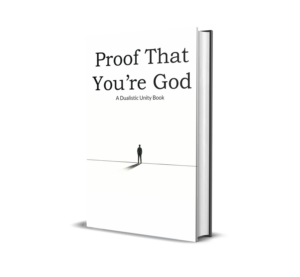
Proof That You’re God was written from within this same inquiry — not to redefine God, not to argue against belief, but to explore what becomes visible when intelligence is no longer imagined as something separate from reality itself.
If this article resonates, you may find Proof That You’re God meaningful. Not as an answer to what God is, but as an invitation to notice how awareness, identity, and reality are already woven together — quietly, seamlessly, and without instruction.