Why what you experience as “now” is already a carefully assembled story
There’s a quiet assumption most of us live inside without ever questioning: that what we’re experiencing is what’s happening. That the world arrives to us directly, moment by moment, in real time.
But it doesn’t.
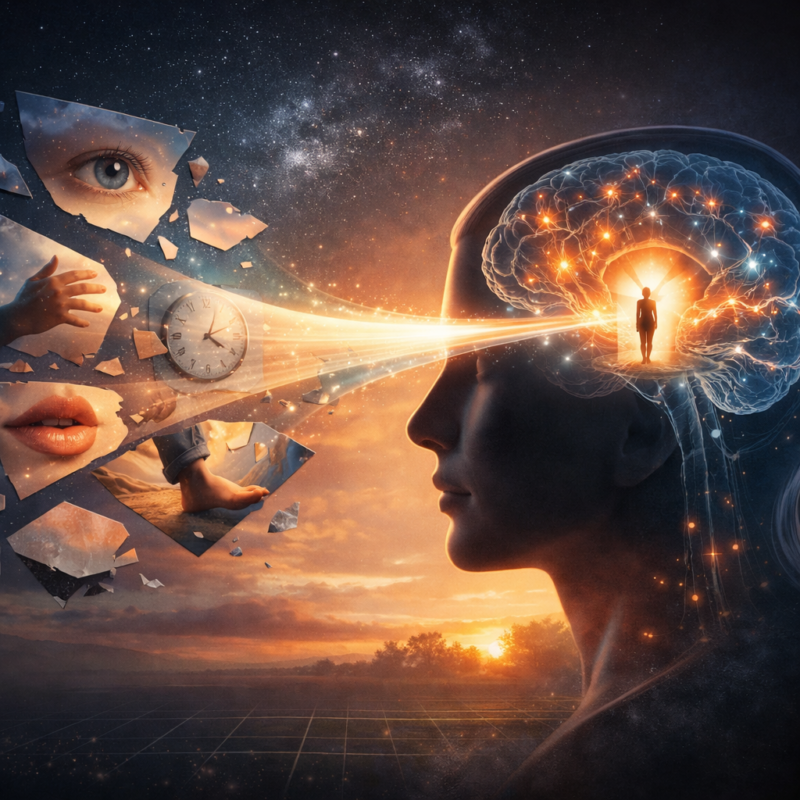
What you experience as now is not the present moment—it’s a reconstruction. A narrow window where the brain gathers fragments of sensation, delays them just long enough to organize them, and then presents the result as a seamless, immediate reality.
This isn’t a philosophical metaphor. It’s a measurable feature of perception.
And once you really see it, something fundamental shifts—not just about how the brain works, but about what you’ve been calling you.
The Small Slice of Reality We Actually Experience
Neuroscience describes a phenomenon often called the temporal binding window. In simple terms, it’s the brief span of time—usually tens to hundreds of milliseconds—during which the brain collects sensory information and binds it together into a single experience.
Within that window, events are perceived as simultaneous. Outside it, they’re experienced as separate.
That’s why you can touch your nose and your toe at the same time and feel it as one unified moment. Your brain anticipates signals from your own body, integrates them efficiently, and folds them into a single perceptual event.
But if someone else touches your toe at “the same time” you touch your nose, the illusion breaks. You feel the gap. The delay. The separation.
Nothing changed in the external timing—only in how the brain organized the information.
What this reveals is subtle but profound: simultaneity is not a property of reality; it’s a decision made by the nervous system.
The Present Moment Is Not Immediate
We like to say “be present,” as though presence means direct contact with what’s happening.
But perception doesn’t work that way.
Vision lags behind touch. Sound lags behind sight. Signals arrive at different speeds, are processed in different regions, and yet somehow show up as a single, coherent moment. How?
Because the brain waits.
It buffers reality.
It delays your experience just long enough to line everything up and present a convincing story called now. By the time you’re aware of anything, the brain has already edited it.
So the present moment you experience is not the raw present. It’s a retrospective synthesis—a best guess assembled after the fact.
This is one of the reasons clarity often feels elusive the harder we try to grasp it, a pattern explored more deeply in our broader work on awareness and perception, including how understanding itself can become an obstacle when we mistake mental models for lived reality (as explored in why clarity often feels harder the more we understand).
A World That Feels Stable—but Isn’t
If perception were literal and immediate, the world would feel chaotic.
Instead, it feels stable.
Objects don’t blur when you move your head. Sounds feel synchronized with moving lips. Your body feels like a single unit rather than a collection of delayed signals.
That stability is not proof of accuracy—it’s proof of successful illusion.
The brain’s job isn’t to show you reality as it is. Its job is to keep you functional, oriented, and alive. It smooths edges, fills gaps, and hides its own delays because a jittery, fragmented experience would be useless for survival.
You don’t see the world.
You see a model.
Where the Sense of “Me” Gets Assembled
Here’s where this becomes more than an interesting fact about neuroscience.
That same temporal window—the one that binds sights, sounds, and sensations—also binds identity.
The feeling of being a single, continuous self moving through time is not discovered. It’s constructed.
Thoughts arise.
Sensations arise.
Memories activate.
Emotions color them.
And then the brain stitches them together and says, “This is me, now.”
But there’s no singular point where a self appears. There’s just ongoing integration.
In Proof That You’re God, this is pointed to directly:
“You are not experiencing reality. You are experiencing your mind’s interpretation of reality—and mistaking that interpretation for what you are.”
The self you feel is part of the same perceptual package as the world you see. Both arrive together, fully formed, already labeled.
Why This Matters for Suffering
Much of human suffering comes from mistaking the constructed for the absolute.
We take thoughts personally.
We take emotions as truths.
We take perceptions as facts.
But when you see that even time itself is being assembled, something loosens.
Anxiety, for example, often feels urgent because it presents itself as happening now. But that urgency is part of the packaging. The body reacts not to reality, but to a predicted narrative stitched into the present moment.
When you realize that what feels immediate has already been filtered, delayed, and shaped, the grip of that urgency can soften.
Not because you suppress it—but because you no longer confuse it for reality itself.
Awareness Is Not Inside the Window
Here’s the quiet inversion most people miss.
If the window of perception is narrow…
If everything you experience is assembled inside it…
Then what you are cannot be limited to what appears inside that window.
Awareness is not something happening in time.
Time is something appearing in awareness.
This is why moments of stillness, awe, or deep presence often feel timeless. It’s not that time stops—it’s that attention loosens from the story being assembled and notices the space in which the story appears.
The podcast has circled this insight from countless angles over the years, not as a belief, but as something people repeatedly notice when they stop trying to manage experience and simply observe it.
You’ve Never Actually Touched the Present
This can sound disorienting at first.
If the present moment is delayed…
If perception is always slightly behind…
Then when do you ever experience reality?
The answer is: you don’t experience reality—you experience experiencing.
And that’s not a loss. It’s an opening.
Because what you are is not the content of the experience, but the context in which all content appears. The narrow window shows up to you. It doesn’t define you.
Once that’s seen, even briefly, the need to control, fix, or perfect experience begins to relax. Not because life becomes predictable—but because you stop demanding certainty from a process that was never designed to deliver it.
Living From This Insight (Without Making It a Belief)
This isn’t about walking around reminding yourself that nothing is real.
It’s about noticing, gently and practically:
- How quickly meaning is assigned
- How automatically “me” appears
- How convincing the story of now can feel
And how none of that requires a manager.
The brain will keep assembling reality. That doesn’t stop.
But the assumption that you are the assembly—that can fall away.
An Invitation to Look Again
The narrow window of perception isn’t a flaw. It’s a clue.
A clue that what you’ve been calling reality is a living process.
A clue that the self is not an object, but an activity.
A clue that awareness was never inside the story—it was always what the story appeared within.
If this resonates, Proof That You’re God explores these insights not as theory, but as lived recognition—through language meant to point, not persuade.
You don’t need to widen the window.
You only need to notice what’s been looking through it all along.