
There’s a moment that arrives for many people somewhere in adulthood that feels less like an insight and more like the ground quietly giving way beneath them.
It doesn’t come as an argument. Or a rebellion. Or a sudden loss of respect.
It comes as a realization:
The people in charge don’t actually know what they’re doing.
Not in the way you once assumed. Not in the way that made life feel oriented. Not in the way that suggested there was a right way to live, quietly held by someone wiser, steadier, or more evolved than you.
At first, this realization can feel shocking. Then unsettling. And eventually, deeply disorienting.
Because authority was never just about rules or leadership.
It was about orientation.
The invisible role authority played
As children, authority figures serve a function far larger than guidance or discipline.
They hold the idea—often implicitly—that someone understands how life works. That there is a correct way to move through the world. That uncertainty, while uncomfortable, is ultimately overseen by competence.
Even when authority was questioned, the underlying assumption usually remained intact:
Someone, somewhere, knows what’s going on.
Teachers. Parents. Experts. Leaders. Institutions.
Authority provided a psychological handrail. Something to lean on when the world felt confusing or overwhelming.
And most of us didn’t notice how much we relied on that handrail—until it wasn’t there anymore.
When the illusion quietly collapses
For some people, the collapse of authority happens slowly.
You notice contradictions. Hypocrisy. Incentives driving decisions that are framed as wisdom. You watch people with power protect themselves rather than reality. You see certainty rewarded more than honesty.
For others, it happens all at once—through a political moment, a career disillusionment, a personal betrayal, or a crisis that reveals how fragile the systems really are.
Either way, the realization lands the same:
Authority isn’t all-knowing. Authority isn’t neutral. Authority is often just people—afraid, self-interested, reactive, and confused in ways that mirror your own.
That recognition doesn’t just change how you see the world.
It changes how safe the world feels.
The untethered feeling no one prepares you for
When authority collapses, what disappears isn’t just trust.
What disappears is the sense that there is a correct way to live that can be learned, followed, or approved.
This is where many people begin to feel untethered.
If no one actually knows how to live, then:
- Who decides what matters?
- Who defines success?
- Who tells you when you’re doing enough?
At first, this can feel terrifying.
Without authority, there’s no one to defer to. No external reference point to fall back on when things get confusing. No guarantee that your choices are justified by something larger than you.
This is why the collapse of authority often brings anxiety rather than relief.
Freedom arrives before orientation.
Why we rush to replace authority
Most people don’t sit with this untethered feeling for long.
It’s uncomfortable. Exposed. Disorienting.
So the mind looks for substitutes.
Ideologies. Gurus. Movements. Moral absolutes. Polarized narratives. Productivity frameworks. Spiritual identities.
Anything that restores the sense that:
There is a right way, and someone knows it.
This isn’t a failure of critical thinking.
It’s a human response to uncertainty without guidance.
But replacing authority rarely resolves the underlying disorientation. It just shifts it into a new container—one that often demands certainty at the cost of honesty.
When no one can show you the right way
Eventually, for some people, the realization settles more fully:
There is no authority coming to orient your life.
No expert who can tell you how to live. No system that will resolve the ambiguity for you. No framework that will remove the responsibility of choosing what matters.
This is not a failure of society.
It’s the truth of being human.
And it’s why this phase feels so lonely.
Without authority, there is no permission slip. No validation that you’re doing life correctly. No external reassurance that the path you’re on is the right one.
Just choices. Consequences. And uncertainty.
The quiet freedom hidden inside the loss
What often goes unrecognized is that this same realization carries a different possibility—one that doesn’t feel empowering at first.
When authority dissolves, so does the idea that you’re doing life wrong by not matching an external standard.
There is no correct timeline. No universal script. No approved version of a meaningful life.
Responsibility remains—but it’s no longer outsourced.
Meaning becomes something lived, not granted.
This doesn’t make decisions easier. It makes them yours.
And while that can feel heavy, it’s also where a deeper kind of integrity begins to form.
Living without permission
Living without authority doesn’t mean living without care, ethics, or responsibility.
It means those things no longer come from above.
They emerge from relationship. From awareness. From seeing the impact of your choices on yourself and others.
This shift shows up very clearly in both law and spirituality.
In law, maturity doesn’t come from memorizing rules or proving you’re technically correct. It comes from understanding why laws exist, what they’re trying to protect, and when rigid correctness begins to violate the spirit they were meant to serve.
In spirituality, the same transition appears. Early on, teachings, practices, and doctrines offer structure and safety. They provide orientation. But at some point, following the teaching becomes insufficient. Repeating the words isn’t the same as recognizing what they’re pointing to.
This is where understanding overtakes correctness.
Rules and teachings can be followed without being understood. Recognition cannot.
When recognition happens, your relationship with everything changes—not because you’re right, but because you’re seeing.
This is why authority eventually gives way to discernment. Not rebellion. Not superiority. But an intimacy with reality that no rulebook can substitute for.
This shift is often messy. Uneven. Uncomfortable.
But it’s also the point where adulthood stops being performative and starts being honest.
This same disorientation shows up collectively as well—when noise, certainty, and outrage attempt to fill the vacuum left by lost authority.
A final reflection
If you’ve begun to sense that no one actually knows how to live, you’re not cynical.
You’re not broken.
You’re encountering a truth that was always there, quietly held together by trust in authority.
Losing that trust can feel untethering.
But it can also be the beginning of living without needing permission—without waiting for someone else to define what matters, what’s enough, or who you’re supposed to be.
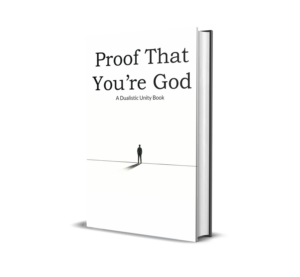
This shift—from external authority to lived responsibility—is explored more deeply in Proof That You’re God. Not as a replacement authority, but as an invitation to notice what remains when no one else can tell you how to live.
There’s no one coming to show you the way.
And strangely, that’s where something real begins.