
There is a moment all our explanations eventually fail to avoid.
It arrives after every strategy runs out.
After every identity stops working.
At the end of every road we believed would finally take us somewhere else.
And frustratingly—undeniably—it looks exactly like where we started.
Here.
Now.
This moment.
Not as a concept.
Not as a philosophy.
But as lived experience, before it’s explained, managed, or escaped.
This is the moment our articles keep circling. Not because it’s special, but because it’s unavoidable. It’s the place life actually happens—and the place we spend most of our energy trying not to be.
The Moment We Keep Trying to Leave
Most of our psychological effort isn’t aimed at living.
It’s aimed at relief.
Relief from uncertainty.
Relief from vulnerability.
Relief from not knowing what’s going to happen next.
We build identities to provide that relief. Stories about who we are, what we’re doing, where we’re going, and why it all makes sense. These narratives give us something solid to stand on in a world that keeps changing.
And for a while, they work.
Until they don’t.
Eventually, every identity reaches a point where it can no longer stabilize experience. Every strategy exhausts itself. Every explanation loses its credibility. And when that happens, we don’t fall into chaos—we fall back into this moment.
Not because we failed.
But because this is where change actually happens.
The End of Every Road Is the Beginning
It often feels like defeat when we end up here again.
We tried to become someone.
We tried to figure it out.
We tried to secure meaning, certainty, or purpose.
And here we are—uncertain, unanchored, without the story we were relying on.
But this moment isn’t a dead end.
It’s a return.
Every road ends here because this is the only place life can be met directly. Anything else is memory, anticipation, or imagination—useful, but not alive in the same way.
This is why clarity so often feels destabilizing. It removes the buffer identity creates between us and experience. It places us back into direct contact, without the distance of explanation or control. That tension—why clarity can feel threatening rather than comforting—is explored more deeply in why clarity often feels harder the more we understand.
Uncertainty Is Potential, Not a Problem
This moment is usually summarized by a single word: uncertainty.
And uncertainty is treated as something to solve.
But uncertainty isn’t the problem.
Uncertainty is potential.
It’s the openness where something new can happen. The space where attention sharpens, sensitivity increases, and life is actually felt. Without uncertainty, nothing can change. There is no learning, no growth, no creativity—only repetition.
What hurts isn’t uncertainty itself.
What hurts is trying to live without it.
Identity promises relief from uncertainty by offering something stable to be. But identity is fragile. It depends on predictability, continuity, and control—none of which life can guarantee.
So we keep reinforcing it.
Defending it.
Adjusting it.
And in doing so, we separate ourselves from the very aliveness we’re trying to feel.
The Choice That Keeps Appearing
Every time we return to this moment, the same quiet choice appears.
It isn’t dramatic.
It isn’t moral.
It isn’t a test.
It’s simply this:
Do we participate in what’s happening—or do we retreat into who we think we are?
Participation feels risky.
Identity feels manageable.
Participation requires attention.
Identity offers explanation.
Participation allows change.
Identity tries to control it.
When we choose identity, we gain a sense of safety—but lose contact.
When we choose participation, we lose certainty—but gain aliveness.
This choice happens constantly, usually beneath awareness. It’s not made once. It’s made moment by moment.
Why Avoiding This Moment Feels So Lonely
Identity separates.
Not because it’s wrong, but because it stands between us and experience.
When life is filtered primarily through self-concept, experience becomes something happening to us rather than something we’re in. Meaning becomes something to find. Connection becomes something to achieve. Purpose becomes something to manufacture.
And so we feel alone.
Disconnected.
Purposeless.
We search for meaning, not realizing we’ve been turning away from the very place meaning arises—direct involvement with what’s here.
The loneliness so many people feel isn’t the absence of connection.
It’s the absence of participation.
The Leap of Faith That Isn’t What It Sounds Like
This moment is often described in spiritual language as a leap of faith.
But it isn’t faith in something.
It’s faith without something.
Faith without guarantees.
Without identity to stand on.
Without certainty to lean against.
God, connection, eternity—whatever language we use—aren’t found somewhere else. They aren’t waiting beyond experience. They aren’t accessed by becoming someone different.
They are what remains when we stop stepping away from what’s already happening.
Not because we achieve them.
But because we stop avoiding them.
The Rudder of the Ship
This moment doesn’t look important.
It doesn’t announce itself.
It doesn’t feel transcendent.
It doesn’t promise resolution.
But it’s the rudder of the ship.
This is where attention deepens.
Where sensitivity grows.
Where responsiveness replaces control.
Where change happens—not by force, but by contact.
Everything meaningful in a human life unfolds from here. Not from certainty. Not from identity. But from the willingness to remain present when there’s nothing solid to hold.
We Never Left
We keep thinking we need to arrive somewhere else.
But this moment isn’t a destination.
It’s the starting point we never left.
We only learned to look away from it—out of fear, and out of a hope that identity could buoy us in a world that changes too quickly to hold.
It can’t.
And it doesn’t have to.
Because what we’re trying to escape is the very ground of aliveness itself.
The Point
This moment—uncertain, open, alive—is not something to overcome.
It’s not a problem to solve.
It’s not a state to maintain.
It’s not an experience to capture.
It’s where growth happens.
Where attention sharpens.
Where feeling deepens.
Where life actually moves.
Every collapse, every questioning, every return is pointing here.
Not because we’re lost.
But because this is the place where living begins again.
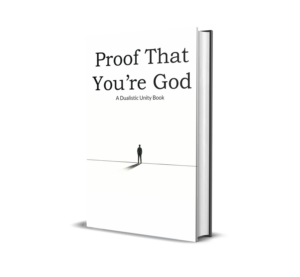
If this recognition feels familiar, it’s because this moment has been quietly shaping every turning point you’ve experienced. Proof That You’re God explores this territory more slowly and continuously—what it’s like to live when the effort to escape uncertainty softens, and attention is allowed to rest where life is already happening.