
I just reached the end of Month 1 in 2026.
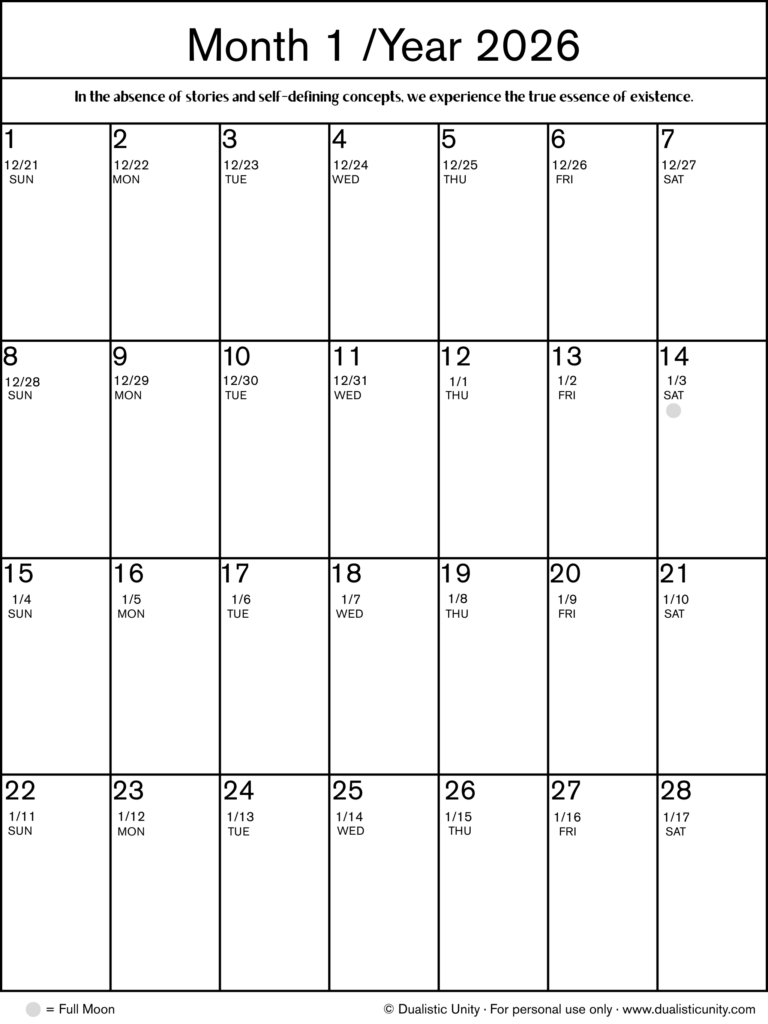
This year, as I’ve lived it, didn’t begin on January 1. It began at the Winter Solstice. Instead of unfolding through twelve uneven months, it’s moving through thirteen identical months, each exactly 28 days long.
I didn’t change my job.
I didn’t change my routines.
I didn’t leave the world everyone else is living in.
But something shifted anyway.
Time felt different.
That difference didn’t arrive dramatically. It didn’t announce itself as clarity or insight. It showed up quietly, as a change in how days related to one another—how beginnings and endings felt less arbitrary, and how the passing of a month no longer carried the same invisible pressure to justify itself.
This first cycle didn’t feel like progress.
It felt like orientation.
And that distinction matters.
Much of what we explore at Dualistic Unity—on the podcast, in our merch, and in our writing—centers around how perception shapes experience long before we consciously intervene. The way we structure time is one of those invisible lenses. It rarely gets questioned, even though it quietly conditions how we relate to effort, meaning, and selfhood. This month made that conditioning visible in a way I hadn’t expected, touching directly on themes we explore more broadly around awareness and perception, including why clarity often feels harder the more we try to force it (Why Clarity Often Feels Harder the More We Understand).
A Year That Didn’t Ask Me to Start Over
There’s something psychologically heavy about January.
Even if we resist it, the cultural expectation is there: reset, improve, commit, become someone slightly better than you were allowed to be before. The year begins with a subtle demand to perform forward motion.
This year didn’t do that.
Beginning at the Winter Solstice changed the emotional tone of the entire cycle. The solstice isn’t an idea—it’s a real turning point. The longest night passes. Light begins its slow return. Nothing accelerates. Nothing announces itself as new. The shift happens whether we notice it or not.
Starting there meant Month 1 didn’t feel like a launch. It felt like settling into something already underway.
There was no sense that I should be further along by the end of the month. No background anxiety about whether I had “used it well.” The month didn’t feel like a container to fill. It felt like a span to inhabit.
That alone softened something fundamental.
Four Weeks Is a Human Amount of Time
One of the most unexpected effects of the 13-month structure was how comprehensible a month became.
In the Gregorian calendar, months are oddly abstract. Some stretch long. Others collapse. February always feels unfinished. December feels overloaded. We rarely know what a month contains until it’s already gone.
But four weeks—twenty-eight days—has a texture.
There’s a beginning you can feel.
A middle that actually arrives.
An ending that doesn’t rush you out.
As Month 1 came to a close, there was no scramble to catch up. No sense of being cut off mid-thought. The cycle simply completed itself.
That sense of completion is rare in modern timekeeping. We usually manufacture it retroactively with reflection exercises or productivity metrics. Here, it arrived on its own.
Nothing needed to be added.
Being Ahead and Behind at the Same Time
There was, however, a strange dissonance.
As Month 1 ended, the rest of the world was still talking about “the beginning of the year.” January conversations were ongoing—resolutions, intentions, fresh starts. Meanwhile, I felt like I had already lived through a full cycle.
That created an unusual sensation: being ahead and behind at the same time.
Behind, because I wasn’t aligned with the social timeline.
Ahead, because I wasn’t waiting for permission to continue.
This tension didn’t feel like conflict. It felt like standing slightly off to the side of a current that most people don’t realize they’re swimming in.
It highlighted something subtle: much of our anxiety around time isn’t about lack of time, but about misalignment of reference points. When the structure underneath experience shifts, the urgency built on top of it loosens.
Not because anything has been solved—but because the frame has changed.
Nothing Needed to Be Carried Forward
One of the quieter gifts of this first month was the absence of residue.
When a Gregorian month ends, it often leaves behind an emotional trail—unfinished intentions, deferred plans, things that should have happened but didn’t. Even when nothing goes wrong, the transition can feel abrupt.
Month 1 didn’t do that.
When it ended, there was nothing to summarize. Nothing to transfer. Nothing to clean up before moving on. The next month wasn’t an improvement on the last—it was simply the next turn of the cycle.
That continuity reduced the sense that life is constantly fragmenting into before and after.
It felt less like moving forward and more like staying with what was already happening.
Living Inside a Structure Without Being Managed by It
It’s important to say this clearly: using this calendar didn’t remove me from the world.
I still scheduled meetings.
I still used Gregorian dates when needed.
I still lived in shared time.
But beneath all of that, another rhythm was quietly running—one that didn’t demand attention, optimization, or belief. It didn’t ask me to “do” anything with it.
That’s consistent with what we’ve seen over years of conversation and facilitation. When structures stop demanding performance, they begin to reveal something else: how experience organizes itself when it’s not being constantly corrected.
This first month didn’t teach me anything new. It revealed something familiar in a different light.
Time doesn’t need to be managed to be lived.
Standing at the Threshold of Month 2
Now Month 2 is about to begin.
There’s no ceremony around it. No feeling that I should reflect deeply or set intentions. The cycle turns because that’s what cycles do.
I don’t know yet what Month 6 will feel like. Or Month 13. I don’t need to project forward to justify the experience.
Month 1 completed itself.
Month 2 is ready.
That’s enough.
A Closing Invitation
This reflection isn’t meant to persuade anyone to adopt a different calendar. It’s simply an account of what happened when one quiet structural assumption was loosened.
If you’re curious to explore this yourself, the 13-Month Solstice Calendar is available as a digital download. And if calendars aren’t the option for you, we continue exploring these themes—identity, awareness, time, and lived experience—through essays, conversations, and our ongoing work.
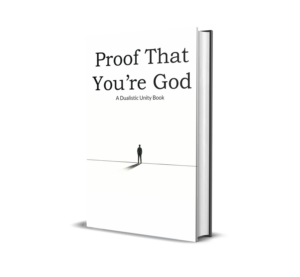
For those who want to go deeper into the underlying recognition these structures point toward, Proof That You’re God remains the clearest articulation of the insight that has guided everything we create: that what you are looking for has never been separate from the looking itself.
You don’t need to change your life to notice that.
Sometimes it’s enough to let a cycle end cleanly—and see what remains when nothing needs to be carried forward.