The question comes up everywhere.
In science.
In philosophy.
In spirituality.
What is consciousness?
It sounds like the right question — serious, rigorous, and appropriately mysterious. And yet, the more carefully we look at experience itself, the more the question begins to feel slightly misdirected.
Because consciousness is never encountered as one thing among others.
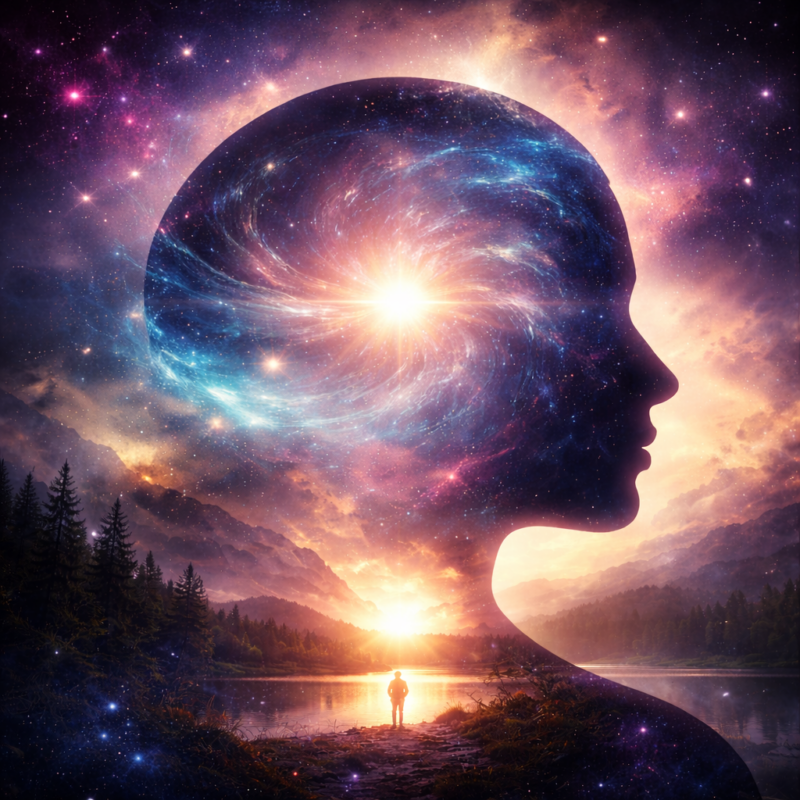
It’s what everything else appears within.
So a more honest question may be:
What isn’t consciousness?
Why the Question Keeps Slipping Away
We’re used to understanding things by defining their boundaries.
A chair is not the floor.
A tree is not the sky.
A thought is not a sound.
But consciousness doesn’t behave that way.
Every attempt to point at it already happens in it.
Every definition appears within the very thing being defined.
This is why consciousness remains so elusive — not because it’s hidden, but because it’s too close.
This difficulty is part of a broader pattern explored in why clarity often feels harder the more we understand. The more fundamental something is, the harder it becomes to treat it as an object.
Consciousness Is Not an Object in Experience
Look closely at your own experience right now.
You may notice:
- sounds
- sensations
- thoughts
- emotions
- perceptions
Each of these has a quality. A location. A duration.
But where is consciousness itself?
Is it a sound?
A sensation?
A thought?
No — it’s what all of those are appearing to.
You don’t experience consciousness the way you experience an object. You experience objects through consciousness.
Which makes the usual scientific impulse — to locate it, isolate it, or reduce it — inherently difficult.
The Category Error We Keep Making
When we ask “What is consciousness?” we often assume it must be:
- a thing produced by the brain
- a property added onto matter
- a function that turns on at a certain level of complexity
But all of these assumptions treat consciousness as something inside the world.
Yet our direct experience suggests the opposite.
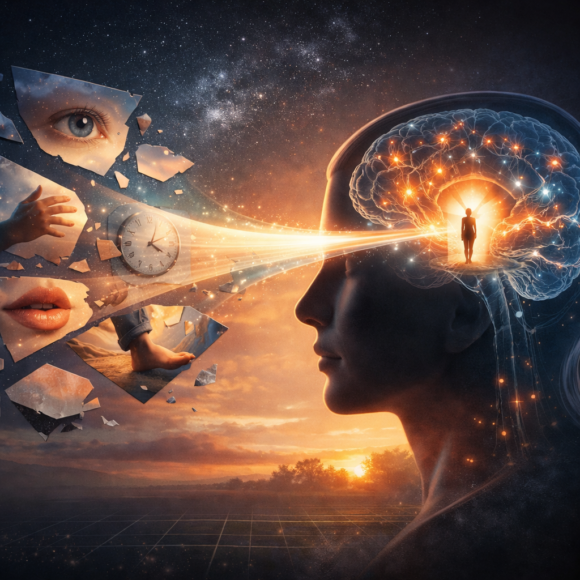
The world appears inside consciousness.
That doesn’t mean the brain is irrelevant.
It doesn’t mean biology doesn’t matter.
It means we may be mistaking a correlate for a container.
The brain correlates with experience.
But experience itself is not found inside the brain the way a thought is found inside a sentence.
Awareness Has No Opposite
One of the simplest clues is this:
Everything has an opposite — except awareness.
Sound has silence.
Light has darkness.
Thought has absence.
But what is the opposite of consciousness?
Unconsciousness is not something you experience.
It’s a description applied after the fact.
Even the absence of experience is only known from within awareness.
This makes consciousness unique.
It doesn’t come and go as an experience.
It remains as the context in which experiences come and go.
Why “What Isn’t?” Is the More Revealing Question
If you begin asking “What isn’t consciousness?” something subtle shifts.
Sensations appear — still consciousness.
Thoughts arise — still consciousness.
Emotions surge — still consciousness.
Even confusion about consciousness appears within it.
The question stops being philosophical and becomes experiential.
You’re no longer trying to understand consciousness as an object.
You’re noticing it as the constant background of every moment.
Consciousness and the Sense of Self
This is where identity quietly enters the picture.
We often assume consciousness belongs to the self.
That I am conscious.
But when examined closely, the sense of “I” appears as:
- a thought
- a narrative
- a point of reference
Which means the sense of self is something known — not the knower itself.
This doesn’t erase identity or personality.
It simply places them within awareness rather than at its center.
And that reorientation can be deeply relieving.
Why This Isn’t a Belief
Nothing here requires adopting a new worldview.
You don’t have to believe consciousness is fundamental.
You don’t have to deny neuroscience.
You don’t have to reject science or spirituality.
You only have to notice what is already true in experience.
That noticing doesn’t produce fireworks.
It doesn’t make you special.
It simply reveals what has never been absent.
Reality Without a Center
When consciousness is recognized this way, something surprising happens.
Experience no longer feels like it’s happening to someone.
It feels like it’s simply happening.
Thoughts arise.
Sensations pass.
The sense of “me” appears and dissolves like everything else.
Nothing is excluded.
Nothing is outside.
And the question “What is consciousness?” gently dissolves — not because it’s been answered, but because it’s been outgrown.
Living the Question Instead of Solving It
The point of this inquiry isn’t to arrive at a conclusion.
It’s to shift orientation.
From trying to understand consciousness
to noticing that understanding itself is an appearance within it.
From asking what consciousness is
to seeing that everything you know already depends on it.
An Invitation to Notice What’s Already Here
Proof That You’re God was written from within this same inquiry — not to define consciousness, but to invite a direct recognition of what remains present before, during, and after every experience.
If this article resonates, you may find Proof That You’re God meaningful. Not as an explanation of consciousness, but as an invitation to notice what isn’t separate from you — because nothing ever was.