Psychedelics are often described as substances that expand consciousness.
They’re associated with mystical insight, ego death, altered perception, and profound shifts in meaning. At the same time, they’re framed as dangerous, destabilizing, or capable of inducing madness.
Both narratives point toward the same underlying mechanism — but neither quite names it.
Psychedelics don’t add something foreign to experience.
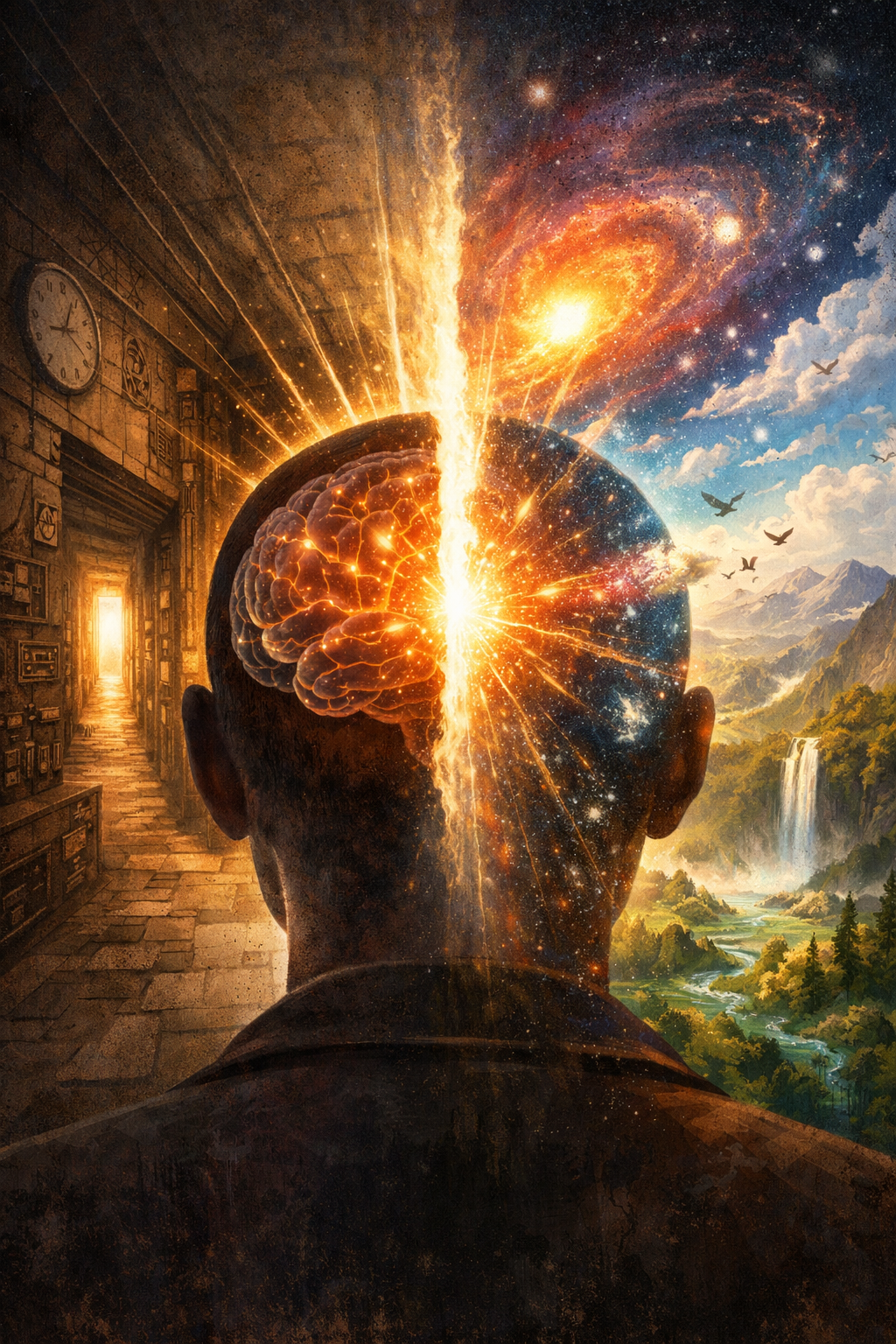
They widen the narrow window through which reality is usually allowed to appear.
And when that window widens, what’s revealed isn’t a new world — it’s how much is normally filtered out in order for life to feel coherent, controllable, and safe.
This article explores psychedelics not as truth‑revealing tools or chemical threats, but as catalysts that temporarily relax the constraints that keep reality narrow — revealing both the expansiveness that exists beneath and the fear that arises when control slips.
This idea — that what we experience as reality is a narrow, functional slice rather than the whole — has been explored more deeply in a broader reflection on why clarity can paradoxically feel harder the more we understand.
The Narrow Window We Call Reality
In ordinary waking life, reality appears remarkably stable.
Objects stay objects. Time moves forward. Identity feels continuous. Meaning feels obvious.
This stability isn’t accidental.
What we experience as “reality” is a highly curated slice of what’s possible, shaped by survival, language, memory, and prediction. Perception is narrowed so experience remains usable. Coherence is prioritized over completeness.
This narrowing doesn’t hide reality.
It makes it livable.
But it also means that what feels like the whole is actually a window — one that filters out ambiguity, excess information, and experiential openness in favor of control.
Psychedelics don’t break this window.
They loosen the frame.
What Actually Changes in Psychedelic States
Modern neuroscience consistently shows that psychedelic states correlate with reduced activity in specific brain networks, particularly those associated with self‑referential thinking and narrative continuity.
Most notably, activity in the default mode network (DMN) tends to decrease.
The DMN is active when:
- We’re thinking about ourselves
- Maintaining a sense of identity
- Replaying the past or anticipating the future
- Interpreting experience through story
- Predicting and managing what’s happening
This network doesn’t create awareness.
It organizes it.
It narrows experience into a coherent story about “me” moving through a predictable world.
When psychedelics quiet this organizing function, awareness doesn’t disappear.
The window simply widens.
Why Less Control Can Feel Like More Awareness
As narrative control loosens:
- Sensation feels more vivid
- Time feels less segmented
- Meaning feels less imposed
- Boundaries between “self” and “world” soften
Nothing new is added.
Less is excluded.
Experience feels expansive not because consciousness has grown, but because the mechanisms that normally compress it have relaxed.
What’s often described as “expanded awareness” is better understood as reduced filtering.
Ego Isn’t the Problem — Commitment Is
The ego is frequently portrayed as something psychedelics destroy.
That framing misses the point.
Ego is simply the structure that allows awareness to be navigated.
It stabilizes identity, enables planning, and keeps experience oriented. Without it, daily life wouldn’t function.
The difficulty isn’t ego itself.
It’s the commitment to ego as reality.
When awareness is fully committed to its own narrative, experience is limited to what fits the story — what can be named, predicted, and controlled.
Psychedelics loosen that commitment.
What’s revealed isn’t chaos.
It’s openness that was always present but normally excluded.
Why This Feels Like Liberation or Panic
The widening of the window can feel profoundly relieving.
But it can also feel terrifying.
As narrative grip softens:
- Control fades
- Certainty dissolves
- Familiar reference points disappear
For someone whose sense of safety depends on coherence and predictability, this can feel like losing sanity.
Not because reality has broken — but because the strategy for managing reality has.
This helps explain why psychedelic experiences are described in such polarized terms:
- Awakening
- Insight
- Ego death
- Panic attack
- Psychotic episode
The difference isn’t the substance.
It’s the relationship to losing control.
Are Psychedelics Revealing Truth?
It’s tempting to say that psychedelics reveal ultimate truth.
It’s equally tempting to dismiss them as distortions.
Both positions miss something subtler.
Psychedelics don’t reveal a different reality.
They reveal how reality is normally constrained.
What feels profound isn’t necessarily new information — it’s the absence of the usual narrowing that makes experience feel manageable.
Insights feel obvious afterward because they weren’t learned.
They were noticed once the window widened.
Shared Awareness, Different Windows
When the story of “me” relaxes, something quiet but radical becomes apparent.
Awareness doesn’t feel personal.
It feels universal — appearing here, as this perspective, but no longer owned.
This isn’t a belief psychedelics install.
It’s a recognition that becomes available when identity stops monopolizing attention.
What differs from person to person isn’t awareness itself.
It’s the window through which awareness is filtered.
Why We Always Come Back to the Window
Psychedelics don’t permanently dissolve ego.
And they aren’t meant to.
Life requires:
- Identity
- Narrative
- Assumption
- Control
The value of these experiences isn’t in escaping the window forever.
It’s in realizing that the window is not the whole of what’s real.
That recognition can soften how tightly it’s held.
The Real Risk
This isn’t an argument that psychedelics are safe for everyone or necessary for insight.
They can destabilize people who aren’t ready for widened perception.
They can amplify fear when context, support, or trust are absent.
The risk isn’t openness itself.
It’s sudden loss of narrowing without grounding.
Psychedelics as Mirrors, Not Methods
Psychedelics don’t manufacture wisdom.
They expose our relationship to:
- Control
- Identity
- Meaning
- Uncertainty
They show what remains when effort drops and the frame relaxes.
Whether that feels like freedom or threat depends on how much safety has been invested in the story.
Closing Reflection
What psychedelics ultimately point to isn’t a better version of reality.
It’s the recognition that awareness was never confined to the narrow window in the first place.
When control relaxes, awareness doesn’t disappear.
It simply stops being compressed into a story that feels manageable.
Proof That You’re God was written for readers drawn to this exact edge — not to abandon the window, but to see it clearly, and discover what remains when it widens.