For many people today, Occupy Wall Street barely registers as history at all.
Those who were too young in 2011 may recognize the phrase without understanding its scale. Those who were adults at the time often remember it vaguely—tents, protests, police, an eventual dispersal—but not the depth of what was unfolding or why it mattered so much in that moment.
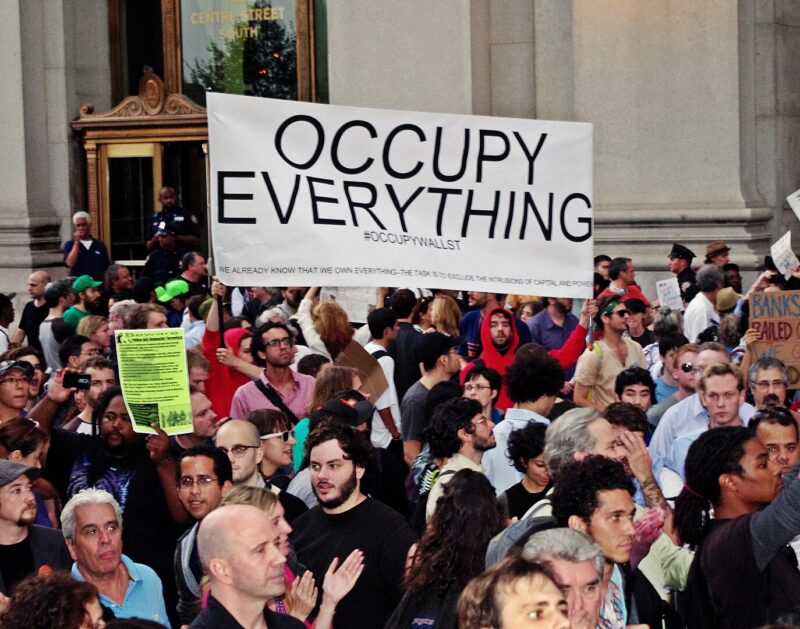
Occupy Wall Street was not a small protest. It was a massive, decentralized movement that emerged in the wake of the 2008 financial collapse, at a time when trust in institutions had quietly eroded but had not yet found a collective voice. It began in September 2011, when a call to occupy public space near Wall Street brought together students, workers, unemployed people, artists, professionals, and activists—many of whom had never protested anything before.
Within weeks, occupations appeared in hundreds of cities across the United States and around the world.
What Occupy disrupted was not just physical space, but narrative space.
It disrupted the assumption that the financial crisis had been resolved.
It disrupted the idea that inequality was unfortunate but inevitable.
It disrupted the belief that dissatisfaction was personal rather than systemic.
And perhaps most importantly, it disrupted the unspoken agreement that people should endure these conditions quietly and individually.
At its height, Occupy persisted for months, drawing tens of thousands of participants and spreading to hundreds of cities worldwide—making it one of the largest coordinated protest movements of its time.
It was beautiful.
A Movement Without Demands
From the beginning, Occupy Wall Street confounded expectations.
There were no official leaders.
No centralized organization.
No list of demands.
This absence was not accidental. It was intuitive.
What people were responding to had not yet crystallized into policy language. The recognition was felt more than understood. The movement was animated by a shared sense that something fundamental had gone wrong—not just economically, but socially and psychologically.
The now-famous phrase “We are the 99%” captured this in a way that statistics never could. It wasn’t a technical argument. It was a relational one. It named a lived divide that people felt every day but rarely discussed collectively.
For a brief period, Occupy created a space where that recognition could be shared without being immediately reduced to solutions.
That space was its power.
The Question That Changed Everything
Then the media arrived in force.
And with it came a question that sounded reasonable, even responsible:
“What, specifically, are you asking for?”
The question wasn’t malicious. But it carried an assumption that reshaped the movement from the inside.
It assumed that clarity must precede legitimacy.
That specificity equals seriousness.
That a movement without demands is incomplete.
What it overlooked was that Occupy wasn’t avoiding clarity—it was resisting premature simplification.
Before moving further, it helps to place this dynamic within a broader cultural pattern: how collective discomfort is often forced into digestible narratives, and how complexity gets flattened by the need for resolution. This is explored more deeply in why the world feels so loud, where meaning is constantly compressed into positions rather than explored as lived experience.
Occupy didn’t collapse because it lacked answers.
It fractured because answers were demanded before the question had finished forming.
The Power of a Shared, Unfinished Recognition
“What do you want?”
Occupy’s most honest answer was also its most unsettling:
“We don’t fully know yet. But this isn’t working.”
That answer created space.
People didn’t gather because they agreed on solutions. They gathered because they recognized the same tension in their lives—an underlying mismatch between effort and reward, between promise and reality, between participation and power.
For a moment, that shared discomfort was enough to hold people together.
Discomfort, when recognized collectively, can unify more deeply than ideology ever does.
When Language Enters Too Soon
The moment Occupy attempted to translate that recognition into specifics, division became inevitable.
To specify a problem, you must choose:
- Which harm matters most
- Which voices take priority
- Which timeline feels urgent
- Which solutions are acceptable
Explanation requires exclusion.
What had once been a shared inquiry began to splinter into competing narratives. The movement didn’t just face external pressure—it internalized the demand to become legible.
And legibility came at a cost.
How Class Differences Quietly Reasserted Themselves
As Occupy searched for clarity, existing social divides resurfaced.
Participants with financial stability could afford abstraction. They spoke about systemic reform, long-term economic restructuring, and philosophical critiques of capitalism. Their language had space because their lives had space.
Participants without stability spoke from immediacy. Rent. Debt. Food. Healthcare. Survival. Their grievances were not theoretical—they were embodied and urgent.
Both perspectives were valid.
They were also no longer aligned.
The very inequalities being questioned quietly reappeared within the movement itself—shaping whose voices carried weight and whose urgency was treated as disruptive.
What had begun as a collective recognition fractured into parallel experiences that no longer felt shared.
Identity Replaced Inquiry
As divisions hardened, identity filled the gap left by inquiry.
People became representatives:
- Of causes
- Of classes
- Of ideologies
- Of moral positions
Once identity solidifies, defense follows.
Once defense follows, listening fades.
Occupy didn’t dissolve because it lacked organization.
It dissolved because the open space of not-knowing collapsed under the pressure to be right.
The Mistake Wasn’t Vagueness — It Was Forgetting the Orientation
The tragedy of Occupy is often framed as a failure to articulate demands.
But its deeper loss was forgetting why it didn’t have them yet.
The movement’s strength was never in isolating a single issue. It was in revealing that the problem might not be isolatable at all—that it was systemic in ways that exceeded economics.
Right down to how people understood themselves.
The System Isn’t Only External
What Occupy brushed up against—but couldn’t sustain—was a more unsettling recognition:
Systems persist because they are mirrored internally.
Hierarchy isn’t only enforced by institutions.
Scarcity isn’t only economic.
Competition isn’t only structural.
They show up as:
- The need to be right
- The urge to prioritize “my issue”
- The discomfort of ambiguity
- The pressure to define oneself against others
When a movement demands immediate clarity, it often reproduces the very dynamics it’s questioning.
Why “Something Is Wrong” Was the Most Honest Position
“Something is wrong” was never a slogan.
It was an orientation.
It left room for listening.
It invited shared inquiry.
It resisted premature solutions.
Most importantly, it acknowledged complexity without pretending to resolve it.
Occupy’s initial power came from holding that space together.
Its unraveling came from abandoning it.
Media, Narratives, and the Need for Resolution
Media thrives on resolution. Movements that resist simplification are labeled confused or unserious. Ambiguity is framed as weakness.
But ambiguity is where genuine understanding begins.
The demand for specificity wasn’t neutral—it was a demand to compress systemic discomfort into something manageable, marketable, and ultimately containable.
Once compressed, the recognition lost its force.
What Occupy Still Teaches Us
Occupy Wall Street didn’t fail in the way history often suggests.
It revealed something enduring:
- Collective recognition is fragile
- Systems resist being named all at once
- Identity reasserts itself under pressure
- Sitting with discomfort is harder than arguing solutions
And yet, for a brief moment, something rare occurred.
People stood together without fully knowing why—and trusted that not knowing enough to remain present.
That may be Occupy’s real legacy.
The Recognition That Keeps Returning
The feeling that animated Occupy hasn’t disappeared.
It resurfaces in:
- Economic anxiety
- Political polarization
- Cultural exhaustion
- Personal identity crises
Each time, the same tension appears:
Do we stay with the discomfort long enough to understand it—or do we rush toward explanations that divide us?
The question remains open.
Closing Reflection
Occupy Wall Street wasn’t a failure of organization. It was an encounter with complexity that arrived before our culture knew how to stay with it.
“Something is wrong” was never meant to be the conclusion.
It was the doorway.
And perhaps the reason it keeps returning—again and again, in different forms—is because we still haven’t learned how to walk through it together.
If this reflection resonates and you’re curious about how systems, identity, and perception intertwine beneath politics and economics, you may find Proof That You’re God a meaningful companion—not as an answer, but as an invitation to look where certainty usually prevents us from looking.