There are certain memories that don’t just stay with us — they shape us.
For me, one of those came from a Christmas morning thirty-something years ago, when I spent my holiday money on a Nintendo game called Shadowgate for the NES. It was nothing like the platformers and action games of its era. Shadowgate wasn’t about reflexes or speed. It was a first-person fantasy adventure full of hidden puzzles, deadly traps, and countless ways for the hero to die — often in abruptly humiliating ways.
You didn’t just lose the game.
You experienced your own vulnerability in real time.
I never finished that game.
Not even close.
But I never really lost either — even though that’s what it often felt like in the moment.
Over the decades since, I’ve realized that what Shadowgate taught me wasn’t how to win.
It taught me how to face exposure without collapsing into self-judgment.
And that lesson — which began in a pixelated castle full of death and riddle — has followed me through many rooms of real life that felt just as hostile and just as confusing. This is part of why video games matter more than we think — not because they distract us from life, but because they quietly rehearse the emotional patterns we’ll encounter again and again outside the screen.
A Game Where Death Is Everywhere
Shadowgate is a point-and-click adventure in which you explore a sinister castle full of puzzles, traps, monsters, and hidden secrets. It casts you as the last of a line of hero-kings, tasked with stopping an evil Warlock Lord before he unleashes catastrophic destruction.
But the castle isn’t generous.
A single misstep — picking up the wrong item in the wrong place, walking into the wrong room, making a choice that seems logical but isn’t — and your character dies. Not in a dramatic climax, but in a way that is sudden and often ironic: crushed by a trap, dissolved by acid, eaten by a creature, or struck down by forces you hadn’t quite understood yet.
The game demanded:
- patience
- careful observation
- willingness to experiment
- acceptance of repeated failure
It was impossible in the sense that you could easily play for an hour, make a small misstep, and find yourself staring at a message that reminded you you were dead and had to try again.
The Emotional Pattern of Loss and Return
As a kid, that felt devastating.
Not because the game was unfair — but because I cared. I wanted to succeed. I wanted to win. I wanted closure, completion, mastery.
And every time I didn’t, something uncomfortable arrived:
- a flush of frustration
- a tightening in the chest
- that self-critical voice saying, “Why can’t you figure this out?”
Yet each time, after a break and a walk away, I came back and tried again.
Not because I was chasing victory —
but because the process itself had a strange allure.
Every time I failed early in the castle, I didn’t just lose progress.
I felt exposed.
Not defeated, exactly.
Exposed.
Exposure Versus Defeat
Loss has many flavors.
There’s defeat — the kind that stops you, crushes your confidence, and leaves you feeling like there’s nothing left to try.
And then there’s exposure — the kind that opens you, even if it feels awkward or uncomfortable.
In Shadowgate, every wrong choice revealed something about the game.
The death message wasn’t just punishment — it was information.
Maybe that torch was meant to stay lit.
Maybe that door hid a trap.
Maybe the riddle wasn’t a riddle at all — it was a hint.
In life outside the game, this is how certain experiences feel:
- you try
- you scan for the “right” move
- you get disappointed
- you feel uncovered
- and then you try again
But there’s a difference between:
- needing to win
- and being willing to try
The first is fear-driven.
The second is curiosity-driven.
Shadowgate didn’t let you win easily — but it conditioned you to play with exposure rather than collapse into defeat.
The Pattern Shows Up Everywhere
That emotional transition — from fear of loss to tolerance of exposure — appears again and again in adult life.
In relationships, when someone we care about gets distant.
In work, when a project doesn’t succeed.
In creativity, when a piece of writing fails to land.
In identity, when an old sense of self doesn’t fit anymore.
In every case, the pattern is the same:
- We reach for mastery
- We encounter resistance or failure
- We feel exposed and unsure
- We can either fold or return with curiosity
This isn’t about success.
It’s about relationship to failure.
And it’s not about never feeling defeated.
It’s about learning that defeat isn’t the opposite of peace.
Exposure — trying without needing to win — often feels worse at first than defeat itself.
But paradoxically, it’s where peace emerges.
Games That Don’t Let Us Hide
Part of why Shadowgate has endured — and why the memory remains vivid — is that it doesn’t let you optimize your way out of tension.
You can’t just be faster.
You can’t just be stronger.
There’s no reflex trick that saves you.
You can only:
- observe
- experiment
- accept feedback disguised as failure
Every wrong choice feels personal.
Every reset feels like revealing your lack.
But every return feels like saying, I’m here again.
At some point, the pain of needing to succeed becomes heavier than the discomfort of exposure.
And that’s when something deep shifts.
You stop playing to win and start playing to experience.
What the Game Taught Me
I never beat Shadowgate as a kid.
And I didn’t for years afterward.
But what I remember most isn’t frustration.
It’s the process of returning — the repeated willingness to open myself to something I didn’t yet understand.
That’s a different kind of resilience.
Not the triumphant kind.
The responsive kind.
It’s the kind that says:
“I can be here again,
even without certainty.”
That pattern has shown up a thousand times since then — in creative work, in relationships, in self-doubt, in loss, in transition.
And each time, the question isn’t:
“Can I succeed?”
It’s:
“Can I stay present to experience — even when I don’t know the outcome?”
That’s what Shadowgate taught a kid with Christmas money.
And what it keeps teaching the grown-up now.
When Loss Turns Into Peace
There’s a moment in many quests — literal and metaphorical — where the desire to win starts to soften.
You realize:
- there’s no harm in trying
- there’s only pressure in needing to succeed at everything
- defeat isn’t a disappearance of self
- it’s an invitation to re-engage differently
Shadowgate didn’t give me victory.
It gave me practice with exposure.
And that practice has folded into the rest of life in ways I still feel — sometimes with frustration, sometimes with peace, and often with a kind of quiet tenacity.
Closing Reflection
If you’ve ever tried hard at something and still not “won” — whether it’s a game, a relationship, a creative pursuit, or a sense of self — you know that loss isn’t always sharp.
Sometimes it feels like exposure.
And exposure isn’t defeat.
It’s openness.
Peace isn’t found in never losing.
It’s found in learning not to collapse when loss reveals, rather than hides, the self.
Invitation
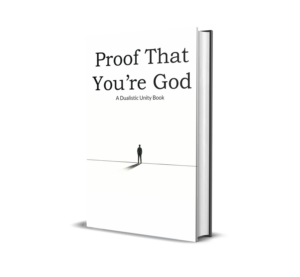
Proof That You’re God explores this same theme from a deeper perspective — how the self tightens around fear, how identity reacts to exposure, and how relief often arrives not in victory but in recognition. The book isn’t about becoming undefeated. It’s about meeting experience directly — without needing to win at everything.