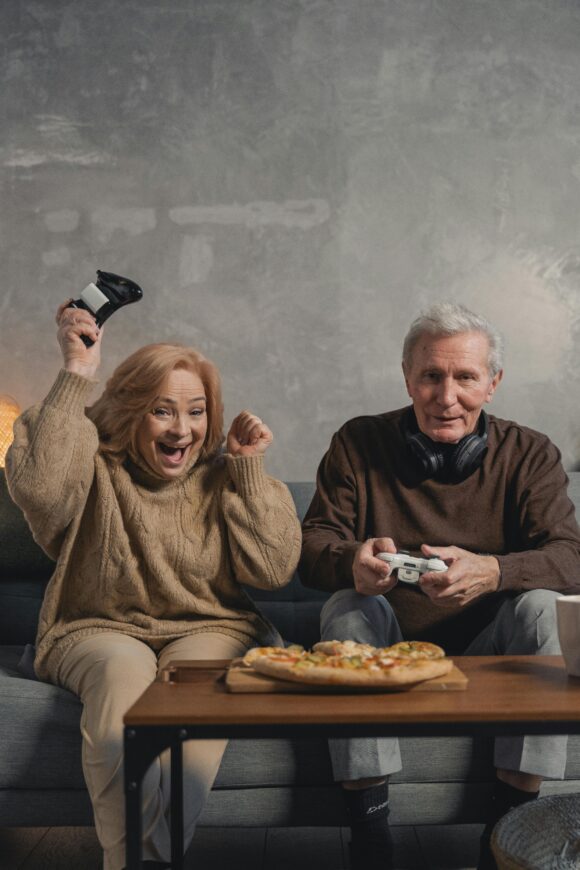

There’s a certain kind of relief that shows up when you boot up a cozy game.
Not the high-adrenaline kind. Not the competitive rush. Just… softness.
You water digital plants.
You decorate a small room.
You fish by a pixelated river where nothing bad ever happens.
And somewhere in that simplicity, your shoulders drop.
What’s interesting isn’t that these games feel calming.
It’s how immediately they do — and how quickly that calm disappears when you turn the game off.
Which raises a quieter question underneath the comfort:
If the calm were coming from the game itself, wouldn’t it last longer?
Cozy games don’t just soothe us. They reveal something about the conditions under which our nervous systems finally stop bracing — and why those conditions feel so rare in everyday life.
This isn’t really about games.
It’s about the way modern life trains us to live in a constant state of background tension, and how even artificial worlds can feel like relief when they remove the pressures we’ve normalized.
That pattern mirrors something much larger about how we relate to meaning, safety, and ourselves — a theme we’ve explored more broadly in our work on why video games matter more than we think, not as escapism, but as symbolic spaces where the mind briefly stops fighting itself.
The World Cozy Games Create
Cozy games strip life down to a very specific formula:
- Clear goals
- Low stakes
- Immediate feedback
- No moral ambiguity
- No social threat
- No identity on the line
You can’t fail in a way that means anything.
There’s nothing to defend. Nothing to prove. No one watching.
Even when there are objectives, they’re gentle. Miss a day of watering crops? Nothing collapses. Forget to talk to a character? The relationship doesn’t fracture. Time waits for you.
Contrast that with real life, where:
- Success is vague
- Failure feels personal
- Consequences are unclear
- And everything seems tied to who you are
In cozy games, action is disentangled from identity.
And that disentanglement is what your nervous system responds to.
Why Your Body Relaxes Before Your Mind Does
Most people assume relaxation is a mental thing — a thought you arrive at, a belief you adopt, a mindset you practice.
But relaxation is physiological before it’s philosophical.
Your body is constantly scanning for:
- Threat
- Evaluation
- Uncertainty
- Loss of control
Cozy games remove those signals almost entirely.
There’s no social comparison.
No performance review.
No existential narrative about whether you’re “doing life right.”
Your body isn’t calming down because the game is pleasant.
It’s calming down because the environment finally stops asking it to defend an identity.
This is why the calm feels so real — and also why it feels so fragile.
The Relief Isn’t the Game — It’s the Absence of Pressure
The most misleading part of cozy games is that they appear to add something to your life: softness, warmth, safety.
But what they actually do is remove pressure.
- No future to worry about
- No self to improve
- No story to manage
For a moment, the internal narrator goes quiet.
And that quiet can feel profound if you’re not used to it.
But here’s the catch:
The game didn’t create that calm.
It revealed that calm was already possible when the conditions allowed it.
Which is why the relief fades the moment real life returns.
Why the Calm Doesn’t Last
When you turn the game off, the world comes rushing back in:
- Decisions with consequences
- Relationships with emotional weight
- Uncertainty about money, health, meaning
- A self-image that needs constant maintenance
The nervous system re-enters an environment where everything feels loaded.
So the calm collapses — not because the game stopped working, but because the conditions that allowed relaxation no longer exist.
This is often misinterpreted as:
“I need more of this game.”
But the deeper signal is:
“I’m exhausted from carrying myself all the time.”
Identity Is Heavy — Cozy Games Set It Down Temporarily
One of the quietest pressures we live under is identity maintenance.
Am I successful enough?
Am I falling behind?
Am I wasting my potential?
Am I being perceived correctly?
These questions rarely stop.
Cozy games offer a space where none of that applies.
You don’t be someone in the game.
You just do simple things.
And without realizing it, you get a break from being a self.
In Proof That You’re God, this dynamic shows up repeatedly — not in the context of games, but in how relief often comes when the narrative of “me” loosens its grip. The self doesn’t disappear through effort. It quiets when it’s no longer needed.
Cozy games simulate that condition.
Not by solving identity — but by suspending it.
Why This Matters (Beyond Games)
It would be easy to dismiss cozy games as harmless escapism.
But they’re actually diagnostic.
They show us:
- How little pressure it takes for the body to relax
- How much strain we’ve normalized
- How often we confuse identity tension with “just how life is”
The popularity of cozy games isn’t a trend.
It’s a response.
A response to lives that feel over-signified, over-evaluated, and over-narrated.
When even a simulated world feels like relief, it’s worth asking what we’ve made the real one into.
You Don’t Need to Turn Life Into a Cozy Game
The point isn’t to recreate cozy-game conditions everywhere.
Life does have stakes.
Relationships do matter.
Choices do ripple outward.
But there’s a middle ground between total pressure and total disengagement.
The deeper invitation is to notice:
- Where you’re carrying unnecessary identity weight
- Where you’re treating uncertainty as danger
- Where you’re bracing against imagined evaluation
Not to fix it.
Just to see it.
Because the moment you recognize that the calm wasn’t coming from the game, something loosens.
You stop chasing the relief — and start understanding the mechanism.
Calm Isn’t Something You Earn
Cozy games don’t teach us how to relax.
They remind us what it feels like when we’re not resisting life.
That resistance isn’t a flaw.
It’s learned.
Conditioned.
Reinforced.
And it can soften — not through effort, but through understanding.
If this resonates, Proof That You’re God explores this pattern across anxiety, identity, meaning, and control — not as ideas to adopt, but as lived experiences to recognize.
The calm you touch in those games isn’t elsewhere.
It’s what remains when the pressure drops.