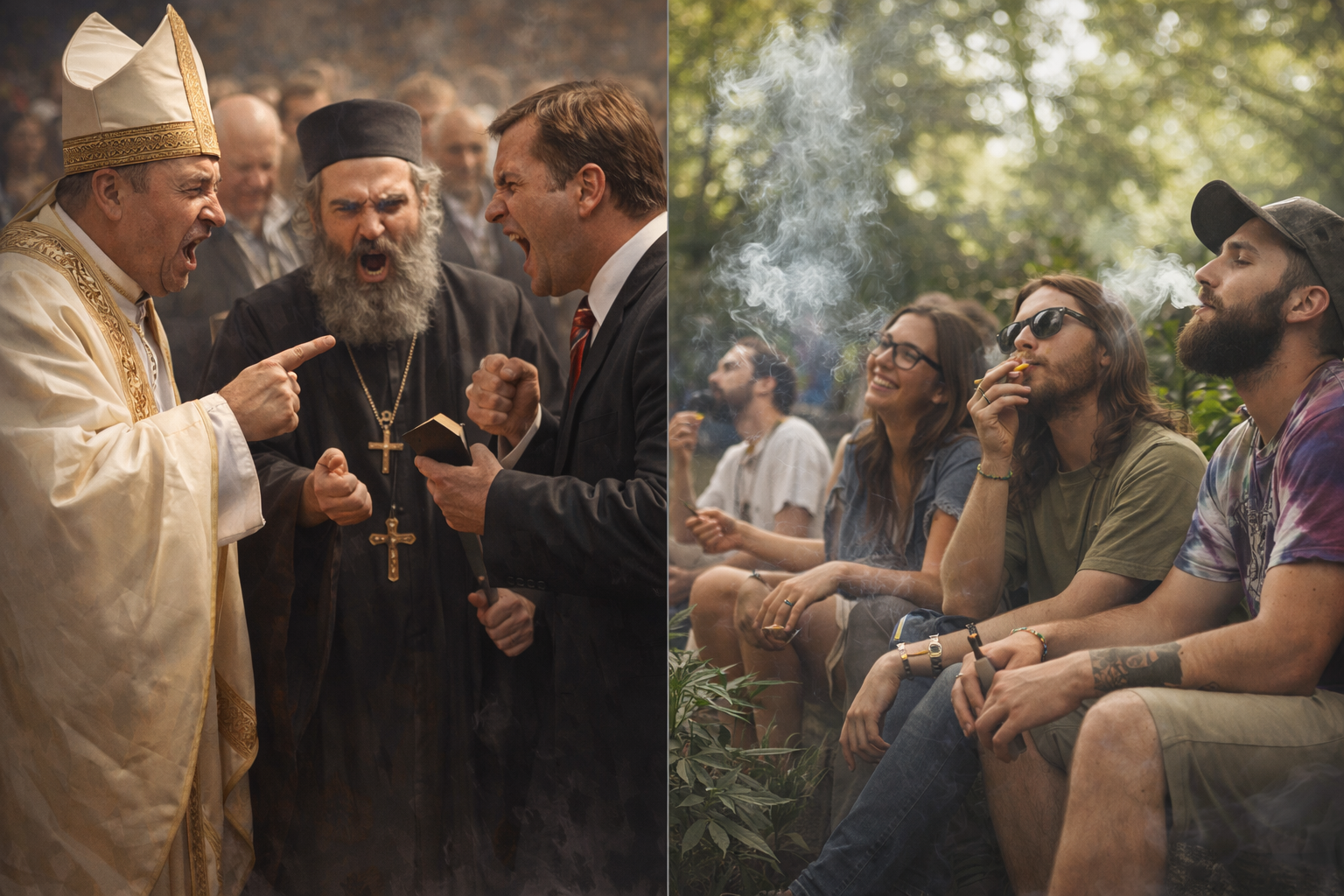
That sentence alone is enough to trigger defenses, outrage, and misunderstanding. Good. Not because offense is the goal—but because reaction reveals something worth examining.
This article is not an attack on Jesus as a historical figure, nor a defense of cannabis as a lifestyle choice. It isn’t theology, and it isn’t advocacy. It’s an examination of responsibility, free will, and the cultural blind spot we carry when harmful behavior wears a sacred mask.
Because here’s the uncomfortable truth:
We have no trouble identifying toxic behavior—until that behavior is called belief.
The Double Standard We Pretend Not to See
Cannabis is one of the most scrutinized substances in modern culture. Entire conversations revolve around:
- misuse
- dependency
- avoidance
- impact on motivation and presence
- responsibility of the user
And importantly, we tend to agree on one thing:
Cannabis isn’t the problem—how it’s used is.
No one claims cannabis removes personal responsibility.
No one says cannabis gets to decide how others should live.
No one excuses harm by saying, “The weed made me do it.”
Now compare that with how we treat religious belief—specifically belief wielded with certainty and authority.
When belief:
- overrides consent
- justifies coercion
- bypasses personal responsibility
- excuses harm as “God’s will”
- or demands conformity “for your own good”
We hesitate to call it what it is.
Not because the behavior isn’t harmful—but because the label scares us.
Religion Isn’t the Issue. Behavior Is.
Let’s be precise.
This article is not claiming:
- Jesus was malicious
- spirituality is toxic
- religion is inherently harmful
It is claiming something far more specific and far more defensible:
Any system of belief that teaches people to override responsibility and violate free will is engaging in toxic behavior—regardless of how sacred it claims to be.
And we already understand this logic everywhere else.
If a partner controls you “because they love you,” we call it abuse.
If a parent overrides autonomy “for your own good,” we call it damaging.
If a government enforces morality without consent, we call it authoritarian.
But when belief does these same things, we suspend our discernment.
That suspension has consequences—personal and collective.
This pattern fits squarely within the broader exploration of identity and psychological narratives, particularly the tendency to outsource authority and morality to something external, as explored more deeply in the self you’re trying to hold together.
Jesus the Symbol vs. Jesus the Authority
There’s a critical distinction that rarely gets made.
Jesus as a symbolic figure—representing compassion, humility, or love—is not the problem.
Jesus as an externalized authority—used to:
- dictate behavior
- enforce morality
- suppress questioning
- or justify harm
…is where things go wrong.
Because once responsibility is outsourced to divine authority, something subtle but devastating happens:
The individual no longer owns their actions.
“It’s not me—it’s God.”
“It’s not my choice—it’s scripture.”
“It’s not my responsibility—it’s the truth.”
This is not faith.
It’s abdication.
Why Cannabis Loses This Comparison Every Time
Cannabis doesn’t:
- claim moral superiority
- tell you how others should live
- threaten eternal consequences
- justify coercion
- demand belief
- override consent
It requires choice.
It requires discernment.
And when harm occurs, responsibility remains exactly where it belongs—with the person engaging it.
That alone makes it less dangerous than any belief system that teaches people they are not responsible for the impact of their actions.
The danger isn’t intoxication.
The danger is certainty without accountability.
The Collective Cost of Moral Outsourcing
When responsibility is bypassed at scale, the effects ripple outward.
History is full of examples where belief:
- justified violence
- erased cultures
- silenced dissent
- enforced conformity
- and traumatized generations
Not because people were evil—but because they believed they were right.
Cannabis has never started a crusade.
It has never justified genocide.
It has never overridden bodily autonomy in the name of salvation.
Belief has—repeatedly.
And the common thread is not belief itself, but the absence of respect for free will.
Free Will Is the Ethical Baseline
This is the line everything comes back to.
You are free to believe anything.
You are not free to override others in the name of that belief.
You are free to seek meaning.
You are not free to impose it.
You are free to follow Jesus, reject Jesus, reinterpret Jesus, or ignore him entirely.
What you are not free to do—ethically—is bypass responsibility for how your belief impacts others.
When belief encourages that bypass, it becomes toxic behavior.
Full stop.
The Real Question This Title Is Pointing At
The title isn’t asking whether Jesus or cannabis is “better.”
It’s asking something far more uncomfortable:
What is more dangerous—something that requires responsibility to engage with, or something that teaches people they don’t need to take responsibility at all?
When framed that way, the comparison stops being provocative and starts being obvious.
What Responsibility Actually Looks Like
Responsibility doesn’t mean rejection of belief.
It doesn’t mean rejection of spirituality.
It doesn’t mean rebellion.
It means:
- owning your actions
- respecting autonomy
- prioritizing impact over intention
- allowing others the same freedom you claim for yourself
Any belief system that supports those values can coexist peacefully.
Any belief system that undermines them cannot—no matter how holy it sounds.
When the Sacred Becomes Dangerous
Cannabis can be misused.
So can alcohol.
So can work.
So can relationships.
We know how to talk about those harms.
It’s time we apply the same honesty to belief.
Because the moment something becomes immune to scrutiny, it becomes capable of doing immense damage while calling itself good.
And that—not weed, not substances, not temptation—is what actually ruins lives.
If this inquiry resonates, Proof That You’re God explores these themes far more deeply—not by attacking belief, but by restoring responsibility, awareness, and respect for free will to the center of the human experience.