
Most people who want to change the world don’t start with a plan.
They start with a feeling.
A sense that something about the way we live, communicate, or understand ourselves isn’t quite right. A quiet frustration with shallow answers. A desire to contribute something that feels honest rather than impressive.
If that sounds like you, you’re not alone.
But you may already feel the tension that comes with it.
Because the moment you try to “do something meaningful” publicly, you’re confronted with a question no one prepares you for:
How do you stay human while trying to have an impact?
The Pressure to Become Something Else
The modern creator landscape doesn’t reward sincerity very well.
It rewards:
- clarity that sounds like certainty
- confidence that borders on performance
- opinions that land cleanly and fast
- identities that are easy to recognize and repeat
If you spend any time sharing ideas online, you’re quietly taught that growth requires compression. Nuance must be flattened. Doubt must be hidden. Complexity must be branded.
Over time, many creators stop asking what’s true and start asking what works.
That shift is subtle—but it’s where a lot of people lose themselves.
Wanting to Help Doesn’t Mean Wanting to Lead
One of the most uncomfortable realizations for many aspiring creators is this:
You can care deeply about people without wanting to guide them.
You can ask good questions without needing to answer them.
You can offer language without offering conclusions.
You can contribute without positioning yourself above anyone else.
But most online spaces don’t know what to do with that posture.
They push you toward authority. Toward leadership. Toward becoming “the person who explains.”
And if you resist that pull, it can feel like you’re doing something wrong.
You’re not.
The Quiet Cost of Performance
There’s a hidden cost to performing certainty.
Even when it’s well-intentioned, performance creates distance:
- between you and your own uncertainty
- between you and the people listening
- between inquiry and outcome
You may notice yourself:
- defending ideas you no longer feel sure about
- repeating language that once felt alive but now feels rehearsed
- simplifying experiences that were never simple
This isn’t hypocrisy. It’s gravity.
Performance is efficient. Humanity is slower.
And if your aim is to change the world—not just influence it—that slowness matters.
Why Integrity Often Looks Like Failure (At First)
Here’s something most people won’t say out loud:
Doing honest work can look like stagnation for a long time.
You may:
- grow slowly
- plateau repeatedly
- watch louder voices surge ahead
- question whether depth actually matters
It’s tempting, in those moments, to assume you miscalculated. That you should pivot. Optimize. Package yourself more clearly.
But there’s another possibility.
You may be building something that compounds internally before it ever compounds externally.
That kind of work doesn’t spike.
It settles.
Changing the World Is Not the Same as Shaping Opinion
A lot of content labeled “world-changing” is actually opinion-shaping.
It persuades.
It polarizes.
It mobilizes.
There’s nothing inherently wrong with that.
But there’s a quieter form of impact that doesn’t move people toward ideas—it helps them see what was already happening in their own experience.
That kind of work:
- doesn’t convert easily
- doesn’t go viral reliably
- doesn’t offer clean metrics
But when it lands, it lands deeply.
And it tends to change people in ways they don’t announce.
Staying With Questions Longer Than Is Comfortable
One of the hardest disciplines for a creator is not producing content—it’s resisting premature resolution.
The internet rewards answers.
But many of the most important human experiences don’t resolve cleanly:
- identity
- meaning
- fear
- connection
- purpose
If you allow yourself to stay with these questions without forcing closure, you may feel exposed. Uncertain. Even unqualified.
That’s not a weakness.
That’s honesty.
And honesty is rarer—and more impactful—than confidence.
You Are Allowed to Change Publicly
Another quiet fear many creators carry is this:
“What if I evolve past what people expect from me?”
So they freeze.
They keep repeating ideas that once felt true but now feel thin. They protect an identity they never intended to maintain long-term.
But growth that can’t be seen becomes stagnation.
You are allowed to:
- outgrow your own language
- contradict earlier certainty
- say “I don’t know” again
- let your work soften
If your audience can’t tolerate that, it wasn’t built on understanding—it was built on expectation.
The World Doesn’t Need More Certainty
Despite how it looks online, the world is not lacking opinions.
It’s lacking space.
Space to feel without being corrected.
Space to question without being recruited.
Space to notice without being labeled.
Creators who offer that space rarely dominate feeds.
But they tend to matter to people longer than trends do.
This sits at the heart of how culture shapes—and is shaped by—our collective psychology, especially in environments that reward noise over nuance.
👉 https://dualisticunity.com/why-the-world-feels-so-loud/
You Don’t Have to Burn Out to Be Serious
There’s a myth that says meaningful work requires self-sacrifice.
That exhaustion proves commitment.
That urgency proves importance.
But burnout doesn’t make work deeper.
It just makes it narrower.
If you’re trying to contribute something that lasts, you’ll need:
- rest
- distance
- patience
- room to not know
Staying human means refusing to turn yourself into a resource.
If You’re Early, You’re Not Late
Many creators feel behind because they haven’t “made it” yet.
But “making it” often just means becoming legible to a system that values speed and certainty.
If your work feels slow, unresolved, or hard to categorize, that doesn’t mean it’s failing.
It may mean it’s honest.
And honesty has a longer arc.
A Quiet Encouragement
If you’re trying to change the world—not by force, but by clarity—there will be long stretches where nothing seems to happen.
You’ll wonder if anyone is listening.
You’ll question whether it matters.
You’ll be tempted to simplify yourself for traction.
You don’t have to.
Staying human is already a contribution.
A Final Note
Dualistic Unity has existed in many forms over the years: conversations, podcasts, retreats, daily discussions, writing. None of it followed a clean growth curve. Much of it unfolded slowly, without certainty about where it was “going.”
That slowness wasn’t a mistake.
It was the work.
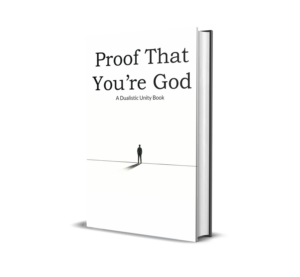
If you’d like to explore these ideas more deeply—particularly how identity, meaning, and certainty soften over time—we’ve collected those reflections in the book Proof That You’re God. It’s not a guide or a framework, but a companion for people navigating clarity without rushing to replace it.