
One of the strangest things about being human is how real our identities feel.
Not metaphorically real.
Not symbolically real.
Physically real.
A criticism can tighten the chest.
A disagreement can raise the heart rate.
A threat to our beliefs can feel indistinguishable from a threat to our bodies.
We react to identity the same way we react to danger.
And that reaction holds a clue.
Why Identity Threats Feel Like Physical Threats
When our identity is challenged—politically, morally, spiritually, personally—our nervous system doesn’t respond with curiosity.
It responds with defense.
Fight.
Flight.
Freeze.
The same physiological cascade that evolved to help us survive predators now activates when:
- our worldview is questioned
- our role is threatened
- our sense of “who I am” feels unstable
This isn’t a metaphor. It’s measurable.
Heart rate increases.
Stress hormones flood the body.
Cognitive flexibility drops.
The body prepares for impact.
This tells us something important: identity is being processed as if it were reality itself.
But it isn’t.
And that confusion may be one of the defining challenges of our time.
Identity as a Model, Not the World
Identity is not the world.
It is a model of the world.
More precisely, it’s a model of ourselves in the world—a continuously updated narrative constructed to help us predict, plan, and navigate social and physical environments.
That model is incredibly useful.
It allows us to:
- anticipate consequences
- imagine futures
- learn from past experience
- coordinate with others
- maintain continuity over time
But a model is not the thing it represents.
And when a model is mistaken for reality, every challenge to the model feels like an existential threat.
This is part of the same pattern explored in the self you’re trying to hold together—the quiet tension that arises when the story of “me” is treated as something that must be protected at all costs.
Evolution Didn’t Prepare Us for Identity
Our nervous systems evolved over hundreds of thousands of years to handle physical threats.
Predators.
Injury.
Starvation.
Exile.
These were immediate, concrete dangers. Responding quickly meant survival.
Identity, however, is a much newer phenomenon.
It emerged alongside language, symbolic thought, and—most importantly—the expansion of the prefrontal cortex.
The prefrontal cortex allows us to:
- hold abstract concepts
- simulate hypothetical futures
- construct narratives about self and others
- evaluate meaning, morality, and purpose
In other words, it allows us to create a reality inside reality.
Or, depending on how you see it, a layer over reality.
The problem isn’t that this tool exists.
The problem is that our older survival systems don’t know the difference.
When an Old Alarm Meets a New Tool
The amygdala doesn’t care whether a threat is symbolic or physical.
It only cares whether something appears to endanger survival.
So when identity becomes fused with reality—when “who I am” feels indistinguishable from “what is”—any challenge triggers the same ancient alarm system.
This is why:
- belief feels life-or-death
- disagreement feels like violence
- criticism feels annihilating
- being “wrong” feels unbearable
Our biology is doing what it evolved to do.
But it’s responding to the wrong category of threat.
Identity Is Real — Just Not in the Way We Think
None of this means identity is imaginary or useless.
Identity is real as a function.
It’s a tool.
A map.
A user interface.
It helps coordinate behavior across time and social complexity.
But it is not reality itself.
Confusing the interface for the system it represents is like thinking the dashboard is the engine.
The dashboard is invaluable.
It is also not where the car actually moves.
Why the World Feels So Polarized
If identity is treated as reality, then defending identity becomes defending existence.
That makes compromise impossible.
It turns conversation into combat.
Difference into danger.
Uncertainty into threat.
And this helps explain why the modern world feels so loud, brittle, and reactive.
We’re asking a nervous system evolved for physical survival to navigate:
- symbolic identities
- abstract belief systems
- global information flow
- imagined futures
- digital representations of self
Without teaching it the difference between model and world.
The Next Evolutionary Challenge
Our next challenge isn’t to eliminate identity.
It’s to learn how to use it without being consumed by it.
The prefrontal cortex is a powerful tool—but tools require skill.
A hammer can build a house or destroy one.
A story can orient a life or trap it.
We haven’t yet developed a shared cultural understanding that identity is provisional, functional, and context-dependent—not sacred, fixed, or absolute.
Until we do, the nervous system will keep reacting as if words were weapons and ideas were claws.
Awareness as the Missing Context
What changes when identity is seen within awareness rather than as awareness?
Something subtle but profound.
Identity becomes:
- editable
- revisable
- responsive
- informative rather than defining
Awareness, on the other hand, doesn’t need defending.
It isn’t threatened by being wrong.
It isn’t injured by disagreement.
It doesn’t require certainty to exist.
This doesn’t remove identity.
It relativizes it.
And that shift alone can reduce enormous suffering.
Why This Isn’t Just Psychological
This isn’t merely about mental health or emotional regulation.
It’s about mistaken ontologies—about confusing a representation for what it represents.
When identity is mistaken for reality:
- suffering increases
- polarization intensifies
- violence becomes justifiable
- listening becomes dangerous
When identity is seen as a tool within reality:
- flexibility returns
- curiosity becomes possible
- disagreement stops feeling fatal
The stakes are existential, not theoretical.
Learning to Hold the Tool Lightly
Using identity skillfully doesn’t mean abandoning values, beliefs, or commitments.
It means recognizing:
- they exist in awareness
- they are not what awareness is
- they can change without destroying us
That recognition isn’t something to believe.
It’s something to notice.
And noticing it may be one of the most important adaptations humanity has yet to make.
An Invitation to See the Difference
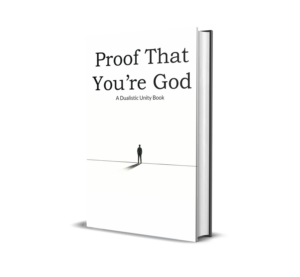
Proof That You’re God was written from within this exact inquiry—not to dismiss identity, but to place it back into context.
If this article resonates, you may find Proof That You’re God meaningful. Not as a solution to identity, but as an invitation to recognize the awareness in which identity appears—and the freedom that comes from no longer mistaking the map for the territory.