
There’s a moment that happens quietly, often without warning.
You hesitate. You forget something simple. You make a small mistake.
And almost instantly, the thought appears:
“Am I stupid?”
It doesn’t really feel like a question. It feels like recognition, as if something about you has just been exposed. But what’s actually happening in that moment is far more subtle—and far more misleading.
Intelligence isn’t the problem. It’s already present, always active, always expressing itself through your ability to perceive, process, respond, and adapt. It’s what allows you to read this, to reflect, to question. It doesn’t switch on and off.
But it can be interfered with.
That interference begins the moment you start thinking about how you’re doing. Your attention splits. Part of you remains engaged in what you’re doing, while another part steps back to watch, evaluate, and comment.
“Did that make sense?”
“Why did I just do that?”
“Do I look confused?”
What was fluid becomes fragmented. Not because your intelligence has disappeared, but because it’s now competing with self-conscious thought.
This is where the loop begins, and it’s the part that often goes unnoticed. You become uncertain or self-aware, your attention divides, and you make a small mistake. That mistake feels significant. It doesn’t register as a simple moment—it registers as evidence.
“See? I am stupid.”
That interpretation increases the pressure. Your attention divides even more. Another mistake happens. And now the experience is reinforcing itself, not because it’s true, but because the conditions are being recreated again and again.
The mistake feels like proof, but it isn’t. It’s a symptom of interference. You weren’t fully present—you were monitoring yourself. And that monitoring disrupted the very intelligence you’re now questioning.
It’s like trying to walk while constantly checking your feet, then concluding you’re bad at walking.
If this were only about attention, it would pass quickly. But something else gets involved: identity. The moment doesn’t stay as “I made a mistake.” It becomes “What does this say about me?” Now the experience is no longer just happening—it’s being interpreted through the idea of who you believe yourself to be.
As explored in the self you’re trying to hold together, we tend to protect an image of ourselves without realizing how unstable that image actually is. When something challenges it, the mind reacts by trying to regain control.
That often shows up as more thinking. More monitoring. More pressure to get it right. But all of that adds to the interference.
At some point, you’re no longer engaged in what you’re doing at all. You’re thinking about how you’re doing it, then thinking about that thinking, then reacting to it. The original moment gets buried under layers of interpretation.
As expressed early in the podcast, “Awareness is not about solving problems. It’s about recognizing there are no problems at all—only life.”
The “problem” isn’t the mistake. It’s the assumption that something about you is at stake because of it.
This becomes even more intense when comparison enters the picture. Someone else responds faster. Someone else seems more confident. And suddenly, you’re not just experiencing your own hesitation—you’re measuring it.
But what you’re comparing isn’t equal. You’re comparing your internal uncertainty to their external behavior. You don’t see their hesitation or feel their doubt, so your experience appears heavier, more flawed, more real.
And through all of this, intelligence hasn’t disappeared. It’s simply being crowded out. Not by lack, but by noise. The constant evaluation, the pressure to perform, the need to confirm or defend an identity—all of it competes with the natural responsiveness that intelligence expresses as.
The loop doesn’t break by trying to be smarter. It breaks when the interference stops being fed. Not through force, not through effort, but through simple recognition.
You notice the self-judgment. You notice the monitoring. You notice the tension. And in seeing that none of it is actually required to continue, something shifts. Attention settles, even slightly.
And in that space, it becomes clear: nothing about your intelligence has changed.
A simpler way to see it is this. Instead of “I made a mistake, so I must be stupid,” it becomes “I got caught in my head, and that affected what I was doing.” That’s not an identity. It’s just a description of a moment. And moments pass.
The real irony is that the question “Am I stupid?” is part of the very interference it’s trying to explain. It pulls attention away from what’s happening and into what it means about you. And in doing so, it creates the experience it points to as proof.
So the next time that thought appears, there’s no need to answer it. Just notice what’s happening around it. The tension. The self-monitoring. The split in attention.
Because what becomes obvious, if you look closely enough, is that your intelligence was never the issue.
Only your relationship to the moment changed.
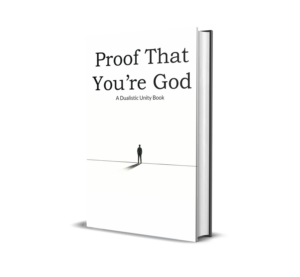
If this resonates and you want to explore these ideas more deeply, Proof That You’re God offers a grounded exploration of identity, awareness, and the nature of self beyond the labels we carry.