There’s a quiet unease spreading through culture right now.
Not panic. Not hysteria. Just a low, persistent tension.
It surfaces in conversations about artificial intelligence replacing jobs, automating creativity, writing code, composing music, diagnosing illness — even holding conversations that feel uncomfortably human. But beneath the surface-level debates about productivity and progress, something else is happening.
The fear isn’t really about work.
It’s about who we are when our usefulness is no longer guaranteed.
Most people don’t say it out loud, but the question is felt deeply:
If a machine can do what I do… what does that make me?
AI didn’t create this question.
It simply forced it into the open.
The Identity We Built Around Being Needed
From early on, we absorb a subtle agreement about how life works.
Do well in school.
Develop skills.
Contribute something valuable.
Become useful.
Over time, usefulness stops being something you do and becomes something you are. Identity fuses with function. Self-worth quietly attaches itself to output.
You may not consciously think, “I am my job,” but the nervous system often behaves as if it were true. Being needed feels like safety. Being competent feels like belonging. Being productive feels like permission to exist.
This is why losing a role — through unemployment, retirement, or redundancy — can feel disorienting even when basic needs are met. The loss isn’t just practical. It’s existential.
AI destabilizes this structure in a way no previous technology has.
Not because it’s faster or smarter — but because it challenges the assumption that usefulness equals value.
Why AI Fear Feels So Deep
On the surface, AI anxiety looks like concern about the future of work.
Underneath, it’s something more intimate.
AI doesn’t just threaten income streams. It threatens the story we’ve been telling ourselves about why we matter.
When a machine can replicate thinking, creativity, or problem-solving — the very traits many people used to define their uniqueness — the identity built around those traits begins to wobble.
This is why reassurance doesn’t land.
Saying “humans will always be needed” or “AI can’t replace real creativity” may calm the mind temporarily, but it doesn’t resolve the deeper tension. The underlying belief remains untouched:
I need a role to justify my existence.
This is the same tension that appears whenever meaning feels strangely elusive — even when life looks successful from the outside. It’s part of a broader pattern where purpose is sought through achievement, contribution, and future relevance. That pattern is explored more deeply in the question of why meaning so often feels just out of reach.
AI doesn’t introduce this struggle.
It simply removes one of the last hiding places.
The Collapse Was Already Underway
Long before AI entered the mainstream, people were already exhausted.
Burned out.
Anxious.
Quietly dissatisfied.
Careers progressed. Goals were achieved. Boxes were checked — yet fulfillment remained unstable. Meaning seemed conditional, fleeting, always dependent on the next milestone.
AI arrives into a culture already stretched thin by identity maintenance.
When usefulness becomes uncertain, the mind scrambles to secure itself. That’s why so much advice right now revolves around reinvention:
Learn faster.
Adapt quicker.
Stay relevant.
Get ahead of the curve.
But this doesn’t resolve the fear — it reinforces it.
Reinvention still rests on the same fragile foundation: If I can remain useful, I’ll be okay.
The problem isn’t that this strategy fails occasionally.
It’s that it can never truly succeed.
What Happens When Usefulness Stops Working
At some point, the mind runs out of guarantees.
There’s always a newer model. A cheaper system. A faster solution. Even those building AI tools often feel the same unease they’re helping create. Winning the game doesn’t bring relief when the game itself feels unstable.
This is where something important becomes visible.
The discomfort isn’t signaling that something essential is being taken away.
It’s revealing that something essential was never actually there.
The identity built on usefulness was always provisional. Conditional. Dependent on circumstances staying favorable.
AI doesn’t destroy meaning.
It exposes how much meaning was being outsourced to roles and outcomes.
What If You Were Never Meant to Be Useful?
This question can feel confronting at first.
If I’m not here to produce, contribute, or optimize… then what am I here for?
Notice how quickly the mind demands an answer. A new purpose. A replacement role.
But that impulse — to secure meaning through function — is the very mechanism that created the tension.
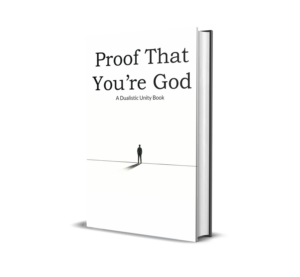
In Proof That You’re God, this pattern appears again and again: the self attempts to stabilize itself through imagined continuity — through stories about who we will be once something is achieved, secured, or proven.
Usefulness is just one of those stories.
And like all of them, it eventually collapses under its own weight.
The Difference Between Meaning and Lived Experience
Think about moments that felt deeply real.
Laughter with someone you love.
Complete absorption in an activity.
Quiet presence without self-reference.
None of those moments required justification. None depended on contribution or future relevance. They didn’t feel meaningful because they served a function — they felt meaningful because they were lived.
AI doesn’t take this away.
It can’t.
What it disrupts is the belief that meaning must be earned through usefulness.
When that belief loosens, something unexpected happens. Work becomes lighter. Creativity becomes less performative. Contribution becomes an expression rather than a requirement.
Not because identity has been improved — but because it’s no longer carrying the burden of existence.
AI as an Unintended Invitation
AI will continue to evolve. Jobs will change. Some roles will disappear while others emerge.
But the deeper invitation has nothing to do with technology.
For the first time at scale, people are being asked to face a question that’s been quietly avoided for generations:
If I’m not here to be useful… am I still allowed to be?
That question feels terrifying only when identity and purpose are confused.
Seen clearly, it becomes something else — a release from a story that never truly fit.
AI isn’t taking your job.
It’s loosening the grip of an identity that was never as solid as it seemed.
Where This Exploration Continues
If this resonates, Proof That You’re God explores these patterns far beyond AI — not as ideas to adopt, but as lived insights into how identity forms, strains, and eventually relaxes.
The book doesn’t offer a new purpose to cling to.
It points to what remains when the need for one falls away.
If AI is unsettling something in you, it may not be because something meaningful is being lost — but because something unreal is finally being seen.