

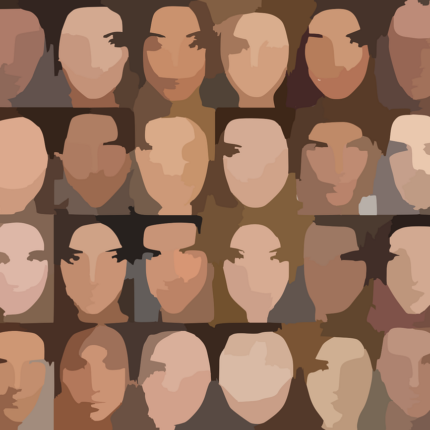
How Courts Struggle to See Individuals—and Why That Matters
The legal system speaks the language of individuality.
The defendant.
The accused.
The person before the court.
But in practice, much of the system still operates as if groups are real, stable, and internally consistent—and as if individuals can be accurately judged through those group-based assumptions.
This is where the idea of “no true group” quietly breaks down.
Because courts don’t just evaluate facts.
They evaluate people.
And people are often processed through categories the law insists are neutral—but aren’t.
This same pattern appears far beyond religion or ideology. It emerges wherever perception is mistaken for certainty—where awareness is treated as a position rather than a process. In legal systems, that confusion hardens categories into identities and averages into judgments. This tension between knowing about something and actually seeing it is explored more deeply in Why Control Doesn’t Bring Relief, which looks at how conceptual insight can expand even as direct perception quietly narrows.
The Legal System Needs Categories—but Pays a Price for Them
Courts rely on grouping because the system is large, fast-moving, and precedent-driven.
So we sort:
- violent vs. non-violent
- repeat offender vs. first-time offender
- gang-affiliated vs. not
- credible victim vs. unreliable witness
- cooperative defendant vs. uncooperative one
These categories make the system manageable.
But they also flatten reality.
Because no category fully captures a person, and no group is internally uniform.
The law often treats categories as if they describe who someone is, not just what pattern they’ve been placed into.
That’s where injustice creeps in—not always through malice, but through overconfidence in abstraction.
Example 1: Mandatory Minimums and the Fiction of the “Typical Offender”
Mandatory minimum sentencing is built on a group assumption:
People convicted of this crime are dangerous enough to deserve the same baseline punishment.
But the moment a minimum is mandatory, context stops mattering.
Courts lose the ability to fully consider:
- coercion
- degree of involvement
- survival-based choices
- mental health
- uneven power dynamics
- whether the person fits the “typical” case the law imagined
Two people can commit the same statutory offense for radically different reasons—and receive the same punishment.
The group (the offense category) becomes more real than the person.
Example 2: “Repeat Offender” Labels and the Erasure of Change
Recidivism-based sentencing treats past behavior as a stable identity.
Once someone is labeled a repeat offender, courts often assume:
- future risk
- moral deficiency
- resistance to rehabilitation
But people are not static.
The law struggles to account for:
- who someone was vs. who they are
- crimes clustered around a specific crisis
- growth that doesn’t fit clean timelines
- uneven access to support systems
The group label persists—even when the person has changed.
Example 3: Victim Credibility and the Idealized Category
Courts also rely on group-based expectations when evaluating victims.
An “ideal victim” is often assumed to be:
- consistent
- visibly afraid
- emotionally coherent
- cooperative with authorities
- morally uncomplicated
Those who fall outside this category—because of trauma responses, survival strategies, prior relationships, or social stigma—are often treated as less credible.
The law doesn’t say this explicitly.
But credibility assessments quietly rely on behavioral stereotypes, not individual psychology.
Once again, the group expectation overrides the person.
Example 4: Gang Enhancements and Associative Guilt
In many jurisdictions, affiliation alone can increase sentencing.
Association is treated as identity.
This assumes:
- shared intent
- shared values
- shared culpability
But social proximity is not moral uniformity.
People exist on the edges of groups:
- coerced
- adjacent
- socially trapped
- economically constrained
- temporarily involved
The law often lacks the tools—or the patience—to separate association from agency.
Why Courts Struggle With “No True Group”
The legal system values:
- consistency
- predictability
- precedent
- efficiency
Individual nuance threatens all four.
So the system compensates by relying on:
- averages
- categories
- typical cases
- risk profiles
But justice is not a statistical exercise.
Patterns can inform lawmaking—but they distort judgment when applied without humility.
The Cognitive Bias Built Into Legal Reasoning
Judges, juries, prosecutors, and even defense attorneys are human.
They carry:
- implicit bias
- narrative shortcuts
- cultural expectations
- emotional heuristics (Your feelings about the relative “goodness” or “badness” of a particular person, object, or activity influence the choices that you make about them.)
Legal reasoning often assumes objectivity—but cognitive bias doesn’t disappear in a courtroom.
It just wears formal language.
When bias combines with group-based categories, individuals become examples rather than persons.
The Paradox at the Heart of Justice
The law must generalize to function.
But justice requires particularity.
This tension can’t be eliminated—but it can be acknowledged.
The danger isn’t that courts use categories.
The danger is when they forget categories are tools, not truths.
A Closing Reflection
There is no true group—only people clustered by circumstance, history, and perception.
When courts forget that, individuals pay the price.
Justice doesn’t fail only when laws are cruel.
It also fails when laws are confidently incomplete.
The question isn’t whether patterns exist.
It’s whether we’re willing to remember that no pattern is a person—especially when someone’s freedom depends on it.
If this resonates…
These themes are explored more deeply in
Proof That You’re God
https://www.amazon.com/dp/B0DKCMR183/
Not as a rejection of the legal system, but as an inquiry into what remains when a social narrative no longer needs to be held together by generalizations.