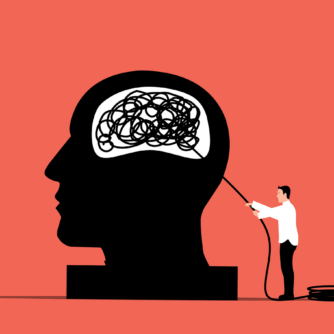


Love is supposed to feel grounding.
Safe.
Affirming.
So when intimacy starts to feel destabilizing, most people assume something has gone wrong.
You finally feel close to someone — emotionally open, seen, connected — and instead of relief, there’s a quiet unraveling. A sense of losing your footing. A strange fear that doesn’t point to anything obvious. The closeness feels real, but you feel less solid inside it.
This experience is rarely talked about honestly. When love unsettles us, we’re quick to pathologize it: attachment wounds, fear of vulnerability, commitment issues. And sometimes those frameworks are useful.
But sometimes, something deeper is happening — something far more ordinary and far less personal.
Sometimes intimacy doesn’t destabilize because love is threatening.
It destabilizes because love removes the structures that normally hold the self together.
When Connection Removes the Edges
Much of what we experience as “self” is quietly reinforced through separation.
Preferences. Roles. Defensiveness. Distance.
The subtle ways we keep ourselves intact by keeping others just far enough away.
Intimacy softens those boundaries.
Not dramatically — often gently, almost invisibly. You open. You relax. You stop monitoring yourself as closely. And in that softening, the familiar sense of being a clearly defined someone begins to blur.
This can feel like:
- Losing clarity
- Losing autonomy
- Losing a sense of direction
- Losing yourself
But what’s actually happening isn’t loss — it’s exposure.
Love doesn’t take something away.
It reveals what was never as solid as it seemed.
This is why intimacy can feel destabilizing even when nothing is “wrong” in the relationship. The destabilization isn’t relational — it’s existential.
Why Love Can Feel More Disorienting Than Pain
Pain often sharpens identity.
You know who you are when you’re hurt.
You know where you stand when something feels wrong.
Love, on the other hand, dissolves the need for constant self-definition.
When you’re deeply connected, there’s less friction. Less opposition. Less internal narration. And without those contrasts, the mind starts searching for something familiar to hold onto.
That search can turn love into a problem:
- Why do I feel off if things are good?
- Why does closeness make me anxious?
- Why do I feel less like myself right now?
But this isn’t anxiety in the usual sense. It’s the nervous system responding to a lack of psychological scaffolding.
For people who’ve spent years orienting themselves through effort, self-concept, or inner management, love can feel like the ground quietly giving way.
Not because love is unsafe — but because it doesn’t require the same internal structures to function.
The Self That Thrives on Distance
There’s a version of selfhood that thrives on tension.
It sharpens itself against:
- Independence
- Self-sufficiency
- Being “together”
- Maintaining control
This self feels competent, oriented, and real — but it depends on separation to stay intact.
Intimacy doesn’t attack this self.
It simply stops feeding it.
And when that feeding stops, the mind interprets the fading tension as danger rather than relief.
This is where many people unconsciously sabotage closeness:
- Creating distance
- Picking fights
- Pulling back emotionally
- Reasserting independence
Not because they don’t want love — but because love has interrupted the familiar way they experience being someone.
This same pattern shows up across emotional life and is explored more broadly in how relationships themselves become the stage where inner structures reveal their limits — a theme that echoes throughout your wider exploration of why relationships so often feel harder than they seem at first.
Intimacy as a Mirror, Not a Threat
When intimacy destabilizes, it’s not pointing to a flaw in you or your partner.
It’s pointing to the way identity has been quietly maintained.
Love doesn’t demand that you lose yourself.
It simply stops propping up the version of self that required effort to sustain.
The discomfort arises when the mind tries to reassert control over an experience that no longer needs it.
You might notice:
- Overthinking the relationship
- Wanting reassurance without knowing why
- Feeling strangely bored or restless
- Longing for space while also craving closeness
These aren’t signs of incompatibility. They’re signs that the usual strategies for feeling real are no longer necessary — and the system hasn’t learned to trust that yet.
Letting the Disorientation Be Honest
The instinct is to fix this feeling.
To “get back to yourself.”
To stabilize.
To understand.
But intimacy isn’t asking for understanding. It’s inviting honesty.
Can you let yourself feel unmoored without immediately reassembling a self-concept?
Can you notice the fear without turning it into a story about what’s wrong?
Can you allow closeness to remain unfamiliar?
Love doesn’t require you to disappear.
It invites you to stop defending your existence.
And that can feel terrifying — until it doesn’t.
Love Isn’t the Problem. Identity Is Just Relaxing.
Eventually, something softens.
Not because you figured it out — but because the system stops fighting the unfamiliar openness.
The destabilization settles into something quieter. Less dramatic. Less personal.
What remains isn’t a loss of self, but a different relationship to self — one that doesn’t need constant reinforcement to feel real.
Love didn’t take you apart.
It simply revealed that you were never as tightly held together as you thought.
And that turns out not to be a problem.
Final Reflection
Intimacy becomes destabilizing when it interrupts the effort required to maintain identity.
What feels like loss is often relief misunderstood.
What feels like danger is often unfamiliar ease.
If this resonates, Proof That You’re God explores this same pattern — not just in relationships, but across anxiety, meaning, control, and the quiet structures we mistake for ourselves. The book isn’t about fixing intimacy, but about noticing what intimacy naturally dissolves.
You don’t lose yourself in love.
You discover how little holding was ever required.