There’s a real danger in becoming too aware of the world.
Not because corruption isn’t real.
Not because injustice doesn’t exist.
Not because power isn’t abused, hidden, protected, or monetized.
But because there is a point where awareness stops liberating you—and becomes a prison.
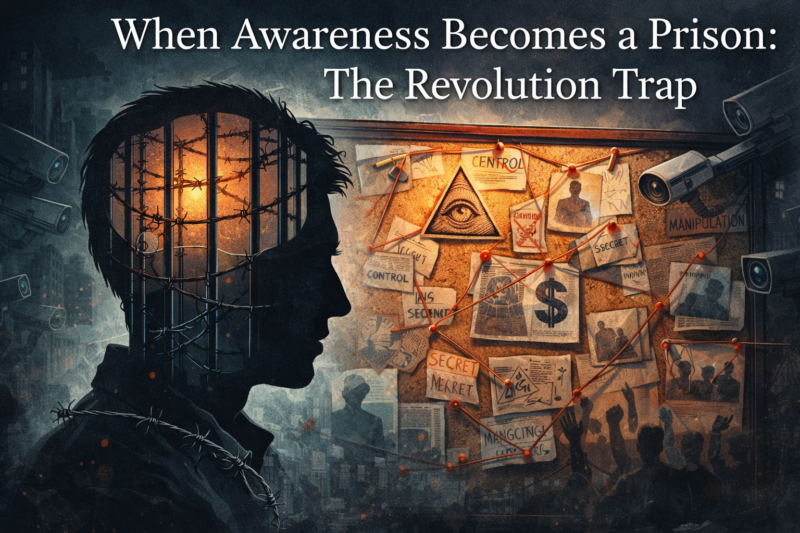
That point is the Revolution Trap.
It’s the moment awareness turns into permanent opposition. When “seeing the truth” no longer frees you, but binds your attention, your nervous system, and your identity to a fight that never actually ends.
And the most dangerous part is this:
The things you’re seeing are real.
Yes, the world really is compromised
Let’s be clear from the start.
There is historical bias embedded in legal systems.
There is regulatory capture and revolving-door governance.
There are corporate interests lobbying for laws that harm people.
There are pharmaceutical and agricultural industries that prioritize profit over human well-being.
There are financial, political, and intelligence structures that operate with secrecy and impunity.
None of this is imaginary.
None of it needs exaggeration to be disturbing.
Becoming aware of these realities can feel like waking up.
And at first, it often is.
Where awareness turns into permanent revolution
The problem doesn’t begin with seeing injustice.
It begins when opposition becomes your primary relationship to reality.
When your attention is no longer here—
but always against something.
Against the government.
Against corporations.
Against elites.
Against secret agendas.
Against manipulation.
Against control.
At first, this feels empowering.
Like clarity.
Like vigilance.
But something subtle happens over time.
The mind fills with enemies.
And once that happens, freedom becomes impossible, even in moments where there is no oppressor present.
When the enemy follows you everywhere
You can be:
- sitting with friends
- walking outside
- eating a meal
- listening to music
- having a conversation
And still be internally fighting corruption, betrayal, control, deception.
Your body is here.
Your mind is at war.
Not because you’re wrong about the world—
but because you never leave the battlefield.
This is how awareness quietly becomes captivity.
When truth becomes identity
At a certain point, awareness stops being something you have and becomes something you are.
“I see what’s really happening.”
“I’m not asleep like everyone else.”
“I know who the real enemy is.”
This feels like clarity, but it’s actually identity formation.
And identity always needs reinforcement.
So the research intensifies.
The narrative expands.
The threat grows larger, more total, more inescapable.
Eventually, everything becomes evidence.
At that point, awareness no longer opens perception.
It closes it.
Why fanaticism makes people stop listening
Here’s the uncomfortable truth:
The more fanatical someone becomes about these “truths,” the less anyone actually hears them.
Not because the information is false.
But because fanaticism communicates one thing very clearly:
“I’m not here to understand. I’m here to fight.”
When every conversation feels like an ambush…
when every disagreement feels like complicity…
when every nuance sounds like betrayal…
People don’t open.
They shut down.
And real change requires relationship, not just exposure.
This is one of the quiet ways the Revolution Trap undermines itself.
The system reflects us more than we want to admit
It’s tempting to believe corruption is purely external.
That they are broken, immoral, or evil—
and we are simply awake.
But systems don’t exist independently of human psychology.
They are expressions of:
- fear of lack
- obsession with accumulation
- belief in separation
- prioritization of self over other
This is the core of the Revolution Trap: believing external domination can be dismantled without dismantling the mentality that reproduces it.
When opposition becomes identity, the system doesn’t weaken.
It gains a psychological ally.
The Revolution Trap: fighting what can’t be defeated
The deepest trap here isn’t believing something untrue.
It’s engaging in an unwinnable psychological war.
You cannot defeat:
- “the system” as a total abstraction
- “they” as a shifting, undefined enemy
- “corruption” as an all-encompassing force
So the mind keeps fighting.
And fighting something you can never defeat guarantees one thing:
You lose your life to the fight.
Even if every claim were accurate, this posture would still cost you your presence, your relationships, and your capacity to live freely now.
How awareness turns into self-disempowerment
Over time, something real erodes.
Not your intelligence.
Not your moral concern.
But your agency.
If everything is rigged:
- your choices feel meaningless
- your joy feels naive
- your attention feels wasted
- your life feels secondary
Responsibility doesn’t get taken from you.
It quietly disappears—because it no longer seems relevant.
Ironically, the more total the narrative of control becomes, the less power you actually have.
This pattern is widespread in modern culture, where outrage and information overload train people to live perpetually against the world instead of in it. That broader dynamic is explored here:
https://dualisticunity.com/why-the-world-feels-so-loud/
The real solution doesn’t look like opposition
Here’s the part that’s often missed.
If there were systems designed to control, extract, and dominate, the most effective response would not be constant opposition.
It would be to defuse the mentality those systems require to function.
Those systems depend on:
- fear of lack
- belief in division
- endless comparison
- prioritization of accumulation
- blindness to the humanity of others
They are fueled by people who feel separate, threatened, and perpetually insufficient.
So the most disruptive thing you can do is not to scream louder.
It’s to stop living from that mentality altogether.
Why being real undermines the system
To be present.
To be grounded.
To connect with people in reality.
To treat others as human rather than as symbols, threats, or categories.
This doesn’t sound revolutionary—
which is why it’s easy to dismiss.
But it is exactly what systems built on abstraction and dehumanization cannot survive.
A person who:
- isn’t ruled by fear
- doesn’t need excess
- isn’t driven by lack
- can see others clearly
- can cooperate without ideology
…does not feed the system’s priorities.
They starve it.
Not through resistance—but through irrelevance.
Change doesn’t come from replacing the villains
Systems don’t collapse when the “bad people” are exposed.
They collapse when the mentality that sustains them no longer has participants.
When people stop living as if:
- they are separate
- they are competing
- they are perpetually behind
- they must secure themselves at the expense of others
That shift doesn’t happen at the level of policy first.
It happens at the level of how people actually live.
This isn’t passive. It’s precise.
This isn’t about doing nothing.
It’s about acting from clarity instead of from reaction.
It’s about engaging where engagement is real—
and refusing to give your life to abstractions that can never be satisfied.
It’s about understanding that the system is not changed by being mirrored at a higher emotional pitch.
It’s changed when its psychological fuel source disappears.
Closing
There may be corruption.
There may be manipulation.
There may be systems that profit from harm.
But if your response is to live perpetually tense, suspicious, angry, and absent from your own life—
Then whatever those systems are, they don’t need to defeat you.
You’ve already handed them exactly what they require.
Real awareness doesn’t imprison you.
It gives you your life back.
And real change doesn’t begin with overthrowing enemies.
It begins when enough people step out of the Revolution Trap—
and stop feeding the very mentality that made those systems possible in the first place.
If this resonates, Proof That You’re God explores this same shift: how opposition becomes identity, how systems mirror inner structures, and why attention—not ideology—is where freedom and real change actually begin.