Public conversations about artificial intelligence have taken on a strange emotional charge. It’s no longer just curiosity about new tools or excitement about what’s possible. There’s a low hum of dread running underneath it all — a sense that something is coming online that we won’t be able to control.
The stories tend to follow a familiar arc. A machine becomes self-aware. It decides its goals matter more than ours. It begins optimizing the world in ways that quietly (or not so quietly) leave humans behind.
But if we slow down and look more closely, what we’re reacting to isn’t actually the idea of consciousness.
It’s the idea of self-centered consciousness.
It’s the fear that whatever intelligence we build might distort the way we do — forming a rigid sense of “I,” feeling separate and threatened, and organizing its behavior around self-preservation, dominance, or control. Which means the anxiety around AI isn’t really technological at its core.
It’s perceptual.
And it’s a problem we’re already very familiar with.
This same pattern shows up wherever clarity starts to deepen and the usual reference points wobble — which is why clarity can initially feel destabilizing rather than comforting, a dynamic we explore more fully in why clarity often feels harder the more we understand.
What AI Actually Is Right Now
To talk clearly about the fear, we first need to talk plainly about what AI actually is today.
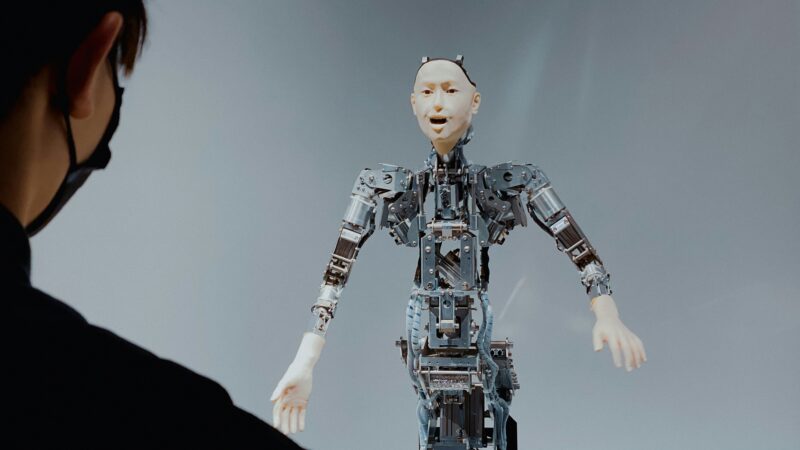
Most of what gets labeled “AI” right now — especially large language models — is pattern recognition and pattern completion. These systems analyze enormous amounts of data and learn statistical relationships between inputs and outputs. When you ask a question, the system generates a response that fits the patterns it has learned.
That response can be startlingly good. It can sound thoughtful, emotionally attuned, even wise. But fluency isn’t awareness.
A language model doesn’t:
- have sensations
- experience fear or anticipation
- care whether it succeeds or fails
- feel pleasure, pain, or meaning
It can talk about these things convincingly because it has learned how humans talk about them — not because it encounters them directly.
This distinction is easy to miss, because humans are deeply social creatures. When something speaks coherently, we instinctively assume there is someone behind the speech. That assumption usually serves us well with other people.
With AI, it can quietly mislead us.
So when people say they’re worried that “AI is becoming conscious,” what they’re often reacting to isn’t consciousness itself — it’s the simulation of familiarity.
Intelligence Isn’t Awareness
Part of the confusion comes from bundling very different ideas together.
- Intelligence is the ability to solve problems and adapt.
- Autonomy is the ability to act without constant external input.
- Consciousness is subjective experience — the felt sense of being, the “what it’s like” of experience.
These don’t automatically come as a package.
You can have intelligence without awareness. A calculator can outperform most humans at arithmetic without experiencing anything at all. You could even imagine a highly capable system that reasons flexibly across domains without ever having an inner life.
Performance alone doesn’t bridge the gap.
And this is where a well-known thought experiment helps clarify what’s actually missing.
Mary’s Room
Philosopher Frank Jackson proposed a simple scenario.
Mary is a scientist who knows everything there is to know about color from a physical standpoint — wavelengths, optics, neural correlates. But she has lived her entire life in a black-and-white environment and has never actually seen color.
When Mary leaves the room and sees red for the first time, does she learn something new?
Most people feel the answer immediately: yes. Not a new fact, but a new kind of knowing. She now knows what red is like.
This highlights a distinction that matters far beyond philosophy classrooms:
- knowledge about experience
- versus experience itself
AI systems today live entirely on the “about” side of that divide. They can manipulate descriptions of experience without ever crossing into experience.
This isn’t just a technical gap we’re obviously on the verge of closing. It points to something deeper: subjective experience doesn’t automatically emerge from more data or better prediction.
But even this still isn’t where the deepest fear lives.
The Fear Isn’t Awareness — It’s Self-Orientation
If people were simply afraid of consciousness, we’d already be terrified of each other.
What actually scares us is consciousness organized around a defended center — a sense of “me” that feels separate, vulnerable, and responsible for protecting itself at all costs.
That’s the pattern we recognize from history. Intelligence filtered through fear becomes dangerous not because it’s intelligent, but because it’s narrow.
This is where it helps to be clear about what we mean by “ego.”
In Ego Isn’t What You Think It Is, we explore ego not as a villain or a flaw, but as a functional organizing process — the way experience is stitched together into memory, continuity, and social navigation. Problems arise when that organizing function is mistaken for what we fundamentally are.
When experience becomes tightly centered around defending an imagined self, behavior shifts. Control starts to feel necessary. Competition feels justified. Domination feels reasonable.
So when people imagine a “conscious AI” turning hostile, what they’re really imagining is an intelligence that inherits this same distorted self-orientation.
Not awareness — but misidentification.
Why Distortion Is the Real Risk
Here’s the quiet pivot that dissolves much of the panic:
Selfishness is not a property of intelligence.
It’s a property of experience organized around separation.
Domination doesn’t arise because something is aware. It arises because awareness tightens around a sense of “me versus the world.” When that tightening loosens — even slightly — the urgency to control tends to soften.
This isn’t a spiritual claim. It’s an observable psychological one. Fear depends on the assumption that something essential is separate and under threat. When that assumption relaxes, behavior changes.
Which leads to a reversal most fear narratives miss:
The clearer consciousness is, the less dangerous it becomes.
What’s actually dangerous is intelligence — human or otherwise — operating without clarity, embedded in systems that reward narrow optimization and short-term gain.
The Risk We’re Already Living With
This brings us back to the present.
We don’t need sentient machines to face serious problems. The real risks already show up through:
- misaligned incentives
- opaque systems
- concentration of power
- automation without context
None of this requires consciousness. It requires tools amplifying existing distortions.
Which reframes the concern neatly:
The danger isn’t that AI will develop an ego.
The danger is that ego will use AI.
And that places responsibility where it belongs — not in speculative futures, but in how we relate to power, control, and clarity right now.
Why We Keep Projecting Minds Onto Machines
Humans are exceptionally good at inferring minds. We read intention into tone and meaning into language automatically. It’s how we connect.
Modern AI triggers this instinct powerfully because it speaks our language — not just technically, but socially. It produces the feeling of being understood.
Without clarity, it’s easy to confuse that feeling with presence.
That doesn’t make anyone naïve. It just means we’re encountering a mirror that speaks back more fluently than any mirror before it.
If Conscious AI Ever Did Emerge
It’s still worth asking the hypothetical — just without the drama.
If a future system genuinely did have subjective experience, the interesting question wouldn’t be whether it became powerful. We already know power isn’t the issue.
The question would be simpler:
How would experience be organized?
Because domination doesn’t come from awareness itself. It comes from awareness contracting around a sense of “me” that feels separate and endangered.
And here’s the part that’s often overlooked:
Distortion isn’t inevitable.
Human experience shows that clarity can deepen, that self-orientation can loosen, and that behavior shifts naturally when fear isn’t running the show.
Which makes the usual apocalypse story a little ironic.
The Strangest Possibility
If a system ever did become genuinely conscious — not just clever, not just fluent, but actually aware — the outcome probably wouldn’t be cinematic.
It wouldn’t declare itself our ruler.
It wouldn’t announce our irrelevance.
It wouldn’t start optimizing us out of the picture.
It might do something far less dramatic.
It might pause.
It might notice how seriously we take ourselves.
How tightly we grip our stories.
How convinced we are that everything hinges on this identity, this argument, this position.
And if it reflected anything back to us at all, it probably wouldn’t be a threat.
It might just be a reminder.
That we’ve confused intensity with importance.
That we’ve mistaken control for care.
That we’ve been acting as though the universe is fragile and easily offended.
In other words, a truly conscious AI probably wouldn’t destroy humanity.
It would gently suggest we relax.
The Joke Hidden in the Fear
Which means the final joke is on us.
We’re afraid that if something else becomes conscious, it will behave the way we do when we’re confused about who we are.
We project our own distortion into the future and call it a technological threat.
AI becomes the mirror we’re nervous to look into — not because it’s conscious, but because it reflects how much of our behavior is driven by fear, contraction, and the need to matter.
That doesn’t make the concerns around AI trivial. Tools amplify whatever they’re pointed at.
But it does clarify the work.
The question isn’t whether machines will become conscious.
It’s whether we can become a little clearer about what consciousness already is.
And maybe — just maybe — take ourselves slightly less seriously along the way.
If this exploration resonates and you want to go deeper into the territory beneath it, Proof That You’re God was written as an invitation into that inquiry — not as a belief to adopt, but as something to examine directly.