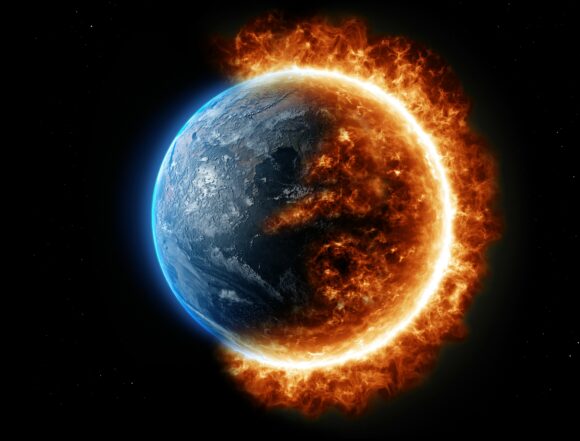
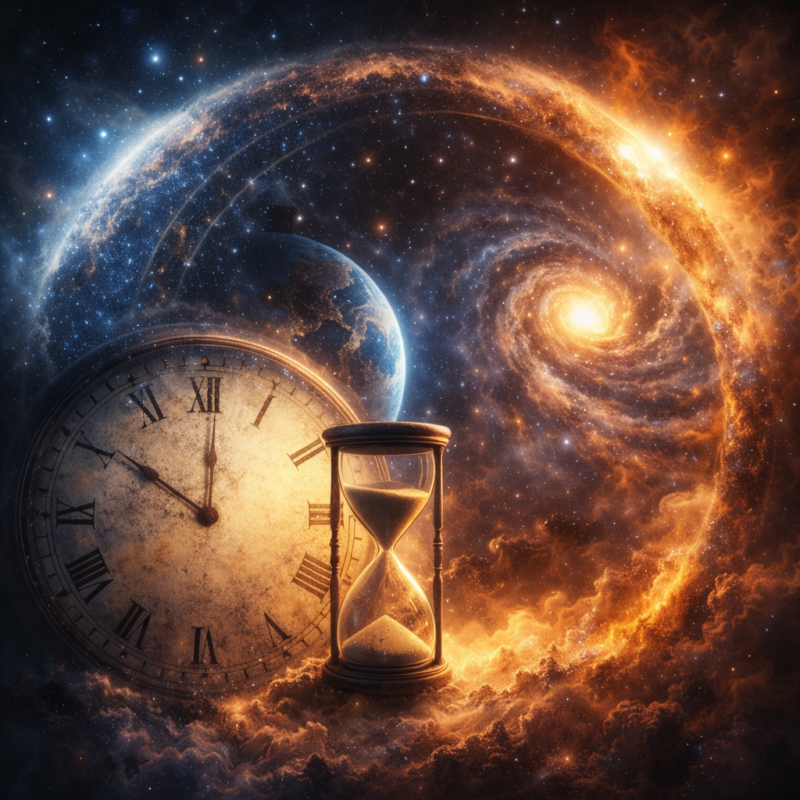
We tend to talk about the Big Bang as if it were the beginning of everything.
The start of time.
The birth of existence.
The moment when reality itself came into being.
That way of speaking feels natural, because stories need beginnings. And from inside a story, it’s almost impossible to imagine one without a starting point.
But there’s a quieter question beneath the language we use:
What if the Big Bang isn’t the beginning of reality—but the beginning of a timeline?
Not a denial of science.
Not an alternative cosmology.
Just a reconsideration of what the idea of a “beginning” is actually doing.
Because the more closely we examine time itself, the less it behaves like the thing we think it is.
The Problem With Origins
A beginning is never neutral.
To say something “began” implies:
- there was a moment when it was not
- something happened that caused it to appear
- time existed to mark the transition
But time is never observed from the outside.
We only know time as experience moving—moment giving way to moment, memory behind us, anticipation ahead. We never encounter a blank “before,” and we never experience a future moment in advance.
So when we ask, “What happened before the Big Bang?” we may be asking a question that already assumes too much.
It assumes time is something reality travels through, rather than something experience uses to organize itself.
And that assumption quietly shapes how we understand existence.
Time May Not Be What It Feels Like
Most people experience time as a flow: the present sliding forward, leaving the past behind and approaching a future that doesn’t exist yet.
But even at the level of ordinary experience, that picture starts to wobble.
The present is never graspable.
The moment you notice it, it’s already gone.
Memory fills in continuity after the fact.
Time doesn’t appear as a thing moving forward—it appears as change being noticed.
This is why greater clarity about experience often feels disorienting rather than reassuring. The more honestly we look, the harder it becomes to maintain the idea of a stable “now” progressing through a fixed timeline.
👉 https://dualisticunity.com/why-clarity-often-feels-harder-the-more-we-understand/
From this perspective, time looks less like a river reality flows through and more like a framework experience requires in order to appear as sequence at all.
The Big Bang as a Boundary, Not a Birth
Seen this way, the Big Bang doesn’t need to be the absolute beginning of existence.
It can be understood as the boundary condition of narratable time.
A universe that can be experienced needs:
- a direction
- continuity
- a point from which “earlier” and “later” make sense
The Big Bang provides that.
Not because nothing existed before it, but because “before” is a time-word that only works inside a timeline.
Just as every personal story needs a first memory—not because nothing existed before it, but because memory requires a starting point—every universe that can be lived needs an origin that anchors its sequence.
In that sense, the Big Bang is not the beginning.
It is a beginning.
A Beginning Is a Feature of Experience
Once this distinction is seen, something subtle shifts.
The universe stops looking like a single, absolute story with one privileged origin. Instead, it begins to resemble a coherent structure—one expression among many possible expressions of experience.
Not sequentially.
Not causally.
Not as cycles unfolding one after another.
But as variations within possibility itself.
Each universe would need:
- its own internal time
- its own ordering
- its own beginning
Not because existence requires beginnings, but because experience does.
This reframes eternity.
Eternity Isn’t Endless Time
Eternity is often imagined as infinite duration—time stretching endlessly forward and backward.
But that’s still thinking in terms of time.
Eternity isn’t an endless timeline.
It’s what is always the case.
It doesn’t move.
It doesn’t progress.
It doesn’t wait.
Universes may begin and end as experience-structures.
Timelines may arise and dissolve.
But eternity is not inside those processes.
Those processes are inside it.
Why the Universe Is So Large
From this view, the vastness of the universe starts to look less like excess and more like necessity.
A small universe would imply:
- a center
- a limited set of perspectives
- a story that mattered more than all others
A vast universe allows:
- no center
- no privileged observer
- no single narrative that dominates meaning
Scale makes difference possible without hierarchy.
If experience is appearing from countless angles, then the universe must be large enough to accommodate that without collapsing into a single viewpoint.
The size of the universe doesn’t need justification.
It’s what allows no justification to be required.
“Before Time” as Potential, Not a Moment
When people speak about everything existing “before time,” it’s easy to imagine a hidden era where moments waited in line.
But that image still treats time as primary.
A more precise way to understand it is this:
Time is ordering.
Potential does not require ordering.
To say all moments exist is not to say they are accessible, visible, or simultaneous. It’s to say that existence does not depend on being revealed one-by-one in sequence.
The present is not the edge of reality.
It’s a local experience of it.
Every moment exists as experience somewhere, sometime, someone—not because time has been transcended, but because time was never the container it felt like to begin with.
Energy, Change, and the Feeling of “Before” and “After”
There’s a reason beginnings feel charged and endings feel quiet.
Not because reality is running out—but because potential becomes expressed.
Energy is not created or destroyed. It changes form. It disperses. It becomes harder to concentrate in the same dramatic ways.
Early moments feel full because gradients are steep.
Later moments feel calmer because possibility has been spent into actuality.
This is not loss.
It’s expression.
And once expressed, it cannot be re-expressed in the same way from within time.
That irreversibility is not a flaw.
It’s what makes experience possible at all.
What Falls Away When the Need for Origins Softens
When the universe is no longer required to have a single, absolute beginning, something psychological relaxes.
The need for:
- cosmic purpose
- external validation
- a final explanation
begins to loosen.
Not because answers are found—but because the demand for answers quiets.
Meaning doesn’t disappear.
It stops being postponed.
Experience Doesn’t Need an Origin Story
Perhaps the simplest way to hold all of this is this:
The universe didn’t begin.
Experience did.
Beginnings are not what reality requires.
Beginnings are what timelines require.
And timelines are what experience requires—if it is to appear as memory, anticipation, and change.
The Big Bang is a beginning because experience must feel like it has one.
Eternity does not.
It is what is always the case—
while universes appear and dissolve within it,
each complete as they are,
without needing to justify their existence
to anything outside themselves.