

There is a persistent myth woven into modern culture: that some people are more logical than others.
It often arrives quietly, dressed up as common sense or “objective observation.” Sometimes it’s framed through gender. Sometimes through race. Sometimes through temperament, profession, or education. But the implication is the same: certain people are said to reason clearly, while others are ruled by emotion.
This myth has done real harm—not only socially and politically, but psychologically. Because beneath it lies a deeper misunderstanding about what logic actually is.
There is no such thing as logic without emotion.
There never has been.
Where the Myth Came From
The idea of “pure logic” didn’t emerge from neuroscience or lived experience. It emerged from power structures that needed a way to legitimize hierarchy.
Historically, groups in power defined their ways of speaking, deciding, and prioritizing as “rational,” while framing others as emotional, impulsive, or irrational. This framing justified exclusion from leadership, decision-making, and authority.
Emotion wasn’t just misunderstood—it was weaponized.
Over time, this story hardened into cultural shorthand:
- Men are logical; women are emotional.
- Some races are rational; others are reactive.
- Certain cultures are disciplined; others are chaotic.
These claims were never neutral. They were never scientific. They were narratives designed to protect status.
And once a narrative becomes dominant, it stops looking like a belief and starts looking like reality.
What Neuroscience Actually Shows
Modern neuroscience quietly dismantles the entire premise.
People with damage to emotional processing centers of the brain don’t become hyper-logical. They become unable to make decisions.
Without emotion:
- priorities disappear,
- risk assessment collapses,
- meaning evaporates,
- and choice becomes impossible.
Emotion is not a threat to reason.
Emotion is what gives reason direction.
Logic answers questions like how, if, and what follows.
Emotion answers why it matters.
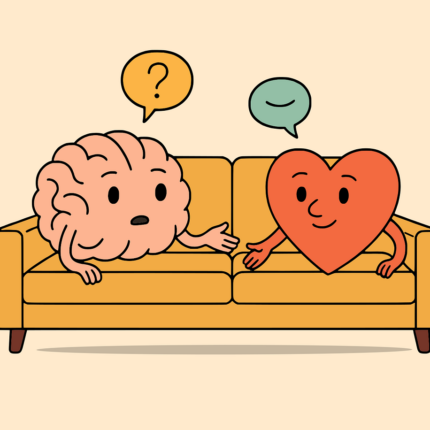
Without emotion, logic has no compass. Without logic, emotion has no structure. They are not opposites—they are partners.
Why “Emotionless Logic” Feels So Convincing
The myth persists because emotional influence is easiest to spot when it’s visible.
Anger. Fear. Passion. Tears.
But the most influential emotions often pass as neutrality:
- comfort masquerading as objectivity,
- familiarity posing as common sense,
- self-interest disguised as realism.
When someone says, “I’m just being logical,” what they usually mean is:
My emotional position aligns with what I’m used to.
This is where culture plays its quiet role. Collective stories teach us which emotions are acceptable and which are suspect, which reactions are “reasonable” and which are dismissed as overreaction. These dynamics—how noise, dominance, and narrative shape perception—are explored more broadly in reflections on culture and collective psychology, including why the world feels so loud.
Logic doesn’t float above culture.
It emerges from within it.
The Cost of Separating Logic from Emotion
When emotion is treated as inferior, people learn to distrust their own internal signals. They override discomfort. They silence intuition. They mistake numbness for clarity.
This doesn’t make decisions better. It makes them disconnected.
Entire systems have been built this way:
- economic policies that ignore human impact,
- technologies optimized without ethical grounding,
- institutions that prize efficiency over care.
These aren’t examples of “too much logic.”
They are examples of logic severed from empathy.
And that separation always comes at a cost.
Why the Myth Persists
The idea that some people are more logical is appealing because it simplifies complexity. It turns disagreement into deficiency.
If someone disagrees with you, you don’t have to examine your assumptions—you can just label them emotional.
This is especially convenient for maintaining dominance. When one group’s emotional reactions are framed as “passion” or “conviction,” and another’s are framed as “instability,” hierarchy sustains itself without needing explicit force.
But awareness exposes this trick.
Once you see that all reasoning is emotionally informed, the hierarchy collapses. What remains is curiosity: What values are guiding this logic? What emotions are being protected here?
Reclaiming Wholeness
From a Dualistic Unity perspective, the problem was never emotion. The problem was fragmentation.
When people are taught to identify with only part of their experience—mind over body, reason over feeling—they lose access to wholeness. They become easier to manage, easier to shame, easier to divide.
But clarity returns when the false split dissolves.
Logic becomes more humane.
Emotion becomes more intelligible.
Decision-making becomes grounded rather than reactive.
This isn’t about becoming “more emotional” or “more rational.”
It’s about becoming more integrated.
What This Changes
When you stop believing the myth:
- You listen differently.
- You argue less defensively.
- You recognize bias without needing villains.
- You stop mistaking detachment for wisdom.
And perhaps most importantly, you stop measuring intelligence by how little someone feels.
Feeling has never been the problem.
Unexamined reaction has.
Closing Invitation
This reflection is part of an ongoing exploration into how identity, perception, and inherited narratives shape the way we relate to ourselves and one another.
These themes are explored more deeply in Proof That You’re God, a book about identity, awareness, and the freedom that comes from seeing clearly rather than dividing experience into false opposites.
Clarity doesn’t come from choosing logic over emotion—it comes from recognizing they were never separate to begin with.