
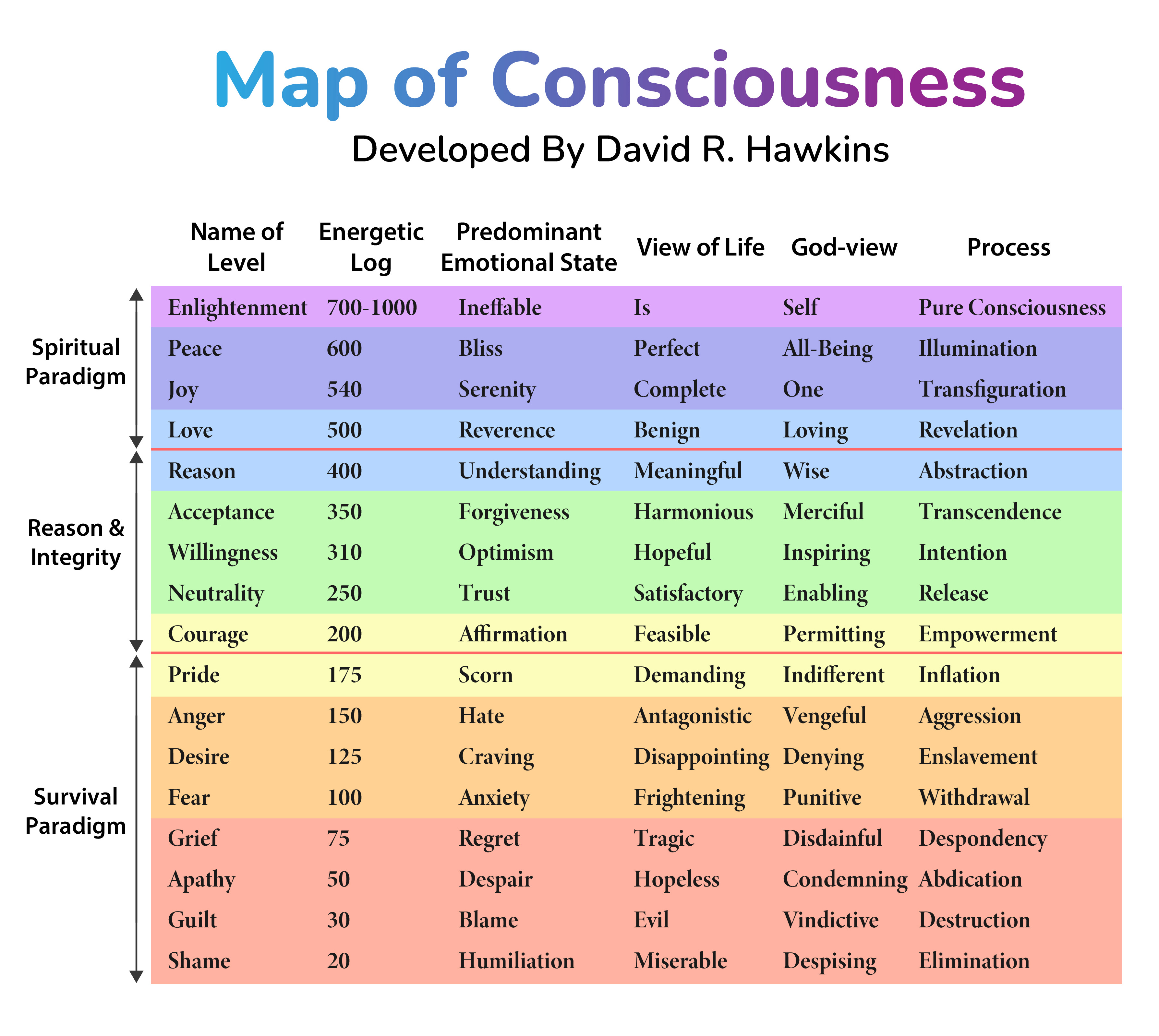
Most people first encounter the Map of Consciousness visually.
They see a vertical diagram with emotions arranged from bottom to top — shame and guilt at the low end, love, joy, and peace near the top. Almost immediately, an interpretation settles in without being questioned:
Lower is worse.
Higher is better.
The point is to climb.
That assumption feels so natural that it rarely gets examined. And yet it is the single biggest reason the Map of Consciousness is misunderstood.
Because the map was never meant to describe where you are.
It was meant to describe how experience is organizing itself in any given moment.
Where the Map Comes From
The Map of Consciousness is most closely associated with David R. Hawkins, particularly through his book Power vs. Force.
Hawkins proposed that human experience can be understood as moving through a wide range of emotional, perceptual, and interpretive states. To explore these states, he used applied kinesiology — muscle response testing — which he believed could distinguish between expansive and contractive states of consciousness.
Some readers focus heavily on the methodology. Others dismiss it entirely. But regardless of how one feels about muscle testing, the usefulness of the map does not depend on taking the numbers literally.
Its value lies in something simpler and more immediate:
the accuracy with which it names how life feels when awareness is contracted or open.
Fear feels different than trust.
Anger organizes reality differently than acceptance.
Grief collapses meaning in a way serenity does not.
You don’t need calibration numbers to recognize that.
Why Calling It a “Scale” Causes So Much Confusion
A scale implies measurement.
Levels imply attainment.
Attainment implies identity.
A map, on the other hand, implies orientation.
It doesn’t tell you who you are.
It shows you the terrain you’re moving through.
The confusion arises because we are conditioned to turn any vertical representation into a hierarchy. We do it with grades, careers, morality, and spirituality. So when we see the Map of Consciousness, the mind reflexively translates it into:
“This is where I am. That is where I should be.”
But consciousness does not function like a location you occupy.
It functions like weather.
Consciousness Is Always in Motion
No one lives at any single point on the map.
You can feel anxiety in the morning, anger later in the day, determination in the afternoon, grief in the evening, and genuine connection that same night. None of those states cancel the others. None of them define you.
They are moment-to-moment organizations of experience.
Fear contracts attention.
Anger mobilizes energy.
Desire pulls awareness forward.
Grief collapses meaning.
Acceptance relaxes resistance.
Love softens boundaries.
These are not virtues or failures. They are adaptive responses to what life is presenting right now.
The map simply names those responses.
Why Movement Gets Mistaken for Progress
Once the map is treated as a hierarchy, movement becomes moralized.
Feeling fear is interpreted as falling.
Feeling anger is seen as regression.
Feeling despair is treated as failure.
But from the perspective of lived experience, movement is neutral.
Fear often shifts into anger because anger has more energy.
Anger can collapse into despair when resistance exhausts itself.
Despair can soften into acceptance when the fight drops.
Nothing has gone wrong in these transitions.
Life is reorganizing.
The only suffering added is the story that says, “I shouldn’t be here.”
The Subtle Return of the “Me”
The moment someone asks, “Where am I on the map?”, something important has already happened.
Experience has been turned into identity.
Now emotions aren’t just passing states — they mean something about who I am. Fear becomes a personal deficiency. Anger becomes a flaw. Peace becomes an achievement to maintain.
The map, instead of pointing away from the narrative of self, gets absorbed into it.
This is how spiritual models quietly become self-optimization projects.
And this is where their usefulness begins to collapse.
What the Map Is Actually Pointing Toward
The Map of Consciousness is not asking you to reach a higher state.
It’s asking you to notice what you’re holding onto.
Every contracted state is held together by a familiar story:
- “This shouldn’t be happening.”
- “I need to fix this.”
- “This says something about me.”
Every moment is an opportunity — not to climb upward — but to loosen that grip just a little.
Letting go doesn’t mean suppressing emotion.
It doesn’t mean choosing positivity.
It means allowing experience to move without being turned into identity.
That’s what widens the field.
Practice Is About Range, Not Residence
Seen this way, practice has nothing to do with stabilizing at love, joy, or peace.
Practice is about increasing responsiveness.
The ability to feel fear without collapsing into it.
The ability to feel anger without acting it out.
The ability to feel grief without making it personal.
The ability to feel clarity without claiming it.
Lower states don’t disappear.
They simply lose their stickiness.
Life gains more room to move.
Why the Map Eventually Becomes Secondary
At a certain point, even the map itself stops being the point.
What matters isn’t labeling states — it’s noticing attachment to states.
The tighter the identification, the narrower life feels.
The looser the identification, the wider the spectrum of experience becomes.
This is the same paradox that shows up again and again: the more we try to understand consciousness conceptually, the easier it is to miss it directly. That tension is explored more fully here:
https://dualisticunity.com/why-clarity-often-feels-harder-the-more-we-understand/
Clarity doesn’t come from perfect maps.
It comes from not needing them to stay fixed.
A Map, Not a Moral Ranking
The Map of Consciousness was never meant to rank people.
It doesn’t separate the “evolved” from the “unevolved.”
It doesn’t tell you where you belong.
It doesn’t measure your worth.
It reflects how awareness organizes itself when resistance tightens or releases.
Seen as levels, it becomes another ladder.
Seen as a map, it becomes a mirror.
And mirrors don’t tell you where to go.
They show you what’s happening.
Where This Points
Dualistic Unity isn’t interested in helping people reach higher states or avoid lower ones.
It’s interested in helping people stop mistaking temporary states for stable selves.
Proof That You’re God explores this territory more deeply — not as a system of consciousness, but as an inquiry into what remains when identification loosens and experience is allowed to move freely.
Not upward.
Not downward.
But open.
Moment by moment.